Full Article
about Pedrajas de San Esteban
Major pine-nut hub; known for its pine-nut industry and Baroque church.
Hide article Read full article
A crunchy pine nut between your teeth can take you somewhere oddly familiar, like those old-fashioned sweets that seem to exist only in a grandmother’s house. In Pedrajas de San Esteban, that flavour is everywhere. Sit in the Plaza Mayor on an ordinary morning with a small paper bag of freshly bought piñones, and it quickly becomes clear why this tiny ingredient defines the place. Around you, people chat, debate the weather, tap their fingers on café tables. Nothing unusual, except that here, everything seems to circle back to the pine nut.
A place shaped quietly by history
Pedrajas does not announce itself with grandeur. It appears suddenly, between cereal fields and long stretches of pine forest, along the road linking Valladolid and Cuéllar. One moment you are driving through open countryside, the next you are already in the village.
Its origins are usually traced to medieval repopulation in the late 11th century. Over time, it passed through the hands of various noble families, including the Avellaneda and later the Counts of Miranda del Castañar, before becoming part of the province of Valladolid during the administrative reorganisation of the 19th century.
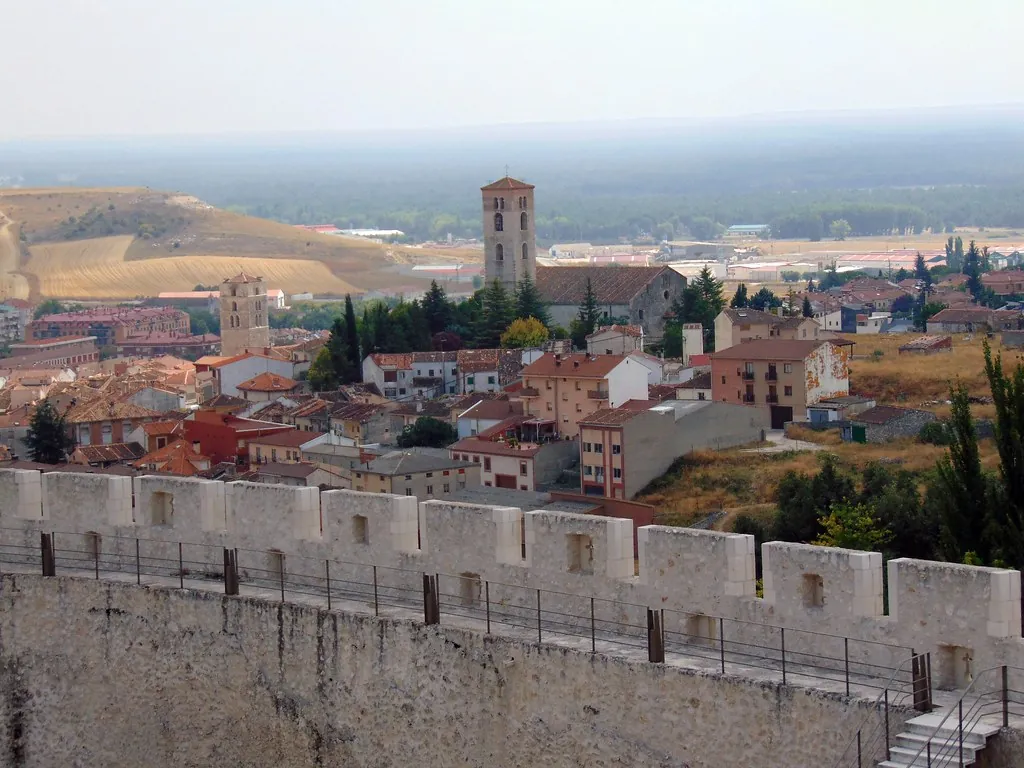
This history is not displayed in bold statements. It lingers in details. The Casa del Tío Bragazas, for example, carries an old coat of arms on its façade, the kind that draws your eye even if heraldry is not your thing. The church of San Esteban tells a similar story in layers. Its structure combines elements from different periods, with a 16th-century doorway partly hidden behind a later portico. It feels like something older quietly sitting beneath a more recent addition.
When everything smells of toasted pine
In Pedrajas, the pine nut is not just an ingredient. It is part of the village’s identity.
At one of the entrances, a monument to the piñonero acknowledges the people who made a living from harvesting pine cones. For generations, this work shaped the local economy. Climbing tall pine trees to collect cones was far from easy, and when the process is described today, it is easy to picture how natural it once seemed for many in the village.
The connection to the pine forests continues in local traditions. The romería of Sacedón takes place on the Monday after Easter, a typical Spanish countryside gathering with both religious and social elements. People head out towards the hermitage on foot or by car, carrying frying pans, tortillas and bags filled with food. It feels less like a formal event and more like a day when everyone decides to eat outdoors together.
The hermitage itself stands on the outskirts, surrounded by pine woods. The path carries the scent of resin and warm sand when the sun is strong. Inside, an old carving of the Virgin has watched over generations of pilgrims, with the rhythm of the day changing very little over time.
A cinema that still gathers people
In the centre of Pedrajas, a traditional cinema continues to operate, something increasingly rare in small towns. It has red seats, a simple foyer, and a programme that mixes recent releases with Spanish films.
It is not presented as an attraction, and it does not need to be. It functions more as a meeting point. On summer evenings, it is common for much of the village to end up there, in the same way people might gather for a drink elsewhere, except here the screen becomes the focus.
Places like this say a great deal about everyday life. They are less about spectacle and more about how a community spends its time together.
Celebrations rooted in local life
The summer fiestas take place towards the end of August and follow a familiar pattern seen across many villages in Castilla. There are peñas, informal groups of friends who organise activities, improvised costumes, and the return of people who now live in cities like Valladolid or Madrid but come back for a few days.
Earlier in August, the feast of San Esteban, the village’s patron saint, brings families together. These gatherings can feel as important as the official programme itself.
Winter brings Santa Águeda, a celebration where women take the leading role. There is a procession, traditional dress, and an atmosphere that sits somewhere between solemn and festive. It has a tone that may feel familiar to anyone who has seen classic Spanish films, where ritual and community blend closely.
Is it worth stopping?
That depends on what you expect.
If the idea is to find a historic centre filled with medieval houses and postcard-like streets, Pedrajas is not that kind of place. Its focus lies outward, towards the pine forests and the surrounding land.
But if there is curiosity about how something as small as a pine nut can shape an entire way of life, then it makes sense to stop. A walk through the Pinar del Concejo, a bag of toasted piñones in hand, and a pause in the main square offer a simple way to understand the rhythm of the village.
There are no grand monuments competing for attention. Instead, there is a steady sense of place. After a while, the air carries a faint mix of pine and toasted warmth, and that alone gives a clear idea of where you are.