Full Article
about Pinarejos
Right on the Pinares highway; known for its church and wooded setting.
Hide article Read full article
The pine before the village
You come across the pine before you reach Pinarejos. It stands on the right as the forest thins and the first stone walls appear. It is about two centuries old and protected by the regional government, the second largest Scots pine in Spain. Beside it sits a small hermitage where, according to local tradition, the Virgin appeared.
You stop, step out, catch the smell of resin, and look at the wrought iron gate. It is closed. There is nothing else to do here for the moment, so you get back in the car and continue.
Driving in
From the A-11, leave at Cuéllar and take the CL-601 towards Arévalo. The drive takes around twenty minutes, mostly through pine forest. The road bends gently and traffic is light. Then the village arrives all at once: a junction, a simple roadside bar with a brick façade, and streets that rise slightly uphill.
Parking is informal. You leave the car wherever there is space. There are no marked zones or restrictions to worry about. The more noticeable issue is mobile data, which often drops out across much of the village centre.
A church that feels too big for the setting
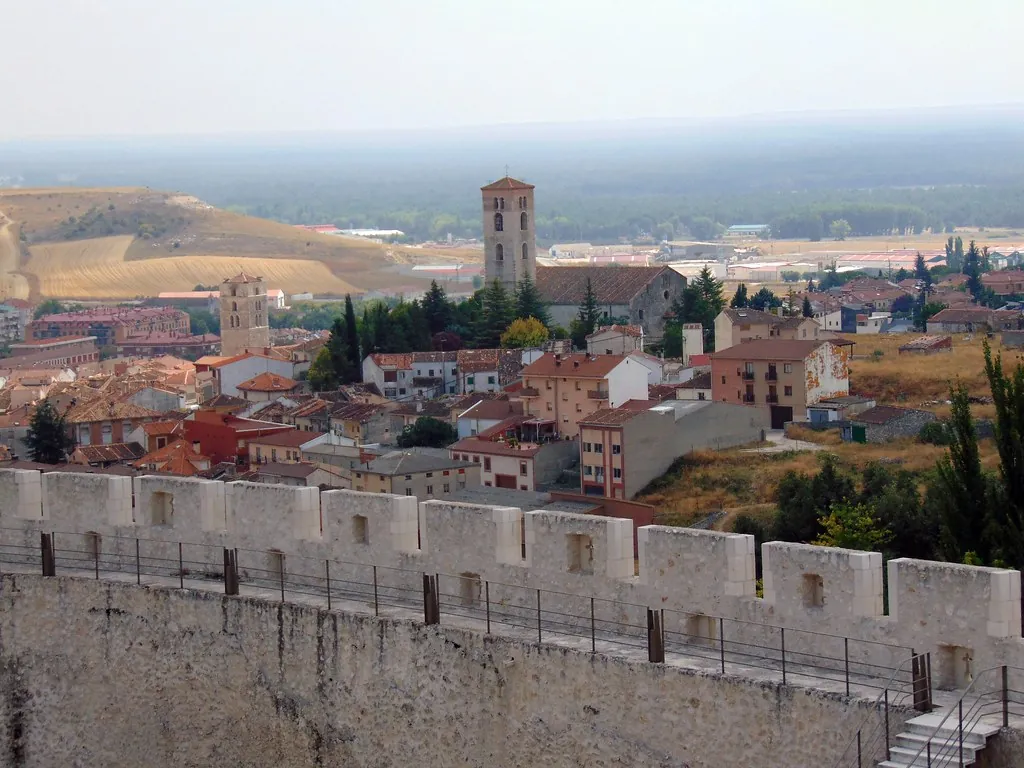
The Church of the Asunción dates from the 16th century and its scale is unexpected. It has three sections in the nave, a well-kept Mudéjar coffered ceiling, and an entrance with archivolts that would not look out of place in a larger town.
It has been listed as a monument since the 1990s, and the upkeep shows. The stonework is clean and the roof does not feel neglected. Inside, there is a clear scent of wax and wood. Visiting usually involves asking at the house opposite to have it opened. There are no organised tours or extended explanations.
One of the pieces that draws attention is a panel known as the Arca de la Esperanza, carved around the 16th century. You take a slow walk along the nave, pause for a moment, and in a short time you have seen what there is to see.
Streets without much to label them
The village layout is small and easy to grasp. Three parallel streets, a couple crossing them, and that is about it. The houses are low, with large gates and the occasional balcony.
Silence dominates most of the time, broken now and then by a car passing along the main road. The town hall occupies a simple building marked by the flag of Castilla y León. Near the door, a plaque notes the population of the municipality: just over two hundred residents.
The village bar is usually open, offering drinks, sandwiches, and the steady rhythm of conversation at the counter. Nothing out of the ordinary, which is part of the point.
Where people actually spend time
What draws attention lies outside the centre. The pine forest stretches out with clear dirt tracks leading between pines and the occasional oak. There are signs marking the Ruta del Mudéjar, a route that connects places with this distinctive architectural style, and others indicating private hunting grounds.
In autumn, mushrooms appear if the season has been wet. At that time, people arrive from Cuéllar and nearby villages carrying baskets and knives. It is a familiar scene in this part of the region.
Daily life still follows long-standing rural habits. In winter, some households continue the tradition of matanzas, the family slaughter and preparation of pork. Sausages hang in kitchens, smoke rises from chimneys, and wood-fired ovens are in use. It is not staged or organised for visitors. It simply happens as part of life here.
A few practical notes before you go
If your visit coincides with the romería of the Virgen del Pinarejo in mid-August, it is best to leave the car as soon as you find a space before entering the centre. The road fills up quickly and turning around later can take time.
The festivities of San Isidro are usually straightforward: a procession, a shared meal, and little more. There is no extensive programme of events.
Anyone planning to walk through the pine forest should bring proper footwear and water. Some paths are heavily marked by motorbikes and animal tracks, and there are not always places to refill along the way.
Pinarejos does not take long to see. It works as a short stop to look at the pine and visit the church before continuing on towards Cuéllar or Arévalo. With just over two hundred residents, the village does not try to be anything beyond what it is.