Full Article
about San Cristóbal de Cuéllar
Small town in the Henar stream valley; farming tradition
Hide article Read full article
Arriving Almost by Accident
Some villages are places you reach on purpose. Others appear because you took the wrong turning. San Cristóbal de Cuéllar feels a bit like the second kind. You leave Cuéllar, follow a straight road lined with pine trees and, just when it seems there will be nothing but forest ahead, the village suddenly comes into view.
San Cristóbal de Cuéllar is small, very small. It has just over 150 residents and lies about eight kilometres from Cuéllar, right in the heart of the Tierra de Pinares. That setting defines it from the first step: sandy soil underfoot, the scent of resin in summer and tracks that disappear into the trees.
This is not a place of grand monuments or quick sightseeing stops. It suits a short wander, a look around and a sense of how life works in a village shaped by fields and pine forest.
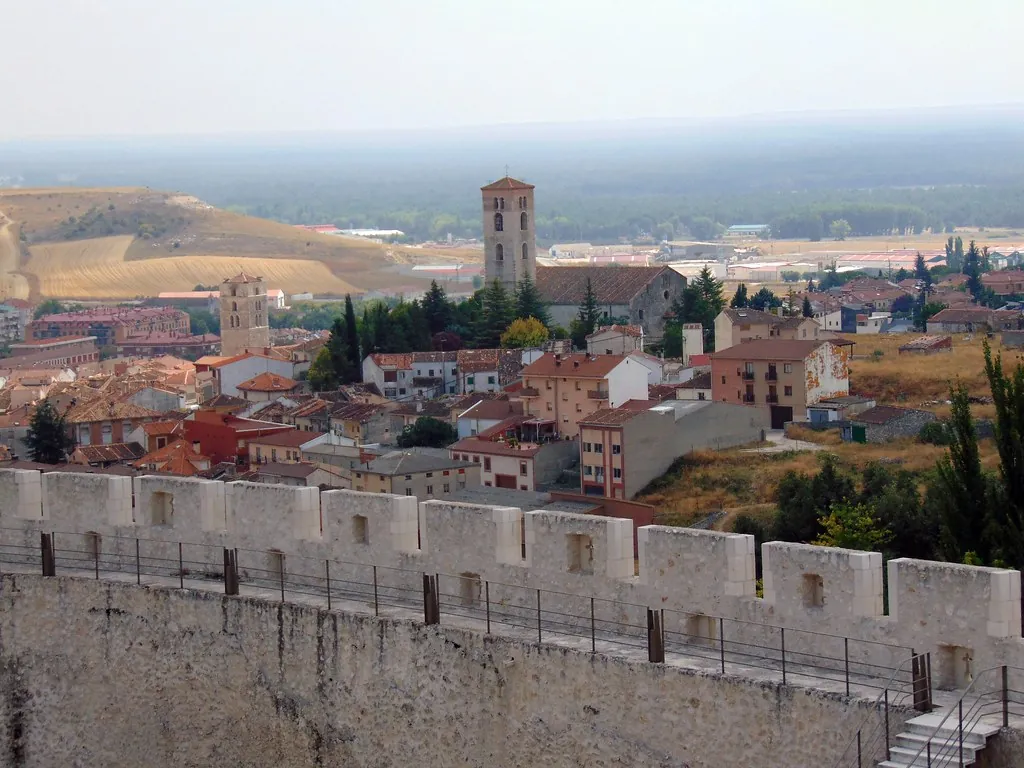
The houses mix adobe, brick and some stone. Many still have large wooden gates that once sheltered carts, firewood and tools. A slow walk through the streets reveals how closely daily life has long been tied to agriculture and the surrounding pinar, the pinewoods that dominate this part of the province.
The Church and the Village Centre
The most visible building is the parish church dedicated to San Cristóbal. It is a simple stone structure with a bell tower that rises above the square. There is nothing monumental about it, yet it feels proportionate to the scale of the village.
Around the church are the oldest streets and the quiet rhythm of everyday life. Neighbours greet each other, a car sits parked against an adobe façade and little seems to disturb the calm. It is the steady pace typical of small rural communities where nothing in particular needs to happen for the day to feel complete.
The patron saint festivities are usually held towards the end of July. There is a procession and religious events, along with the atmosphere you would expect in a small Spanish village where everyone knows each other. It is not a large-scale celebration designed to draw visitors. Instead, it is a moment when those who have moved away return for a few days and the village briefly feels fuller.
The Pinewoods of the Tierra de Pinares
In San Cristóbal de Cuéllar, the real landscape lies beyond the houses. The village is surrounded by the pinewoods of the Tierra de Pinares, an area where you can walk for half an hour and still see the same type of forest stretching in every direction.
The soil is sandy and resin pines dominate the view. For decades, resin extraction was an important part of the local economy. Although it carries less weight today, some trees still bear the marks of tapping and traces of that activity can be seen here and there.
There are no viewing platforms or sweeping panoramas. Instead, there is silence. For anyone who enjoys walking, that can be more than enough.
The forest may appear uniform at first glance. Pines repeat themselves, the sandy tracks look similar and landmarks are few. Yet that uniformity is part of the experience of the Tierra de Pinares, a region whose identity is built on this continuous woodland landscape.
Walking the Farm Tracks
Several agricultural tracks lead directly out of the village towards nearby places such as Castrillo and Villafranca. These are wide dirt paths used by local residents to reach their fields, so walking or cycling along them is straightforward.
That said, the pinewoods can be more disorientating than they first appear. Everything looks much the same and reference points are scarce. If heading further from the village, it makes sense to carry a phone with GPS or a simple map.
The appeal of these paths lies in their simplicity. There are no signposted routes or interpretative panels, just open tracks, sandy ground and the sound of the wind in the trees. It is an everyday landscape rather than a curated one, shaped by work and routine more than by tourism.
Mushrooms and Forest Life
In autumn, many local people head into the pinewoods to gather mushrooms. Níscalos, known in English as saffron milk caps, appear frequently in years with good rainfall. Boletus can also be found in certain areas.
Mushroom picking is regulated in much of these pinewoods, so it is advisable to check the rules beforehand. Anyone without experience is better off going with someone who knows what they are doing. The forest offers excellent edible species, but also others that are best left well alone.
Beyond mushrooms, there is plenty of life in the pinar if you pay attention. Great tits, blue tits and other small birds can be heard among the branches. It is not unusual to spot a buzzard circling above a clearing. Foxes and other animals move through the area too, though usually they leave only tracks behind.
The sense of quiet is constant. Even when there is movement, it tends to be subtle: a birdcall, a flicker between the trees, footprints in the sand.
Eating Nearby
San Cristóbal de Cuéllar itself has very few services for visitors, which is to be expected in a village of this size.
For a meal or a longer stop, the most practical option is to head to Cuéllar. There, the atmosphere is livelier and it is easy to find traditional Castilian cooking. Roast lamb, often prepared in wood-fired ovens, is one of the most common dishes in the area.
The contrast between the two places is part of the experience. San Cristóbal offers quiet streets and pine-scented air, while Cuéllar provides more movement and choice without being far away.
A Place to Pause Briefly
San Cristóbal de Cuéllar is not a destination for a full-day excursion, and there is no need to pretend otherwise.
It suits those already exploring the area around Cuéllar or travelling through the Tierra de Pinares. You park, take a gentle walk through the village, spend some time in the pinewoods and then continue on your way.
Sometimes that is exactly what is wanted: a small village, free of noise and without the sense that everything has been arranged for visitors. Life here continues at its own rhythm, whether anyone is passing through or not.