Full Article
about San Miguel de Bernuy
By the Las Vencías reservoir; perfect for water sports and nature.
Hide article Read full article
Morning Light in the Tierra de Pinares
Early in the morning, when the sun filters low through the pine trunks, San Miguel de Bernuy moves at its own unhurried pace. A door opens, a car engine turns over, a broom scrapes across a stone threshold. This small municipality in the Tierra de Pinares area of Segovia province sits among woodland and open fields, in a landscape that shifts little from one season to the next and where silence still carries more weight than traffic.
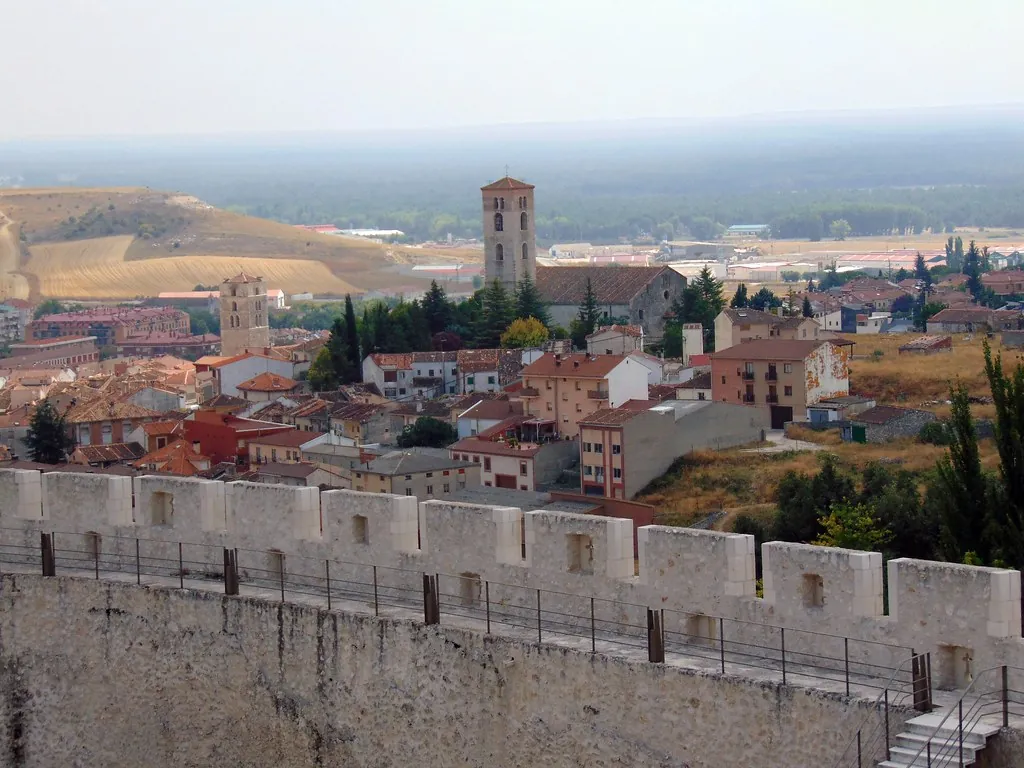
The village centre is compact and easily covered on foot in a matter of minutes. Short streets, brick and adobe houses, and the occasional dark wooden gate that has clearly seen several generations come and go. It is not a monumental place. Here, the surroundings set the tone. Within moments of leaving the last houses behind, the pinewoods that give the comarca its name take over, a near-continuous stretch of maritime pine that shaped the local economy for decades.
San Miguel de Bernuy belongs to the northern part of the Tierra de Pinares, a region defined by forests and sandy soils. The visual rhythm rarely changes: straight tracks, pale ground, tall trunks rising in parallel lines.
The Mark of Resin in the Forest
The connection between these villages and the pine is long-standing. In San Miguel de Bernuy, traces of that past remain visible. On some trunks, the scars of old cuts can still be seen, the marks where resin was once tapped and collected. For years, resin extraction provided work across this part of Segovia, and the forest was not just scenery but livelihood.
Anyone who has walked through these woods will recognise the smell. Dry earth, pine needles underfoot and resin warmed by the sun blend into something distinctive and persistent. It is a scent that clings to the air, particularly in the heat of summer.
At the centre of the village stands the parish church, dedicated to San Miguel Arcángel. It rises without grandeur, built in simple masonry and topped with a modest bell gable where a single bell hangs. Inside, there are usually restrained altarpieces and wood darkened by time. Nothing ornate, nothing excessive, very much in keeping with the sobriety associated with this part of Segovia.
Tracks Through the Pines
What truly defines San Miguel de Bernuy is not a single building but the kilometres of forest tracks that surround it. Wide, straight paths stretch through the pines, their surfaces covered in pale sand and fallen needles. The most constant sound is the wind moving through the high canopies.
There are no significant gradients, which makes these tracks suitable for walking or cycling. In summer, it is wise to head out early or later in the day. The shade from the pines offers some relief, yet the heat of the Castilian plateau makes itself felt from midday onwards.
Autumn brings a change of rhythm to the forest. Cars appear parked along the edges of the tracks, and people walk slowly with baskets, eyes fixed on the ground. Níscalos, known in English as saffron milk caps, are among the most sought-after mushrooms here when the year has been wet enough. Mushroom foraging requires proper knowledge of species and adherence to local regulations, which vary depending on the area.
Despite the human activity, the setting retains its essential character. The landscape is largely horizontal. Pines repeat into the distance, cereal fields open up between wooded sections, and from time to time a small lagoon or damp area breaks the pattern. In spring, frogs can be heard in these wetter spots, their calls carrying across the flat ground.
Wildlife and Quiet Evenings
Patience is rewarded in these woods, especially towards dusk. Movement flickers between the trunks and across clearings. Roe deer dart quickly through the pines. Rabbits emerge from the margins of tracks. Coveys of partridges take off abruptly, their wings beating in unison as they scatter. Birds of prey circle above the open fields, scanning the ground below.
This is not a place of dramatic viewpoints or sweeping panoramas. There are no lofty lookouts or headline vistas. The appeal lies instead in repetition and subtle variation. The same elements recur, yet the light, the season and the hour shift their tone. An afternoon in late summer feels different from a misty morning in early spring, even if the outlines remain familiar.
The quiet is part of the experience. Stand still for a while and the sounds settle into a simple pattern: wind in the canopy, the occasional call of a bird, perhaps the distant hum of a tractor working a field beyond the trees.
Quiet Roads and Nearby Villages
San Miguel de Bernuy also works well as a calm base for exploring this stretch of the Tierra de Pinares. Other villages lie a short drive away, each sharing similar ties to forest and farmland. Coca is relatively close and offers a change of scale, particularly for those interested in visiting its castle or spending time in a slightly larger town.
Road connections are straightforward yet lightly used. It is the kind of driving where several minutes can pass without meeting another vehicle. From the city of Segovia, the journey usually takes around an hour by car, depending on the chosen route. Public transport does exist, though it is limited, so most visitors arrive with their own vehicle.
The sense of distance here is not about remoteness in kilometres but about atmosphere. Traffic is sparse, noise minimal, and the horizon uninterrupted by large developments.
Fiestas and Everyday Life
The main celebrations revolve around San Miguel, towards the end of September. During those days the atmosphere shifts noticeably. Family members who live elsewhere return, activities are organised in the village square and the evenings stretch later than usual.
Outside those dates, San Miguel de Bernuy returns to its steady rhythm. In the late afternoon, as the sun drops behind the pinewoods, the air carries different scents depending on the season, wood smoke in colder months, dry earth in warmer ones. Sit quietly for a while and the dominant sound once again is the forest itself.
In San Miguel de Bernuy, that remains the norm.