Full Article
about Sanchonuño
Major vegetable-growing and industrial hub amid pine forests; a lively town
Ocultar artículo Leer artículo completo
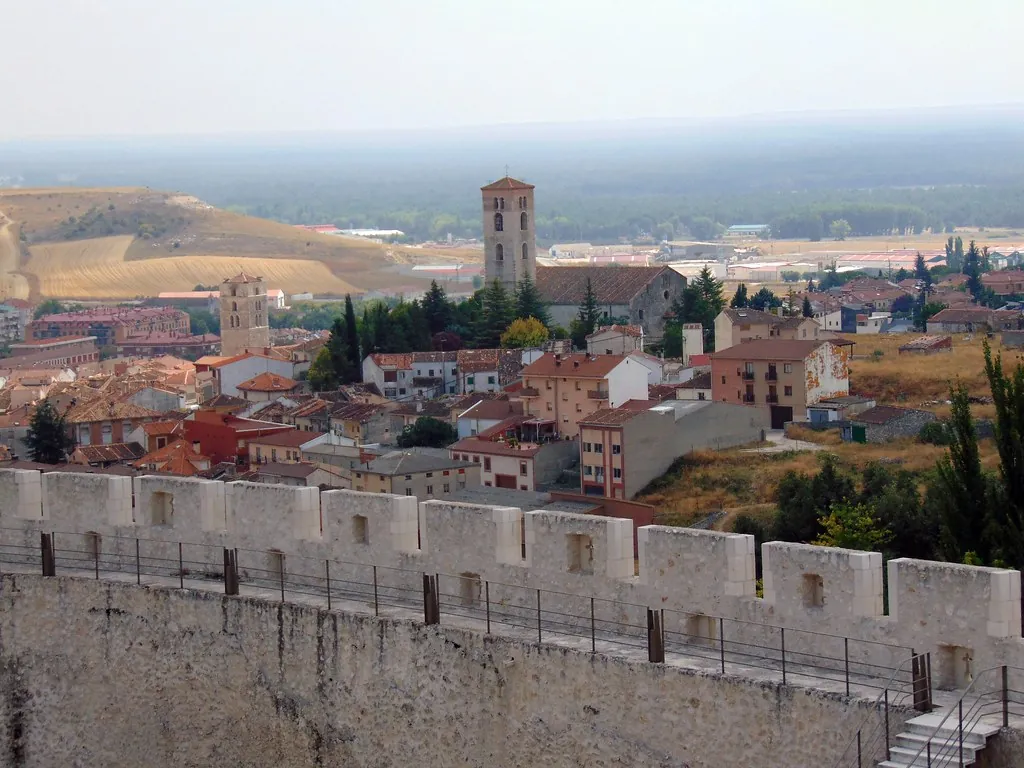
The morning bus from Segovia drops you at the edge of Sanchonuño with a hiss of air brakes and the smell of diesel. At 804 metres above sea level, the air carries a snap that Londoners rarely feel outside the Cairngorms. Fields of wheat stubble stretch eastwards; to the west, resin pine plantations climb gentle ridges. There is no taxi rank, no car-hire desk, no tourist office with glossy maps. Just a bench, a litter bin, and the certain knowledge that the next bus back to the city leaves in five hours.
That is usually time enough. Sanchonuño spreads across a low promontory rather than climbing it, so the 45-minute loop from the church to the grain co-op and back involves more horizon-gazing than thigh-burning. Adobe walls the colour of digestive biscuits shoulder up to 1970s brick garages; wooden gates hang slightly askew on hand-forged hinges. The only deliberate stop is the parish church of Nuestra Señora de la Asunción, whose tower serves as both compass needle and weather vane. Inside, the nave is refreshingly bare: no gilded excess, only a 16th-century font where every local baby since the Reconquest has been welcomed, and a side chapel whose paint flakes like sunburnt skin.
Walking the Resin Roads
The real map begins where the tarmac ends. A grid of agricultural tracks radiates into the pinares, each one graded by the regional government as either “firm” or “seasonal”. The firm ones—wide enough for a combine harvester—let you walk 12 km north to Ayllón without encountering anything louder than a woodpecker. Seasonal tracks shrink to single-file sand that turns to biscuit dough after rain; bring shoes you don’t mind staining orange. Spring and autumn are kindest: summer heat can top 35 °C by eleven o’clock, while January fog pools so thick that the parish bells disappear entirely.
Elevation gain is modest—rarely more than 150 m between valley and ridge—but the altitude still tricks the lungs if you’re fresh from sea level. Locals stride past with the measured pace of people who have never needed to check a fitness app. Stop to breathe and you’ll notice the resin taps: small V-shaped cuts in the pine bark, each fitted with a galvanised cup that drips slowly into a tin. The resin ends up in industrial solvents; the smell ends up on your clothes for days.
Birdlife is understated but constant. Crested tits swing through the upper branches; Iberian grey shrikes perch on telephone wires, impaling beetles like butchers’ displays. Bring binoculars, yet accept that the forest is not a hide. Tractors grind past at 7 a.m.; hunters’ 4×4s appear on Sundays, radios crackling with football results. This is a working wood, not a wilderness.
What You’ll Actually Eat
Forget tapas crawls—Sanchonuño has two bars and one restaurant, all within 200 m of the church square. Opening hours obey the agricultural calendar more than Google: if the harvest is late, the owner may simply lock up. The safest bet is Mesón la Plaza (no website, no card machine). Order lechazo—milk-fed lamb roasted in a wood-fired clay oven—by the quarter-kilo. It arrives as a lacquered slab, bones caramelised to the colour of Burton ale, with a bowl of judiones (giant butter beans) stewed with morcilla. Expect €18 a portion; bread and a simple Rioja add another €8. Vegetarians get sopa castellana heavy on garlic and paprika, or a plate of roasted piquillo peppers. Pudding is usually bought-in flan; skip it and ask instead for a cortado made with whole milk from the dairy co-op outside town.
Picnickers should stock up before arrival. The village shop opens 9–1, closes for siesta, then reopens 5–7. Shelves hold tinned tuna, vacuum-packed chorizo, and local cheese wrapped in waxed paper. Fruit is whatever has travelled least: apples from Arévalo, melons from Villacastín. There is no cashpoint; the nearest ATM is 11 km south in Carbonero el Mayor.
When the Village Parties
Fiestas patronales centre on 15 August, when temperatures can still nudge 30 °C at midnight. The programme mixes religious procession with tractor-pull contest. Visitors are welcome but not fussed over: if you want a front-row seat for the evening concert, bring your own folding chair. Earlier in the summer, the pine-wood cutting competition (early June) draws crews from across Tierra de Pinares; axes thud in synchrony while children chase feral cats between stacked logs. Winter brings the Fiesta de la Matanza—pig slaughter turned social event—on the last Saturday of January. Tourists sometimes wince at the practicality of it all; locals hand out fresh morcilla sandwiches and move on.
Getting Here, Staying Over
No train line serves Sanchonuño. From Madrid, take the high-speed service to Segovia (28 minutes), then bus line 121 to Sanchonuño—two departures daily, €4.20 single, journey 55 minutes. The last return leaves at 6 p.m.; miss it and a taxi costs €45. Drivers follow the A-1 to km 113, then the CL-601 north for 9 km; petrol is 10 cents cheaper in the province capital, so fill up before turning off.
Accommodation is limited. Casa Rural La Higuera (three doubles, shared kitchen) charges €70 a night with a two-night minimum at weekends. Heating is by pellet stove; instructions are in Spanish only. A smarter option is the new apart-hotel in neighbouring Ayllón, 12 km away, where studios start at €85 and you get Wi-Fi that actually reaches the bedroom. Either way, pack a torch—street lighting is switched off after 1 a.m. to save the council €6,000 a year.
The Honest Verdict
Sanchonuño will not change your life. It offers no souvenir shops, no Michelin stars, no sunrise yoga on miradores. What it does provide is a calibration point for anyone who thinks Spain ends at the Costas. Stand beside the resin cups at dusk, when the plateau breeze carries woodsmoke and distant bleating, and Madrid feels as foreign as Manchester. Just remember to check the bus timetable—because at 804 metres, with night temperatures sliding below freezing for half the year, the village is perfectly happy to let you stay until morning, but it won’t make a fuss about driving you home.