Full Article
about Sebúlcor
Gateway to the Hoces del Duratón Natural Park; known for the Convento de la Hoz.
Hide article Read full article
A Landscape Shaped by Pine and Plateau
Tourism in Sebúlcor revolves above all around its landscape. The village lies in the north of the province of Segovia, within the area known as Tierra de Pinares, yet very close to the canyon of the river Duratón. Here the terrain shifts between broad expanses of resin pine forest, open high plains and slopes that fall away towards the valley.
With just over two hundred inhabitants and sitting at close to 950 metres above sea level, Sebúlcor has traditionally depended on what the land and woodland could provide. Resin tapping, timber, some livestock and dry farming shaped the local economy for generations. That close relationship with the surrounding environment still defines the place today.
The setting feels open and elevated. Pine woods dominate much of the municipality, but the sense of space changes as the land begins to break up towards the Duratón valley. It is this contrast, between dense forest and exposed plateau, that gives the area its particular character.
A Village Linked to the Forest
Sebúlcor’s layout reflects its agricultural and forestry roots. The streets are short and fairly straight, lined with houses built from masonry and adobe using materials drawn from the immediate surroundings. Some properties still have wooden galleries or large gateways, features designed for daily practical use such as storing tools or bringing in carts rather than for decoration.
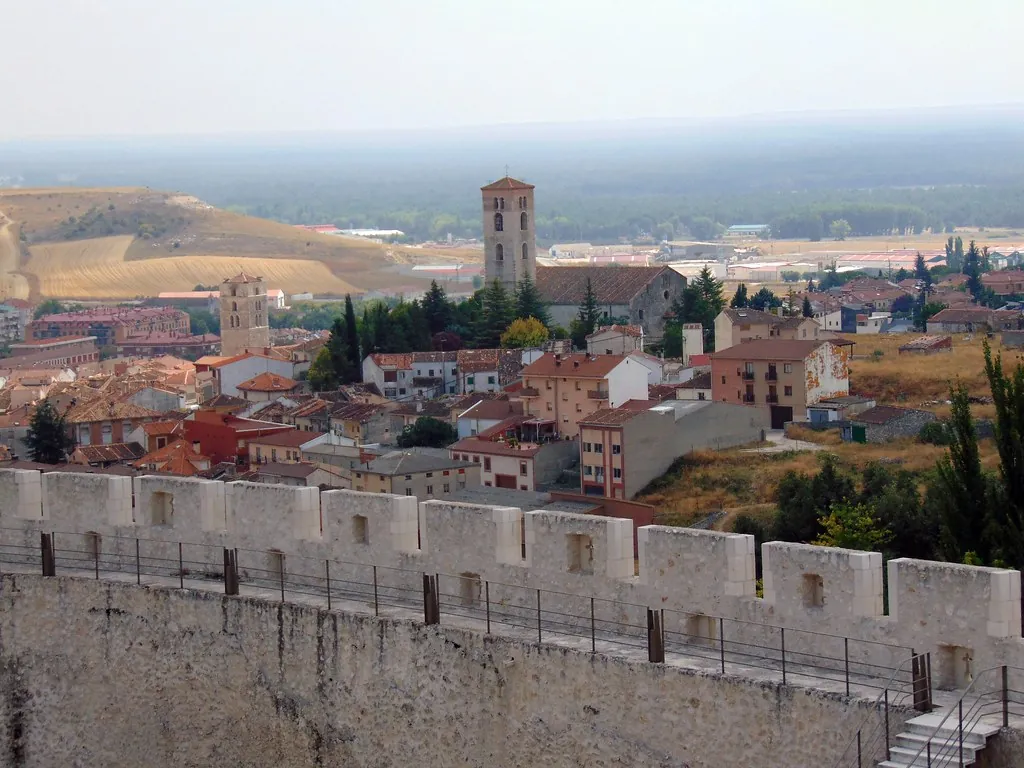
At the centre stands the parish church of San Pedro. The current building has undergone several alterations, yet parts of it date back to the 16th century. The stone doorway is the clearest reminder of that period. As in many villages in this part of Castilla Leon, the church also acts as a spatial anchor. Most streets lead, in one way or another, towards its surroundings.
Sebúlcor is small enough to explore on foot in a short time. There are no grand monuments or elaborate squares. Instead, the interest lies in the way the built environment connects directly with the working landscape that surrounds it. The village feels functional, shaped by necessity and routine rather than by ornament.
Forest Tracks and Seasonal Changes
The municipal area is encircled by extensive stands of resin pine. For decades, resin extraction was a common activity across the region. Even now, some of the older trees still bear the scars of former cuts made to draw out the sap. These marks offer a quiet reminder of the labour that once sustained many families in the comarca.
From the edge of the village, forest tracks head straight into the pines. They are wide paths, originally intended for forestry work, and today they are used for walking and cycling. The terrain is generally gentle, with moderate gradients that make exploring accessible without demanding technical ability.
The atmosphere shifts with the seasons. In spring, the undergrowth fills with rockrose, thyme and lavender. The scent of these plants carries easily on warm days. In autumn, attention turns to mushrooms. Many people head into the forest in search of níscalos and other species typical of the area. It is important to do so with knowledge and in accordance with the regulations that govern mushroom picking in local woodland.
The pine forest offers shelter from the wind, yet shade is not always continuous. In summer, planning matters. Water sources are scarce outside the village itself, and the sun at midday can be strong despite the altitude.
Towards the Duratón Valley
Although Sebúlcor is surrounded by pinewoods, the landscape changes a short distance away. To the west and north, the ground begins to fracture and drop towards the valley of the river Duratón. Its canyon forms part of a well-known natural park within the province.
Sebúlcor is often used as a base for exploring this section of the Duratón area, where high plateaus, limestone cliffs and cultivated land alternate across a relatively small space. The shifts in terrain are noticeable. Open parameras give way to rocky escarpments, and fields interrupt stretches of scrub and woodland.
There are no large, purpose-built viewpoints within the village itself. However, along nearby tracks small rises appear from which the extent of the pine forest can be clearly appreciated. These modest high points offer perspective over the surrounding terrain without formal infrastructure.
The proximity to the Duratón canyon adds another dimension to Sebúlcor’s setting. While the village remains closely tied to its forests, the presence of the valley nearby introduces a sense of geological contrast. The soft, sandy soils of the pinewoods stand in opposition to the harder limestone formations that shape the canyon landscape.
Walking, Cycling and Local Life
The network of forest tracks allows visitors to move through the area without great technical difficulty. Many routes are flat or gently sloping, making them suitable for both walking and cycling. The experience is less about reaching a single landmark and more about moving through the environment at a steady pace.
In practical terms, Sebúlcor functions as a small rural nucleus. Daily life unfolds on a modest scale, and the village can be covered quickly on foot. What draws people here is not an urban centre but the space beyond it: the pinewoods, the tracks and the gradual transition towards the Duratón valley.
The most important celebrations are dedicated to San Pedro. Traditionally they take place in summer, when many former residents who now live elsewhere return for a few days. During this period, the church and the square once again become the heart of activity, hosting religious events and gatherings among neighbours.
These festivities are not designed as a tourist attraction. They serve primarily as a moment of reunion for local people and for those who maintain family ties with the village. The emphasis remains on community rather than spectacle.
Sebúlcor does not present itself through grand claims or headline sights. Its appeal lies in continuity: the persistence of pine forests marked by old resin cuts, the agricultural rhythms that shaped its streets, the church of San Pedro anchoring the centre, and the nearby presence of the Duratón canyon. For those interested in the history of resin tapping, it is enough to look closely at the older pines. Many still carry the visible traces of that work, quiet evidence of a way of life closely bound to the forest.