Full Article
about Torrecilla del Pinar
In the pine-forest region; noted for its church and the Cristo chapel.
Hide article Read full article
Torrecilla del Pinar sits on the plains of northern Segovia, within the comarca of Tierra de Pinares. The name is the guide: this is a village defined by the forest that encircles it. For much of the last century, the local economy moved to the rhythm of resin extraction, a trade that shaped both the landscape and the structure of daily life here.
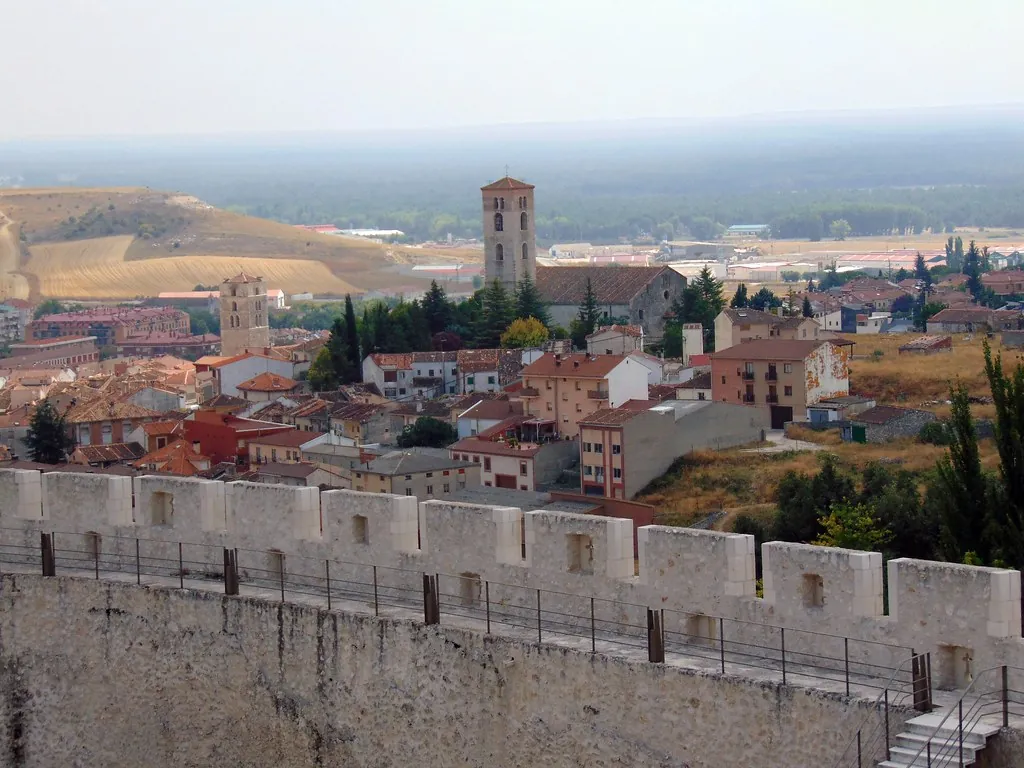
The built environment is modest, a collection of traditional houses in stone, brick and timber built for utility. The horizon, in every direction, is a line of pines.
A village built for forestry
The layout is straightforward. The houses, many with large entrance gates designed for carts and forestry equipment, speak of a practical past. You see brick, exposed timber frames, and stonework that was meant to last. These were buildings for storing tools, firewood, and resin.
At the geographical centre is the church of San Juan Bautista. It’s a simple parish church from the 16th century, similar to others across the Castilian plateau. Its significance is social rather than architectural; for generations, it was the fixed point for community life. The streets radiating from it share that same functional character.
The resin trade, written on the pines
The pinar begins where the last street ends. This is part of an extensive woodland of resin and stone pines that covers much of northern Segovia. The relationship is immediate, with dirt tracks leading directly from homes into the trees.
Evidence of the old trade is still visible on the trunks. You can see the vertical scars from tapping, and sometimes a rusted metal guide still fixed in place. It was a meticulous, seasonal craft that required specific tools—a púa for scoring and a pote for collection—which you might find in an older shed here.
The terrain is flat, making the woods accessible for walking. In autumn, activity increases with the mushroom season, focused on níscalos (saffron milk caps). Foraging is often regulated locally, so it’s worth checking current rules.
The annual rhythm
With around 180 registered inhabitants, winter here is quiet. The social dynamic shifts noticeably in summer, when former residents return and the annual fiestas, typically in August, are held. These are low-key events, centered on the square and the churchyard.
This pattern of a dormant winter and a sociable summer is standard for small villages in inland Spain. In Torrecilla, it underscores a continued attachment to place.
Walking into the woods
Several unsignposted forest tracks start at the village's edge. They are flat and clear, but the uniformity of the pine landscape can disorient. Distances are deceptive; what looks like a short loop can easily become a two-hour walk. There is no shade on the approach tracks, and none of the paths have services or signage. Carrying water is necessary from late spring to early autumn.
A walk here is less about scenic vistas and more about understanding a spatial relationship. You see how quickly the village gives way to the productive woods.
Cómo se visita
Torrecilla del Pinar is compact. You can walk its streets in under an hour. For provisions or a meal, you’ll need to drive to larger villages nearby in the Tierra de Pinares.
The reason to come is to see a specific type of Castilian village, one organized around forestry. The interest lies in the details: the resin scars on the pines, the wide doorways on the houses. It is a place that makes sense only in context with the forest that surrounds it.