Full Article
about Traspinedo
Known for its lechazo skewers and wineries; set among pine forests
Hide article Read full article
A village shaped by its land
Tourism in Traspinedo makes most sense when you begin with its setting. The village lies around 20 kilometres from Valladolid, in the stretch of countryside where pinewoods start to merge with vineyards and arable farmland. With just over a thousand residents, it retains an economy closely linked to agriculture and the processing of local produce. That connection to the land still sets the pace of daily life.
The surrounding landscape is flat and open. Plots of vines alternate with cereal fields and patches of pine forest, with few changes in elevation. These are agricultural tracks rather than purpose-built walking routes, yet locals use them regularly and they offer a clear view of how the territory is organised. A few kilometres away flows the River Duero, one of the great rivers of northern Spain. Running parallel to it is the Canal del Duero, a historic irrigation canal that continues to shape the agricultural landscape of the area.
There are no dramatic viewpoints or striking ridgelines. The appeal here lies in reading the land: seeing how vineyards sit beside grain fields, how irrigation has altered the terrain, and how pinewoods mark the southern part of the province of Valladolid.
San Martín and the fabric of the village
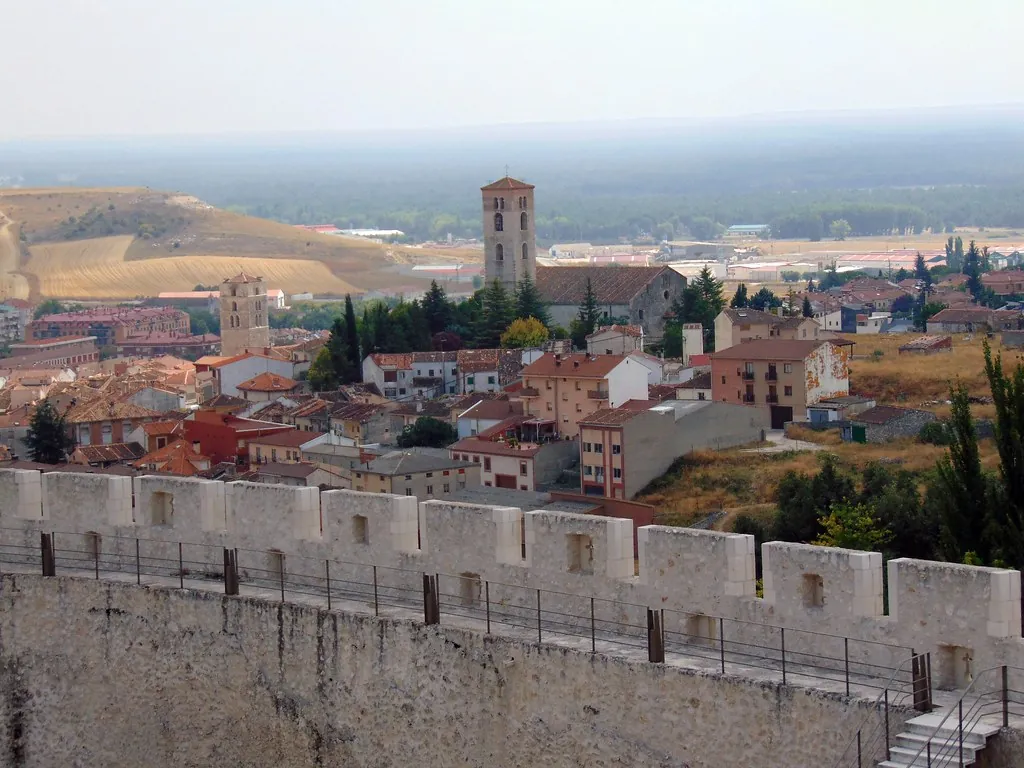
The heart of Traspinedo centres on the parish church of San Martín. The present building stands on foundations dating back to the 16th century, although it has undergone later alterations. Its tower acts as a visual reference point from several streets and defines the outline of the urban centre.
Around it, the streets mix relatively recent houses with examples of traditional popular architecture. Some older homes are built in adobe or brick, with whitewashed walls, large wooden gateways and interior courtyards. These features reflect practical needs tied to agricultural life: storage, access for carts, and private outdoor space.
Beneath certain houses, underground cellars carved into the earth still survive. This is a common element in wine-producing villages across Castile. For centuries, many families made small quantities of wine for their own consumption, and these cellars formed part of that domestic economy. Although home production is now far less widespread, the physical traces remain, linking present-day Traspinedo to its winemaking past.
Walking through the village does not take long. The urban area is compact, and within about an hour it is possible to gain a clear sense of its layout and character. The experience is less about individual monuments and more about how buildings, streets and open spaces fit together.
Between vineyards and the Canal del Duero
The immediate surroundings of Traspinedo are straightforward yet easy to interpret. Pinewoods, characteristic of much of the southern part of the province, appear between cultivated fields and vine plots. The landscape rewards a slow pace. Agricultural paths allow movement between parcels of land and small wooded areas, offering close contact with working farmland rather than curated rural trails.
During the grape harvest, activity in the fields becomes especially visible. Tractors and trailers move in and out of the vineyards, and the rhythm of work shapes the atmosphere of the area. Even outside harvest time, the presence of vines makes clear that wine is not an abstract tradition but a living part of the local economy.
Near the Canal del Duero, the setting changes subtly. There is more riverside vegetation, and birds associated with water are commonly seen. The canal itself is an important piece of historic infrastructure. Built to irrigate farmland, it continues to influence how crops are distributed and how the countryside looks today. It also offers a different perspective on the territory, where water management rather than topography defines the scene.
Wine and roast lamb
Vineyards have formed part of this landscape for generations, and the area has long been associated with wine production. In and around Traspinedo there are family-run wineries and cooperatives that have traditionally worked with local grape varieties. Domestic winemaking, once widespread, has become more residual, yet it shaped village life for a long time and explains the presence of those underground cellars.
Food holds a visible place in everyday life. Traspinedo is known across the province for its tradition of lechazo asado en horno de leña, roast suckling lamb cooked in a wood-fired oven. In Castile, lechazo refers to milk-fed lamb, prized for its tenderness and simple preparation. In Traspinedo this culinary reputation has drawn people from Valladolid and nearby towns for decades. The steady flow of visitors, particularly at weekends, is closely tied to this gastronomic identity.
That fame forms part of how the village sees itself. It is not presented as a modern reinvention, but as continuity with long-established practices rooted in livestock farming and rural cooking methods.
Local traditions through the year
The annual calendar in Traspinedo follows patterns common to many municipalities in the province of Valladolid. The patron saint festivities take place in summer. Religious events are combined with popular activities held in streets and squares. During those days, the rhythm of the village changes noticeably as relatives who live elsewhere return, increasing the population and altering the usual pace of life.
Holy Week also maintains a presence in the local calendar. Processions move through the urban centre in a sober style typical of many Castilian towns and villages. These are not large-scale spectacles, but they preserve a traditional tone and reinforce community ties.
Both celebrations reflect continuity rather than spectacle. They connect Traspinedo to wider regional customs while remaining grounded in local participation.
Practical notes for a visit
Traspinedo is easy to explore on foot. The centre is small, and within a short walk most of the key streets and the church of San Martín come into view.
To understand the surrounding countryside more fully, it is worth leaving the built-up area via one of the agricultural tracks that lead towards the vineyards or heading in the direction of the Canal del Duero. These are straightforward outings, intended for unhurried walks rather than long-distance hikes. The interest lies in observing how fields, pinewoods, irrigation and small-scale wine production fit together.
Traspinedo does not rely on dramatic scenery or major monuments. Its character emerges from the relationship between village and land, from the persistence of viticulture, and from the steady draw of a culinary tradition centred on lechazo asado en horno de leña. For those curious about the everyday texture of rural Castile, that combination defines the experience.