Full Article
about Vallelado
Famous for its garlic crops; set on the Cega floodplain.
Hide article Read full article
A village shaped by sand and pine
Vallelado sits in the Segovian district of Tierra de Pinares, a landscape best understood by looking outwards rather than searching for landmarks. The soil here is sandy and not especially generous for many crops, a condition that favoured the spread of resin pines over centuries. From that balance between woodland and farmland comes much of the village’s story.
Today around 750 people live here. Life still follows the rhythms of the countryside, although resin tapping no longer carries the weight it once did. For much of the twentieth century, resin was a regular source of work across this area. Each season, pine trees were cut to draw out the sap, and the job of resinero formed part of the working year for many families.
Walking through the pinewoods, traces of that past remain easy to spot. Trunks still bear the channels cut to guide the resin, and in some cases the old metal fixtures that directed it into containers are still embedded in the bark. Even as the local economy has shifted towards agriculture and occasional forestry work, the memory of resin tapping has not faded.
Vallelado lies between Segovia and Valladolid, on a broad plain where villages are separated by kilometres of pine forest and cereal fields. It is not a place defined by major monuments. Its interest lies instead in the landscape and the way that landscape has shaped everyday life.
Santo Tomás and the shape of the streets
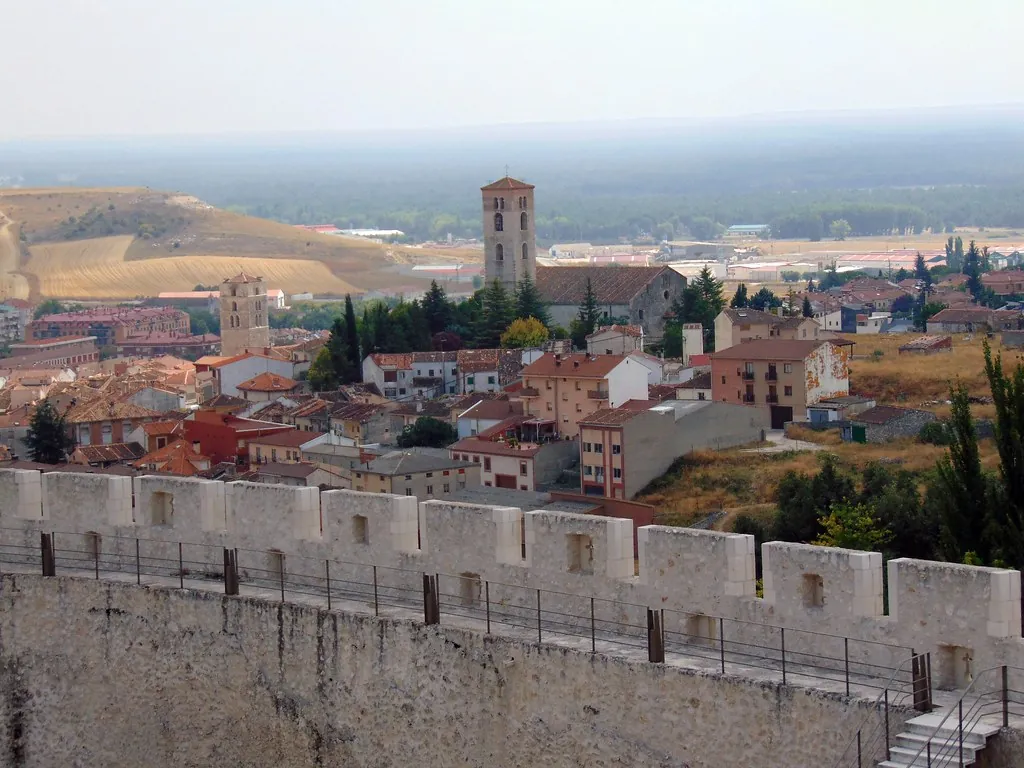
Near the centre of the village stands the parish church of Santo Tomás. The current building dates to around the sixteenth century, though it has undergone later alterations. Like many churches in the Segovian countryside, it is a restrained structure built of stone and brick. Inside, the decoration is simple, with traditional devotional elements and a modestly sized altarpiece.
Much of Vallelado is organised around this church. The streets are flat and laid out in a clear, practical way, with no steep gradients or sudden changes in level. Houses often retain walls made from adobe or rammed earth, sometimes reinforced with brick in later updates. This is architecture shaped by climate and available materials rather than by any desire to impress.
There are still wide gateways that once opened onto courtyards or agricultural spaces. In some streets, it is possible to come across underground cellars or old communal ovens, although they are not always signposted or accessible. These features hint at a way of life closely tied to farming and shared resources.
The pine forest as the defining landscape
The municipality forms part of one of the large expanses of pine forest on Spain’s northern plateau. These woods are relatively uniform, planted and managed over generations to make use of timber and, above all, resin.
A walk through them gives a clear sense of how that work functioned. Many trees still show the distinctive cuts where resin once flowed. It is also common to see small metal plates fixed into trunks, remnants of the system used to collect the sap. These details, easy to overlook at first glance, tell the story of an activity that shaped both the land and the local economy for decades.
The terrain is almost entirely flat. The sandy soil drains well, so paths tend to remain passable even after rain. Between stretches of pine forest, there are plots of cereal crops and occasional clearings where different uses of the land meet.
Wildlife is present, though it often keeps its distance. Rabbits are common, and with some luck roe deer can be seen in quieter areas. Overhead, birds of prey typical of the plateau, such as buzzards, are a frequent sight.
Routes through woodland and fields
The surroundings of Vallelado are well suited to exploring on foot or by bicycle. There is a wide network of agricultural and forest tracks, and navigation is generally straightforward thanks to the lack of elevation changes.
Within a short distance from the village centre, the urban area gives way directly to pine forest. Other routes cross open farmland and link Vallelado with nearby places such as Villaverde or La Seca. These are calm, unhurried routes where encounters are more likely to involve a tractor or a neighbour moving between plots than any kind of traffic.
In summer, heat can be a factor, particularly in the more exposed cultivated areas where shade is scarce. Spring and autumn bring noticeable changes to the landscape. The green of growing cereal or the ochre tones of recently harvested fields break up the continuity of the pinewoods and give the area a different character.
Traditions tied to the rural calendar
The festive calendar in Vallelado follows patterns common to towns across the plateau. The main celebrations take place in summer, around Santo Tomás. At that time, much of the year’s collective activity is concentrated into a few days, with religious events, music in the evenings, and family gatherings as people return to the village for the holidays.
In January, the tradition of San Antón continues, historically linked to domestic animals and agricultural life. The blessing of animals still forms part of the celebration in some households, maintaining a connection between older customs and present-day life.
Outside these moments, daily life in Vallelado is calm. The village can be covered on foot in a short time and does not have large tourist facilities. What it offers instead is a landscape characteristic of Tierra de Pinares and a way of life that, despite inevitable changes, remains closely tied to the land.