Full Article
about Villanueva de Duero
A riverside town on the Duero and Adaja; noted for its church and the ruined Cartuja de Aniago.
Hide article Read full article
A geography of pine and plain
Villanueva de Duero sits on the southern edge of the province of Valladolid, part of the comarca called Tierra de Pinares. The name is literal. The landscape here is defined by extensive forests of resin pine, a tree that shaped the local economy for generations. The village itself, home to around twelve hundred people, occupies a flat stretch of land at roughly 690 metres above sea level. The horizon is low, the sky wide, and the pinewoods are not a distant view but a permanent presence at the edge of the fields.
Built for resin and rural life
For much of the nineteenth and twentieth centuries, the primary industry here was resin extraction. Men would carve notches into the trunks of the pines, attaching small clay pots to collect the sap. You can still find trees bearing these scars in the surrounding woods, a physical record of a vanished trade. The village architecture mirrors this practical past. Houses are built from adobe, brick, and rammed earth—materials common to the rural Castilian plateau. The street plan is simple, without grand plazas. Some older façades show coats of arms or modest decorative work, hints of the agricultural families who built them.
The parish church and its context
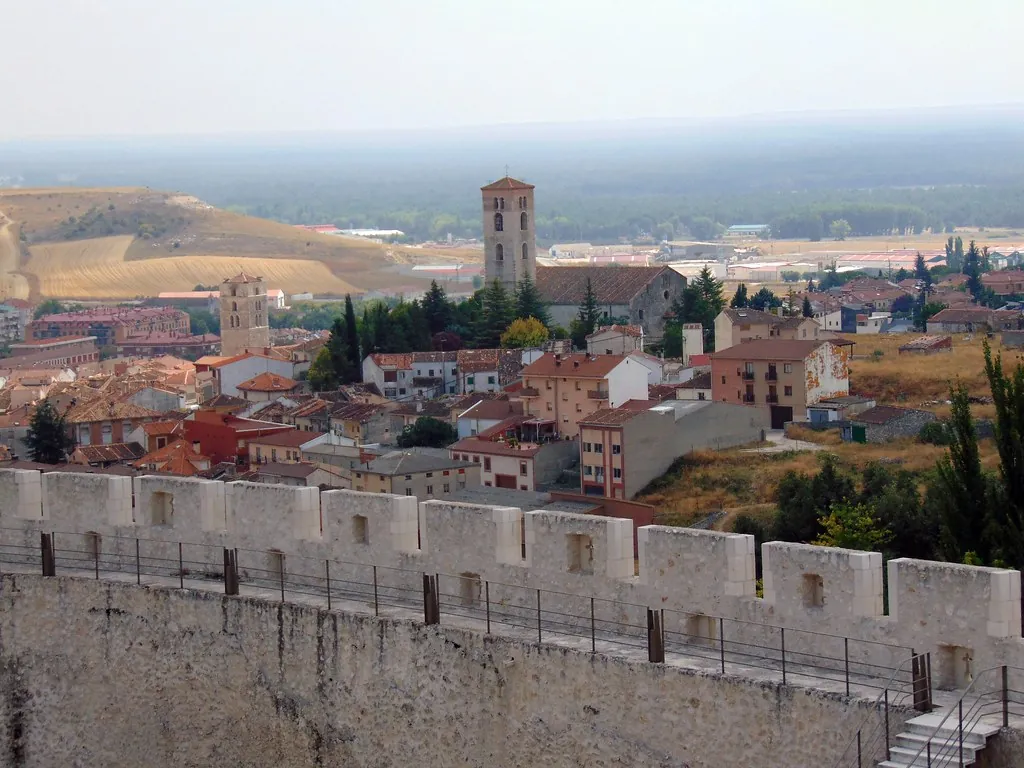
The parish church, dedicated to the Visitación, occupies a central position. The structure dates from the sixteenth century, though it has seen later modifications. Its tower is placed at the foot of the nave, a common arrangement in these parts. The interior holds a Baroque altarpiece of modest scale, typical of the work produced by regional workshops in the early modern period. Its artistic interest is secondary to its social function. For centuries, this building has served as the community’s main gathering point, for both religious observance and civil meetings.
Cellars and construction logic
Walking through the village, you notice small vents and low doorways set into the ground. These are the entrances to private underground cellars, used for storing wine. They are seldom open to the public but form a characteristic element of the streetscape. Such cellars were a practical solution across this part of Valladolid, using the earth’s constant temperature for preservation. Above ground, the same functional logic applies. The thickness of the walls, the orientation of the houses, and the materials chosen all respond directly to the dry continental climate and to an agricultural way of life.
Walking in the pine forest
The pine forest that gives the region its name begins where the farmland ends. The terrain is flat, crossed by sandy paths that run between evenly spaced trees. It is easy walking. Among the pines, you will still see the vertical scars left by resin tappers, a direct link to the area’s recent history. The woods are now used for walking and cycling. In autumn, mushroom foragers search for níscalos when conditions are right; local regulations usually apply, so it is wise to check the current rules.
Local rhythms and practical notes
The village’s annual rhythm follows the traditional calendar, with the patronal festivities in honour of the Visitación forming the centrepiece. These are community events, focused on local participation rather than outside spectacle. Other gatherings may relate to agriculture or rural trades, their formats adapting over time.
You can see Villanueva de Duero thoroughly in a couple of hours on foot. Look for the texture of the adobe walls, the simple brickwork around windows, and those cellar entrances. The place reveals itself through these details and through its quiet relationship with the encircling pine forest.