Full Article
about Castrotierra de Valmadrigal
A small rural settlement on the Leonese plain; it still lives the rhythm of traditional farming.
Hide article Read full article
A place you don’t plan, but notice
Tourism in Castrotierra de Valmadrigal feels a bit like pulling over because you’ve spotted a church tower from the road and thought, “let’s have a quick look.” It is not somewhere people arrive with a checklist. It works more as a place where, within a few minutes of stepping out of the car, you start to understand what the Tierra de Sahagún is really like.
With just over a hundred residents, Castrotierra de Valmadrigal sits on the flatlands of south-eastern León. The landscape sets the tone: open fields, agricultural tracks and small villages spaced a few kilometres apart. There are no major landmarks or dramatic viewpoints, but there are plenty of clues about how people have lived here over generations.
The church and adobe houses
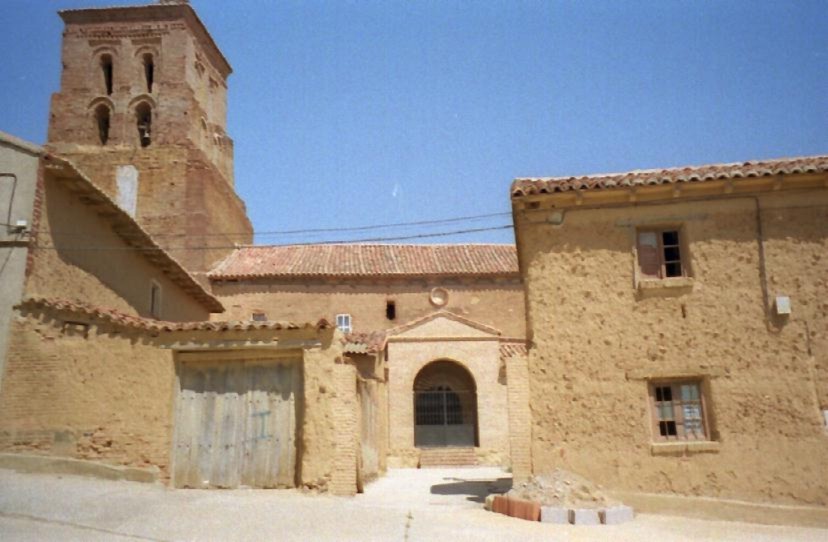
In villages of this size, one building usually anchors everything. Here, that role belongs to the parish church of Nuestra Señora de la Antigua. Built with a mix of stone and brick, it reflects a style commonly found in this part of León. Its tower becomes visible from a distance as you approach along the minor roads that cut through the fields.
Around it sit the traditional houses of the village. Adobe walls are typical, along with large gates designed to bring in tractors or store farming equipment, and enclosed yards at the back. Some homes have been repaired over time, while others still show the slightly uneven look shaped by decades of cold winters and very dry summers.
A slow walk through the streets brings out small details: old threshing floors, rammed-earth walls, the occasional well or agricultural outbuilding. These are everyday elements, but they point to a way of life closely tied to the land, something that still feels present here.
The open landscape of the Tierra de Sahagún
The surroundings follow the pattern of the wider comarca: a cereal-growing plain with wide plots and dirt tracks linking one village to the next. In spring, the fields turn green. By early summer, the colour shifts towards the gold of ripening grain, which comes to dominate the view.
This is not a landscape of mountains or cliffs. Its appeal lies elsewhere, in the sense of space and quiet. At times, the only sounds are a tractor in the distance or the wind moving through the crops.
Birdlife adds another layer, especially if you pay attention. Birds of prey can often be seen circling above the fields, while smaller birds gather near seasonal streams. Towards evening, this becomes more noticeable.
Walking the agricultural tracks
There are no marked trails or information boards here. What you find instead are the long-established dirt paths used by farmers to reach their land.
Many of these tracks connect Castrotierra de Valmadrigal with nearby villages. Sahagún, for example, lies relatively close and acts as the main hub of the area, with more heritage and services. For that reason, quite a few visitors arrive here as part of a short trip from Sahagún.
If you decide to walk for a while, the advice is simple: keep track of where you came from. The paths look very similar to each other, and it is easy to lose your bearings when everything around you is fields.
Eating and stopping nearby
Castrotierra de Valmadrigal does not have bars or restaurants operating on a regular basis. That is typical for a village of this size. The practical option is to eat or stop for a drink in Sahagún or another nearby village, then come here for a walk.
Food in the area reflects what the land provides. Legumes, lamb, cured meats and filling dishes are common, more suited to colder months than to presentation.
Village festivals and seasonal life
The local calendar remains closely tied to religion and to summer, when people return who have family roots in the village. The main celebrations usually take place in August. They include a procession, shared meals and a few days when the village becomes livelier than usual.
These are not events designed to attract large numbers of visitors. They function more as a meeting point for those who have lived here or still maintain a connection to the place.
A short stop that makes sense
Castrotierra de Valmadrigal is the kind of place you give an hour or so, take a gentle walk, and then continue through the comarca. That suits it.
Anyone expecting major sights or a list of well-known attractions may find it limited. But for those interested in how small villages in the Tierra de Sahagún really are, especially those still shaped by agricultural life, stopping here fits naturally. Even if it is only to walk between adobe houses and watch the horizon stretch out in every direction.