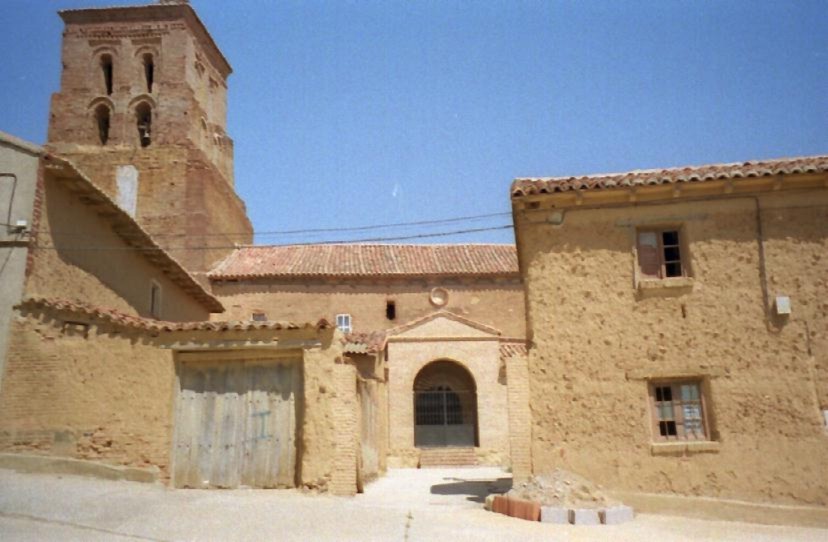
En El Burgo Ranero.jpg
Random username 083794703875938 · CC0
Castilla y León · Cradle of Kingdoms

Burgo Ranero (El)

The storks arrive first. By late April, they're rebuilding their twiggy apartments atop the tower of San Pedro, clattering their beaks like castane...

697 inhabitants · INE 2025
879m Altitude

Why Visit

Mountain Church of San Pedro Camino de Santiago

Best Time to Visit

spring

San Pedro (June) junio

Things to See & Do
in Burgo Ranero (El)

Heritage

  • Church of San Pedro
  • Apple Lagoon

Activities

  • Camino de Santiago
  • Birdwatching

Festivals
& & Traditions

Fecha junio

San Pedro (junio)

Las fiestas locales son el momento perfecto para vivir la autenticidad de Burgo Ranero (El).

Full Article
about Burgo Ranero (El)

Key landmark on the Camino de Santiago; known for its sunsets over the plain and the Manzana lagoon.

Ocultar artículo Leer artículo completo

The storks arrive first. By late April, they're rebuilding their twiggy apartments atop the tower of San Pedro, clattering their beaks like castanets while the morning's first pilgrims shuffle into town. It's an oddly theatrical welcome to a place that, by all reasonable measures, shouldn't exist at all. El Burgo Ranero is barely a smudge on the map—700 souls clinging to 879 metres of Castilian plateau—yet every spring it becomes an accidental United Nations of blistered feet and sun-fried shoulders.

The Village That Walks

Everything here happens on one street, and that street happens to be the Camino de Santiago. The medieval engineers who plotted the French Route knew their business: draw a straight line across the meseta, and eventually you'll hit a settlement desperate enough for coins to offer bread and beds. El Burgo Ranero obliged, and eight centuries later it's still obliged, though now the transaction involves contactless payments and €8 pilgrim menus.

The effect is surreal. By 11 a.m. the main drag looks like a badly organised hiking festival. German trekking poles click against Spanish cobbles. Korean smartphones translate "tortilla" into hangul. A British woman in injudicious shorts asks the bar owner whether he has oat milk (he doesn't). Then, as suddenly as it began, the tide recedes. Anyone not walking the Camino has no reason to be here, and by early afternoon the village remembers it's essentially a farming community with unusually stiff competition for sun loungers.

Walkers who linger discover the peculiar rhythm of a place that exists in two time zones simultaneously. There's Greenwich Mean Time, obviously, but there's also Pilgrim Time—an elastic concept that stretches from the first coffee at 6 a.m. (somebody always leaves at five) to the last glass of tinto at 9 p.m. (somebody always arrives at ten). Between these poles, the village performs its daily theatre of arrival and departure, each guest convinced their blister is the worst in Christendom.

Flat Land, Hard Walking

The meseta lies. It looks gentle—wheat fields rolling away like a beige ocean, horizon so distant you could balance the moon on it—but the plateau is a master of low-level torture. There's no shade between here and Mansilla de las Mulas, 17 km west. The sun reflects off the limestone track, doubling its strength. In July the ground temperature hovers around 40°C, hot enough to melt the rubber on trekking shoes. Locals, who've seen every variety of heat-addled foreigner, recommend starting before sunrise. They also recommend carrying two litres of water minimum. Most people carry one, discover their error around kilometre eight, and spend the remaining nine composing mental TripAdvisor complaints about Spain's sadistic geography.

Winter reverses the problem. At this altitude frost arrives overnight and lingers until ten. The same unforgiving straight track becomes a wind tunnel channeling Siberian air directly into your face. Accommodation prices drop by half, but so do opening hours—several albergues simply shut from November to March, reasoning that anyone mad enough to walk across northern Spain in January probably deserves to sleep in a barn.

Spring and autumn provide the sweet spot, though "sweet" remains relative. April mornings require gloves; May afternoons require sunscreen. September brings dramatic skies and the annual stork migration, when twenty-odd pairs wheel overhead like feathered RAF pilots returning to base. October is harvest: combine harvesters straddle the fields, kicking up chaff that drifts across the Camino like biblical locusts.

What Passes for Civilisation

The church of San Pedro won't make anyone's Renaissance art syllabus. Inside it's dim, echoing, stripped of ornament by centuries of pragmatic villagers who valued roof lead over baroque altars. The tower, though, is worth the climb—twenty minutes of narrow spiral stairs for views across a landscape so flat you can spot tomorrow's walking route. Time it right (late May) and you'll share the platform with stork chicks, fluffy grey bundles that hiss like defective kettles when disturbed.

Below, the main street offers exactly six businesses of interest to non-farmers. Three are bars serving identical pilgrim menus: soup that tastes of yesterday's vegetables, chicken braised until submission, flan wobbling with factory-made defiance. The fourth is a bakery whose custard pastries justify getting up early. The fifth is a tiny shop selling Compeed in every size, plus the kind of chocolate bars that taste better when you're desperate. The sixth is the ATM, positioned with geographical precision exactly halfway between the albergues and the bars, ensuring maximum overdraft fees for people who've lost the ability to do mental arithmetic after twelve walking days.

Food options divide cleanly into "before 8 p.m." and "starve". The Hostal Piedras Blancas does a flan that British walkers describe, without irony, as "life-changing"—a testament either to Spanish dairy or cumulative pilgrimage delirium. Their carbonara is safe for children and other fussy eaters: light, not creamy, definitely not tinned tuna masquerading as bacon. Vegetarians learn to specify "sin atún" because the Spanish concept of meat-free frequently involves fish. Vegans learn to like chips.

The Quiet Hours

By nine the streetlights flick on and the village remembers it's essentially a collection of houses around a grain silo. Bars stack chairs; pilgrims limp towards dormitories. Someone always tries for a nightcap at 9:30 and finds the door locked. The silence is abrupt and total—no traffic, no televisions, just wind across the fields and the occasional clatter of storks settling down.

This is when El Burgo Ranero reveals its actual purpose. It's not a destination; it's a comma in a sentence that started in Saint-Jean-Pied-de-Port and finishes in Santiago. The village provides exactly what exhausted walkers need: a bed, calories, and permission to stop moving for twelve hours. Nothing more, nothing less. By morning the comma becomes a semicolon; boots hit the road again, and the wheat fields resume their patient wait for the next batch of feet.

Key Facts

Region
Castilla y León
District
Tierra de Sahagún
INE Code
24024
Coast
No
Mountain
Yes
Season
spring

Livability & Services

Key data for living or remote work

2024
ConnectivityFiber + 5G
TransportTrain station
Housing~6€/m² rent · Affordable
Sources: INE, CNMC, Ministry of Health, AEMET

Planning Your Visit?

Discover more villages in the Tierra de Sahagún.

View full region →

More villages in Tierra de Sahagún

Traveler Reviews