Full Article
about Almaraz de Duero
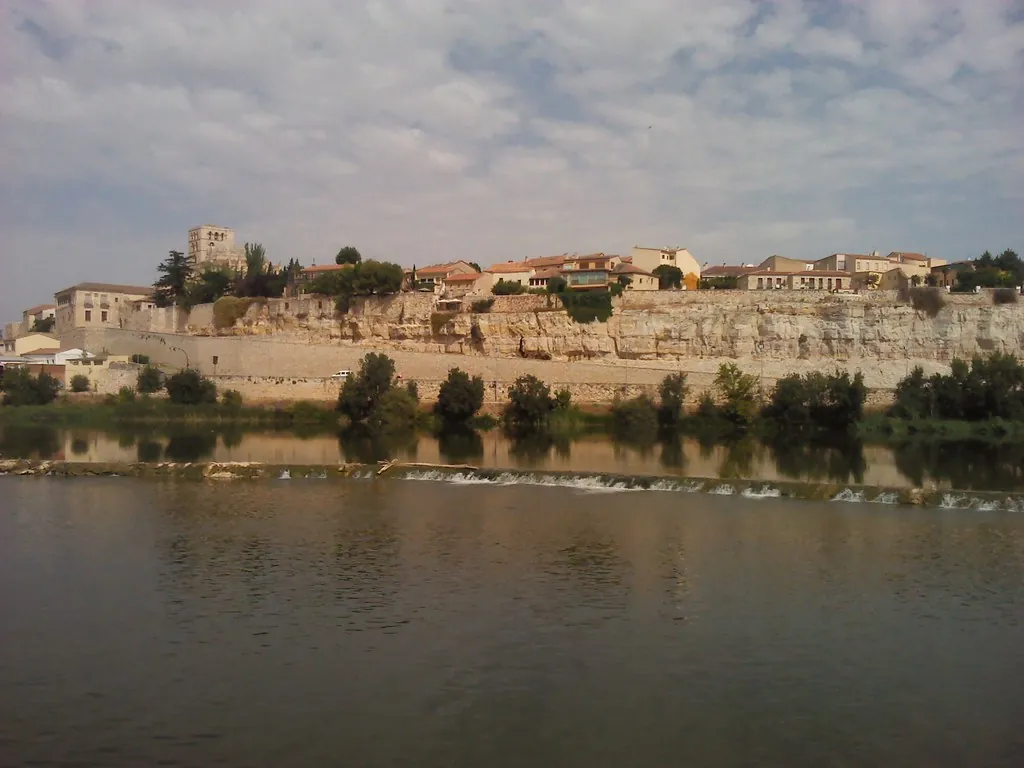
Municipality known as the Balcón del Duero for its closeness to the river and its landscapes; transition zone toward the Arribes with old tin mines and a rich natural setting.
Hide article Read full article
Some villages form an image in your mind before you arrive. Others, like Almaraz de Duero, work differently. Tourism in Almaraz de Duero does not follow the logic of brochures. There is no carefully staged street for photographs, no viewpoint with a queue forming at sunset. What you find instead is a place that carries on with its day while you happen to pass through.
Almaraz de Duero sits in the region known as Tierra del Pan, in the province of Zamora, and the River Duero is close by. The river has shaped the rhythm of life here for centuries. It is not presented as an attraction with signs and facilities. It is simply there, part of the landscape and part of the routine.
This is the kind of stop that often comes about almost by accident, perhaps because a road leads towards the river or because the map suggests open country ahead. And open country is exactly what defines this corner of Castilla y León.
A Small Farming Village in Tierra del Pan
Almaraz de Duero has around 400 residents. It quickly becomes clear that agriculture still sets the tone. Tractors move in and out, agricultural sheds stand on the outskirts, and the surrounding plots shift in colour with the seasons.
The village lies at about 716 metres above sea level, in a wide, open stretch of Zamora province where the landscape feels broad and almost flat. The horizon seems to stretch without interruption. There are no dramatic mountain backdrops or dense forests, just farmland and sky.
The architecture reflects that rural focus. Many houses are built from stone and adobe, with thick walls designed to cope with both summer heat and winter cold. Interior courtyards remain in use, sometimes storing tools or housing animals. There have been few concessions to modern design. For better or worse, this has helped the village retain a strong sense of continuity.
A walk through the streets is straightforward and does not take long. In half an hour, you have a clear idea of the village’s size and layout. Still, it is worth slowing down. Small details reveal how life has functioned here for generations: an old wooden door worn smooth with use, a well-preserved rammed earth wall reinforced with stone, an open corral that hints at daily routines tied to the land.
This is not a curated rural setting prepared for visitors. It feels like a working village that has adapted just enough to keep going.
The Church of San Juan Bautista
In a village of this scale, one building usually draws the eye. In Almaraz de Duero, that is the parish church of San Juan Bautista.
The church has medieval origins, although it has undergone alterations in different periods. It is not grand in scale. Compared with some of the more elaborate churches elsewhere in Castilla y León, it comes across as sober and even austere. That restraint suits the character of the village.
Inside, a number of decorative elements remain, reflecting the passage of time and the various stages of construction and reform. The interior is not spectacular, yet it carries the atmosphere of a building that has been used continuously for centuries. Generations of residents have marked baptisms, festivals and farewells within these walls.
San Juan Bautista also shapes the village calendar. The feast day, usually celebrated in June, brings a procession and gatherings among neighbours. For a few days, the population swells as people who live elsewhere return. It is a moment when the streets regain some of the busier feel they may have had in the past.
A Few Minutes from the Duero
The most appealing aspect of Almaraz de Duero lies just beyond the built-up area. A short walk towards the river is enough for the landscape to shift.
The Duero flows relatively close to the village, and agricultural tracks lead down to its banks. There are no marked hiking routes or wooden walkways. These are dirt paths used by locals to reach their fields. The experience is simple and unstructured.
Following one of these tracks, the surroundings gradually change. A stand of poplars appears, then a clearing beside the water. The river does not announce itself with dramatic scenery. It moves steadily, defining the edge of cultivated land.
For those who enjoy watching wildlife, the riverbank can be rewarding. Herons and other species are often visible along the water. The setting encourages quiet observation rather than activity. This is not a place designed for a full day of organised pursuits. It suits a slow stroll and perhaps a few minutes sitting by the river, watching the current pass.
In this sense, the Duero here feels less like a landmark and more like a companion to everyday life.
Traditional Architecture That Endures
One of the striking aspects of Almaraz de Duero is how many traditional features remain standing. Heavy wooden doors, wine cellars dug into the earth, and rammed earth walls reinforced with stone still form part of the built environment.
Some buildings are closed or see little use, a situation common in many villages across the area. Even so, there are inhabited houses that preserve their older structures with few alterations. The overall appearance remains coherent. It does not resemble a restored stage set for tourism. It looks like a place that has changed only as much as necessary to continue functioning.
Seasonal rhythms reinforce that impression. Beyond the June celebrations of San Juan Bautista, summer brings a handful of simple activities, particularly in August when there is more movement in the village. Dances and neighbourly gatherings are organised primarily for residents and returning families rather than to attract outside visitors.
For the rest of the year, life is quiet. In winter the pace slows considerably, and the focus returns to farming, family and daily routines.
A Brief but Revealing Stop
Almaraz de Duero is not a destination for a long stay. It works better as a short stop while travelling through Tierra del Pan or when seeking out a peaceful stretch of the Duero.
There is nothing spectacular to tick off a list. What it offers is a clearer sense of how life unfolds in this part of Zamora. The fields, the church of San Juan Bautista, the unmarked paths to the river and the enduring architecture all point to continuity rather than display.
In places like this, the absence of grand attractions becomes part of the appeal. The village does not demand attention. It simply continues at its own pace, with the Duero flowing nearby as it has done for centuries.