Full Article
about Palacios del Pan
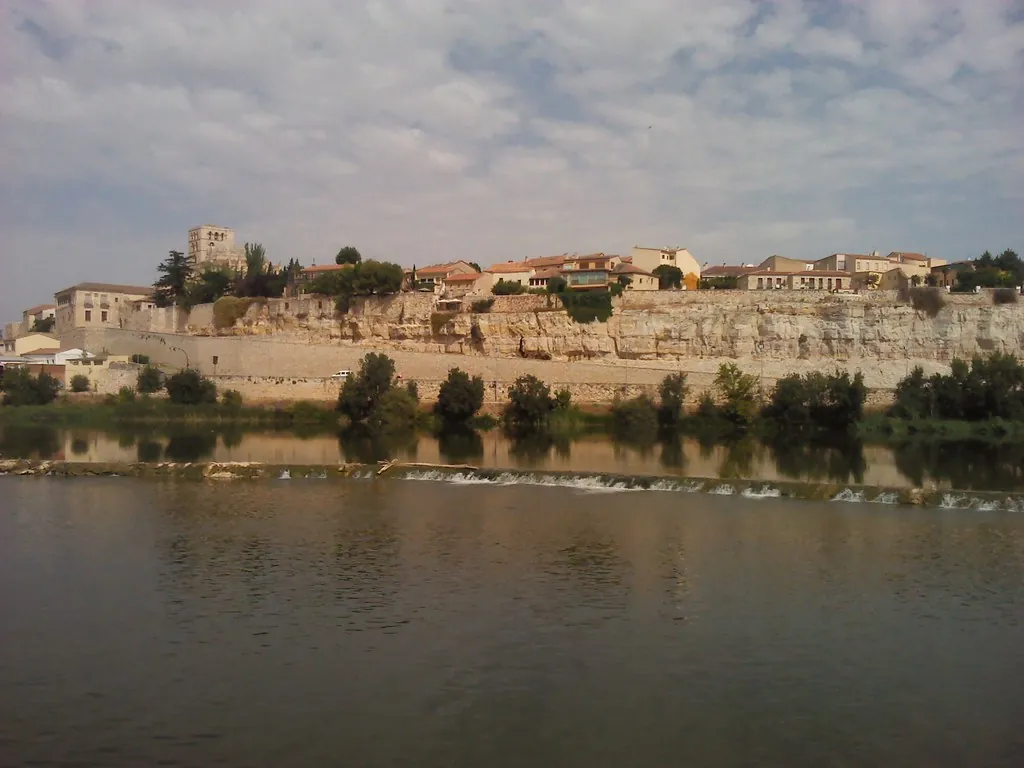
Set beside the Esla reservoir with panoramic views; ideal for fishing and enjoying the water landscape.
Ocultar artículo Leer artículo completo
Seventeen minutes from the motorway, four centuries slower
Exit the A-66 at Zamora, follow the wheat signs for a quarter of an hour and the tarmac narrows to a single thread. At 717 metres the air thins and the thermometer drops three degrees; stone houses appear, roofs still pegged with hand-split oak. This is Palacios del Pan, a council of 250 souls whose name remembers both medieval manor houses and the golden grain that still pays the bills. There is no brown sign, no visitor centre, no souvenir stall—just the abrupt sensation that the twenty-first century has been switched off.
The village sits on a gentle swell of Castile’s “Land of Bread”, a patchwork of estate-size fields that run to every horizon. In April the wheat is ankle-high and emerald; by July it will be shoulder-high and the colour of a lion. Come August the harvesters drone from dawn to dusk, pouring grain into lorries that rattle through the lanes raising pale dust. Outside those weeks the loudest noise is the church bell, struck by hand at noon and again at eight.
What passes for a centre
There is no plaza mayor, only a widening of the main street where the petrol-green parish church of San Lorenzo confronts a bench and a defunct fountain. The building is 16th-century Romanesque refaced in the 1700s; its tower acts as the village’s lighthouse, visible from every approach across the plain. The door is usually locked—telephone the priest in Alcañices the day before if you want to see the gilded altar and the worm-eaten choir stalls. Otherwise content yourself with the exterior: granite blocks the colour of weathered teak, and a stone bread loaf carved into the keystone of the south portal, a mason’s joke that gave tour guides something to talk about long before Instagram.
From the church the street dwindles into lanes barely wider than a tractor axle. Houses are built from the ground they stand on: adobe bricks sun-baked on site, topped with half-round roof tiles heavy enough to survive the winter gales that sweep across the plateau. Many still have bodegas underneath—hand-dug cellars three metres deep where families once stored wine made from itinerant Rioja vines. Several owners will lift the iron hatch and show you if you ask politely; the temperature drops ten degrees in the descent, a natural fridge that keeps peppers hanging from the rafters until Easter.
Walking without waymarks
Palacios is the accidental start of three caminos that never made it into the guidebooks. The simplest is the farm track south-east to the abandoned hamlet of Trabanca: 5 km out, 5 km back, dead flat. You share the route with crested larks and the occasional four-wheel-drive piloted by a farmer checking rainfall gauges. Mid-March brings flocks of migrating lapwings that stand in the furrows like grey-clad sentries; in October the stubble fields glow amber under low sun—bring a wide-angle lens and a thermos, sunrise lasts longer at this altitude.
A rougher circuit heads north, crosses the county boundary into Ourense province and climbs to the granite outcrop of Pico de San Cristóbal (823 m). The ascent is only 100 metres but the view opens onto four provinces: Zamora, Ourense, León and a sliver of Portugal. On clear winter days the snow-capped Trevinca massif floats on the western horizon like a misplaced Alpine postcard. The path is not signed; download the GPX from the Zamora tourist board or follow the tractor ruts and the occasional concrete post stamped “Mojón 1852”.
Bread, lamb and the absence of pintxos
There is no bakery in the village—the last one closed when the owner retired in 1998. Instead, bread arrives three times a week in a white van that toots at ten o’clock: baguette-style picos and round barras still warm from the industrial ovens of Zamora. Queue with the locals, hand over 1.30 € and you have breakfast sorted. If you need anything more exotic than tinned tuna, drive the 12 km to Alcañices before the supermarket shutters at 14:00; the village shop opens “when the owner finishes the fields”, a timetable that defeats even the Spanish.
For a proper meal head to Bar Palacios, the only public table in town. The menu is written on a paper tablecloth: slow-roasted lamb shoulder for two (24 €), lentils with chorizo (8 €), and a house red drawn from a 5-litre plastic drum that started life in Toro. Portions are farm-hand size; ask for a media ración unless you’ve just ploughed forty hectares. Kitchen hours remain obstinately Castilian—lunch 14:00-15:30, dinner 21:00-22:00—so carry biscuits if you arrive in the gap. When trade is quiet the owner locks up early; if the door is shut, the nearest alternative is the roadside grill in Gallegos del Pan, ten minutes west.
Where to lay your head
Hotels have never caught on here. The village instead offers a single vineyard glamping pitch arranged through Campspace: a flat patch of grass among the vines, compost loo in a wooden hut, cold-water tap marked “no potable”. At 15 € a night it is the cheapest roof—well, canvas—within 30 km. Bring your own drinking water and a mallet; the ground is stony Zamora topsoil that laughs at tent pegs. The owner, Inés, speaks fluent English and will lend you a firepit for cooking sausages under stars that the Milky Way actually milks.
If you prefer walls, the closest rural houses are in Alcañices: Casa Rural Abuela Benita (two bedrooms, wood-burner, 80 €) or the slightly smarter Casa del Cura (90 € with breakfast). Both give you the luxury of a shower that does not involve a solar bag.
Seasons of gold and brown
Spring is the easy sell: green wheat, almond blossom, daytime 18 °C and night-time frosts that keep the mosquitoes honest. Come mid-May the abubilla (hoopoe) calls from every telegraph pole and the air smells of fennel crushed under tractor tyres.
Summer turns serious. July routinely hits 35 °C; the fields become a yellow ocean rippling in the tarde breeze. Afternoons are for siesta or sitting in the bar’s single patch of shade; walking is restricted to the two hours after dawn when the dew still holds the dust down.
Autumn is the photographers’ window: stubble, storks, long shadows. Harvest dust finally settles and the sky returns to a deep Iberian blue. By November the temperature swings from 20 °C at noon to 2 °C at midnight; pack both fleece and sun-cream.
Winter is not for the faint-hearted. The plain funnels freezing continental air; -8 °C at dawn is normal and snow can arrive overnight. Roads are gritted late, if at all—carry chains and know that the glamping pitch shuts from December to February. On the other hand, you will have the horizon to yourself and the lamb tastes better when the mist hovers at chimney height.
How to arrive (and why you might turn back)
Fly to Madrid or Valladolid, collect a hire-car and point it north-west. From Madrid it is 230 km of fast motorway; from Valladolid barely 100 km. The final 12 km from the Zamora exit are country two-lane—watch for wild boar at dusk. There is no bus, no train, no Uber. If the fuel light blinks, fill up in Zamora; the village pump closed in 2004 and the next garage is 25 km away.
Palacios del Pan will not change your life. It offers no souvenir tea-towels, no audio guides, no sunrise yoga. What it does give is the sound of wheat rustling like heavy silk and a night sky still dark enough to read Orion’s belt. Bring walking boots, a corkscrew and the capacity to enjoy places that do not try to impress you. Arrive with those and the village, indifferent but hospitable, will hand you back an hourglass full of silence.