Full Article
about Alaejos
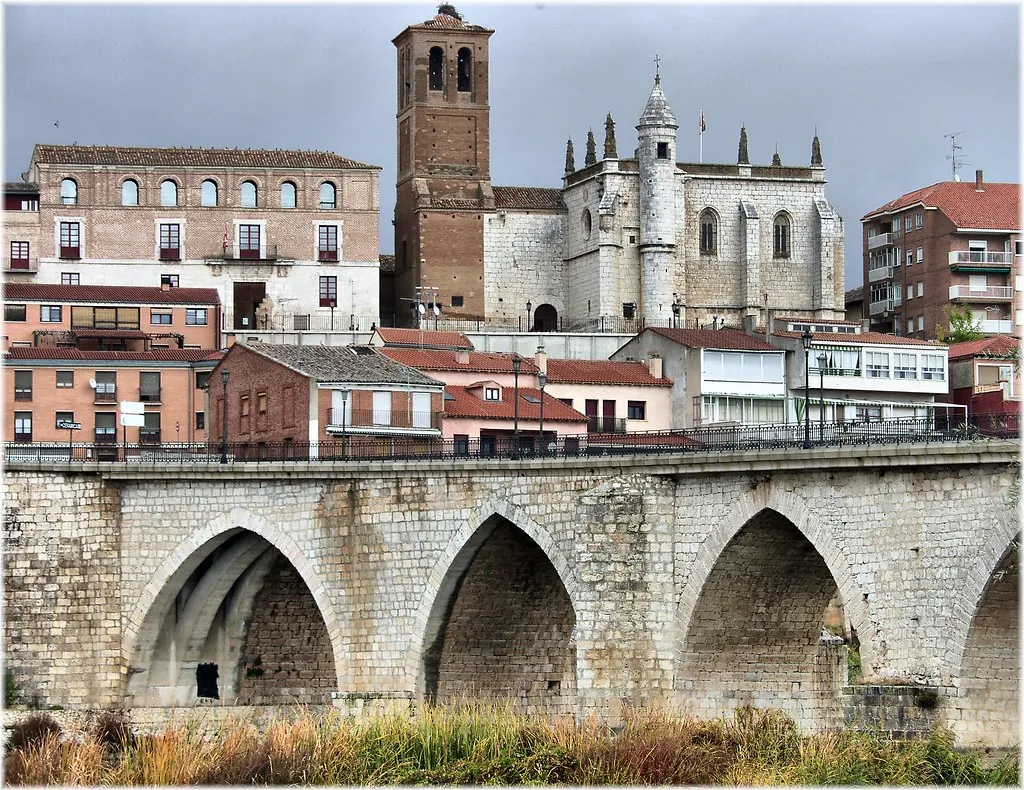
Historic-Artistic Site famous for the striking church towers that dominate the landscape; a benchmark of Mudéjar and Baroque in the province.
Hide article Read full article
The scent of dry earth and warm brick hangs in the air long before you see the tower. Out on the plain, the light is flat and vast. Alaejos appears suddenly, a compact silhouette of brick and stone rising from the vineyards of Tierra del Vino in Valladolid.
It’s a place of about fourteen hundred people, where the past prosperity from wine is written in the architecture—churches that feel too large, stone palaces with weathered coats of arms. The streets are quiet, the pace measured. Life here feels anchored to the agricultural rhythm of the surrounding fields.
The Brick Towers: Santa María and San Pedro
From almost any corner, the Mudéjar tower of Santa María acts as a guide. Its brickwork turns a deep, burnt orange in the late afternoon sun. Stepping inside is a sensory shift: the air is cool and still, a stark contrast to the heat outside, filled with a silence that seems to absorb sound.
A few minutes’ walk brings you to San Pedro. Another brick church, older, its forms simpler. The space between these two buildings holds the old quarter. In the evening, you might hear the murmur of conversation from doorways as people sit outside. The details here are what matter: the pattern in a wrought-iron grille, the uneven texture of centuries-old brick, a wooden door smoothed by generations of hands.
The Village Underground
The history of Alaejos isn’t just above ground. It’s directly beneath your feet. Many houses sit atop traditional bodegas, narrow cellars dug deep into the earth. These were not for show; they were essential, providing a constant, cool humidity for aging wine in a land of hot summers and cold winters.
Most remain private, part of family homes. Some open during local fiestas. Don’t expect guaranteed access—it’s something you must ask about locally. Their existence explains the substantial feel of the village above; this was once a more significant hub of wine trade than its current quiet suggests.
Stone Palaces and Whitewashed Walls
The Palacio de los Águila is the most obvious reminder of that past wealth. Its stone façade is heavy, carved with heraldic shields that have softened with weather and time. But just as telling are the simpler houses nearby: whitewashed walls, large wooden gates leading to courtyards you can only glimpse from the street.
Walking these streets doesn’t take long in distance. It takes time if you choose to look, to notice the layering of different eras in the brick and stone, to feel the quiet that settles in after midday.
Walking the Perimeter: Vines and Sky
The urban edge gives way to farmland within a few hundred paces. Dirt tracks, used by tractors, lead straight out into vineyards and cereal fields. The horizon is a long, clean line.
These tracks are for walking or cycling. The terrain is flat, but be prepared for wind—it can sweep across the plain with little to stop it. In summer, go early. The light at dawn is sharp and clear; by midday, the sun is relentless and the landscape bleaches out. Come autumn, the vine leaves turn a rust-red that echoes the village brick.
A Practical Rhythm
If your visit can coincide with late spring or early autumn, do it. The temperatures are kinder, and the fields are green or golden. Summer has a stark beauty, but plan around the heat: be outside in the early morning or after six in the evening.
The main fiestas for San Pedro happen at the end of June, filling the plaza with music and bringing back former residents. Semana Santa here is a quieter, more intimate affair than in the cities—processions winding through those narrow streets without spectacle.
Alaejos won’t fill a checklist. It offers space, both physical and temporal. It’s best understood by standing in its plaza at dusk, watching the brick towers darken against a wide sky, knowing the cellars are below and the endless plain stretches out beyond. That is its character.