Full Article
about Bercero
A municipality with a rich religious heritage, set in a valley amid farmland and scattered vineyards.
Hide article Read full article
Arriving and Getting a Feel for the Place
Parking in Bercero is straightforward. The streets are narrow and not designed for much traffic, so the easiest option is to leave the car near one of the village entrances and continue on foot. It takes around ten minutes to walk from one side to the other.
Timing makes a difference. Early morning or late afternoon are the most comfortable moments to wander through. Around midday, especially in summer, the sun is strong and there is very little shade. This is not a place with constant movement or a steady flow of visitors. On some days, there may be more local residents out and about than anyone passing through.
Bercero sits in the heart of Tierra del Vino, a rural area traditionally linked to wine production. The surroundings are open and practical rather than dramatic. There are wide cereal fields, a scattering of vineyards, and a landscape that stays mostly flat in every direction. Dirt tracks lead out of the village across this working land.
The look of the countryside shifts with the seasons. Spring brings a green cover across the fields, while summer turns everything into dry yellow tones. There are no large viewpoints or scenic platforms. This is farmland shaped by use rather than display.
The overall atmosphere is quiet. Birds can be heard, sometimes a dog in the distance, and very little else.
The Village Itself
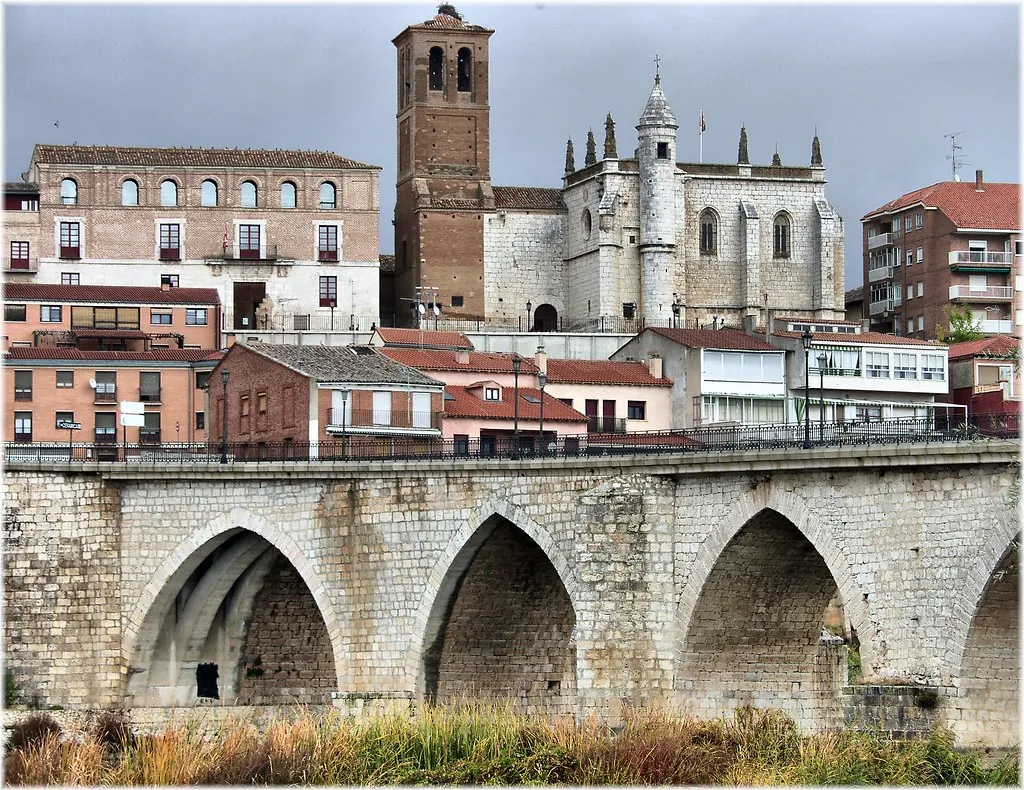
The main reference point in Bercero is the church of Nuestra Señora de la Presentación. Its origins are old, probably medieval, although what stands today reflects later alterations. The building is simple in form, with thick walls, a restrained interior space, and very little decoration.
Beyond the church, the village follows the pattern common in this part of Castilla y León. Houses are built using adobe and rammed earth. Some have been restored, while others remain much as they were. Several properties include underground wine cellars, either beneath the house itself or in adjoining courtyards. Many of these spaces are still in private use and are not open to visitors.
The streets are short and quiet, without a defined historic ensemble or a collection of standout landmarks. It is easy to walk through the entire settlement in a short time, taking in the details without needing a plan.
Walking Out into the Fields
For those who enjoy walking, several agricultural tracks begin near the village square. These are simple dirt paths that run between cereal fields and vineyards, linking plots of land rather than forming marked routes.
There is no signage or set itinerary to follow. The experience is more about choosing a direction and seeing where the track leads before turning back. The terrain is easy to manage, mostly flat and open, without steep sections or technical difficulty.
At certain times of year, small seasonal streams appear along the way. In winter or spring they may carry a little water, though they are not permanent features. Birdlife is typical of open farmland, with common species moving across the fields.
There are no designated viewpoints or specific highlights along these paths. The appeal lies in the simplicity of walking through an agricultural landscape and returning to the village at your own pace.
Traditions and Local Life
In August, Bercero usually celebrates festivities in honour of the Virgen de la Presentación. These are modest village celebrations, centred on religious events, a procession, and activities organised by local residents when the population increases slightly for the occasion.
Semana Santa (Holy Week, the period leading up to Easter) is also marked with smaller processions. Participation tends to come mainly from people who live in the village or families who return during those days.
As in many small villages, the scale and rhythm of celebrations depend on how many people are present each year. The calendar is shaped by the community itself rather than large organised events.
Practical Notes for Visiting
Bercero can be reached by car from Valladolid in under an hour, passing through Tordesillas and continuing along regional roads into the interior of Tierra del Vino.
There is no regular direct public transport to the village, so travelling by car is the usual option. For meals or a wider range of activities afterwards, it is more practical to head to larger towns in the surrounding area.
A simple approach works best here: stop, take a walk through the streets, and then head out along one of the tracks for a while. If the aim is to see major monuments or find constant activity, this is not the place. If a stretch of quiet countryside is enough, Bercero fits the bill.