Full Article
about Carpio
Historic town with a medieval layout; noted for its Herrerian church and traditional bull-running festivals.
Ocultar artículo Leer artículo completo
The wheat fields surrounding Carpio hiss like a kettle when the wind picks up. At 759 metres above sea-level, the village sits high enough for the air to carry a whistle, yet low enough for the horizon to stretch uninterrupted across the Tierra del Vino. This is cereal country: ochre soil stitched with vines, the whole patchwork tilting gently towards the Duero basin. Nothing breaks the line except the occasional stone hut and, every few kilometres, a square church tower that turns gold at dusk.
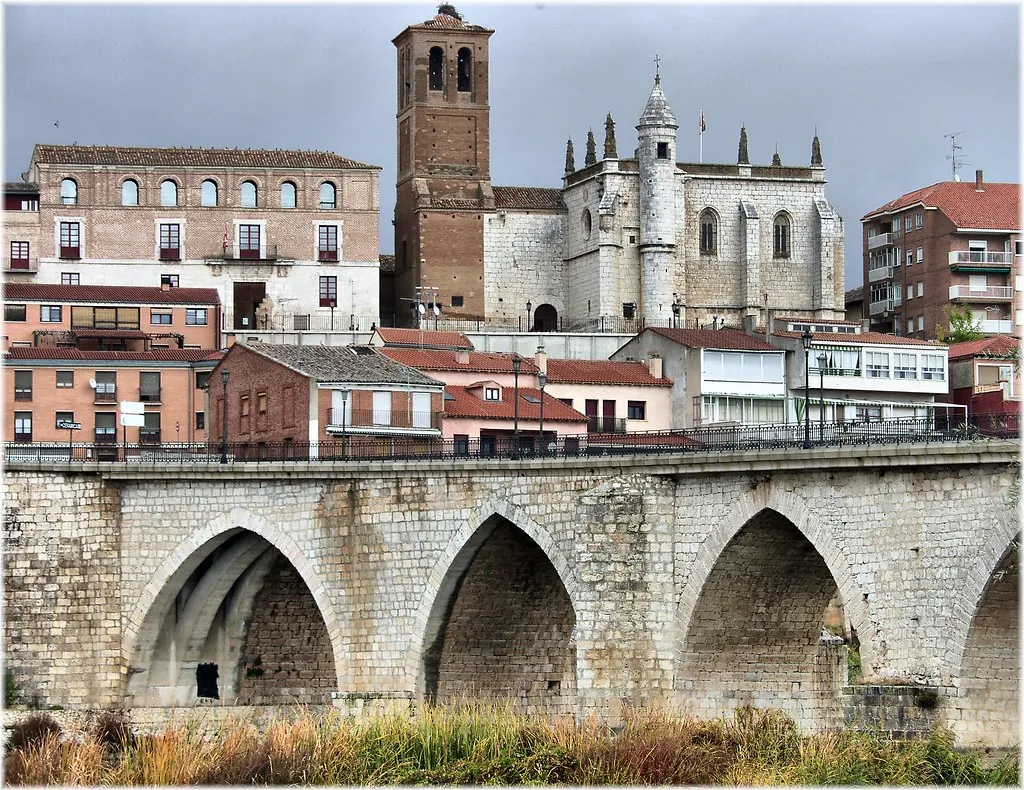
Carpio’s tower is no exception. The fifteenth-century parish church rises from a cluster of terracotta roofs, its bells still marking the hours for barely 900 residents. Inside, the nave is cool and plain; no gilded excess, just thick walls designed to keep July heat and January frost at bay. The building sums up the place: functional, weather-worn, honest. Services are sung only on Sundays; the rest of the week the doors stay shut unless you ask for the key at the bar opposite, where Pilar will rinse a coffee cup and shout across the square until someone’s uncle appears with a ring the size of a saucer.
Stone, adobe and the smell of ferment
A five-minute walk covers the historic core. Calle Real, the single paved lane, is just wide enough for a tractor with hay spikes. Houses are dressed in local stone below and sun-dried adobe above, the upper floors bulging slightly, as if the bricks have breathed. Many still wear their original ochre wash, though a few have surrendered to modern pastel pinks that look jarringly suburban. Wooden gates hang on hand-forged hinges; behind them, patios no larger than a London kitchen hold firewood piles, a motorbike and, almost always, a plastic paddling pool that serves as a wine vat at harvest.
Those harvests matter. Carpio lies inside the VT Castilla y León wine zone, and almost every family tends a micro-plot. The reds—mainly Tempranillo—are sold to the cooperative in nearby Medina del Campo, but a couple of households still tread their own grapes in the old caves dug into the hillside. One belongs to Julián, retired forester, who will pour you a glass of cloudy mosto in late September if you knock politely. The flavour is sharp, almost cider-like, and costs nothing, though he accepts a packet of Ducados cigarettes as fair barter.
The village lacks a bodega open for formal tasting; wine tourism stops 25 km west in Rueda. What you get instead is the raw process: the yeasty smell drifting from cellar grates, the purple runoff staining the lanes, the sound of barrels being rolled across packed earth at midnight. It is agriculture without theatre, and all the better for it.
Walking the cereal ocean
Three footpaths radiate from the church, all signposted with yellow dashes on gateposts. The shortest—6 km—loops through wheat and sunflower plots to an abandoned stone granary where storks nest on the chimney. Take water; shade is limited to three poplars and a ruined railway bridge. Spring brings green wheat that waves like seawater; by July the stalks stand brittle and blond, crackling underfoot. Farmers regard walkers with polite suspicion but will wave if greeted; the correct formula is “Buenos días, ¿puedo pasar?” before unlatching any wire gate.
A longer track (12 km, flat) follows the ancient drove road to Villanubla, joining the Cañada Real Leonesa. This is proper migratory sheep highway; you may meet a flock of 1,000 merinos still trailed by two mounted shepherds who spend the night in stone refuges that smell of lanolin and burnt coffee. The route is way-marked but not way-managed—after heavy rain the clay sticks to boots like wet cement, and in August the dust rises in sheets fine enough to clog camera sensors.
Cyclists use the same paths; mountain bikes can be hired in Medina del Campo (€20 a day), delivered to Carpio if you ask nicely in the tourist office opposite the train station. Road cyclists should note: the N-601 is fast and shoulder-less; better to thread together the minor CV-401 and farm tracks where traffic consists mainly of white vans delivering animal feed.
Roast lamb and the 3 p.m. shutdown
There is only one sit-down restaurant, Casa Galín, open Thursday to Sunday. Order lechazo—milk-fed lamb roasted in a wood-fired brick oven until the skin forms a glassy sheet. A quarter portion feeds two (€24), arrives with a simple tray of roast potatoes and a jug of local tinto served at cellar temperature. The meat is so tender it parts from the bone with a stern look; the crackling shatters like toffee. Vegetarians get a plate of pimientos de Padrón and must resign themselves. Kitchens close at 4 p.m. sharp; turn up late and you will be handed a tin of tuna and a beer by way of compromise.
For lighter fare, the Mesón bar opens at 7 a.m. for truckers and shuts by 9 p.m. Coffee is €1.20, tortilla €2.50 a slice. They stock one artisanal cheese—queso de oveja from a cousin in Villafáfila—kept under a glass dome that no one seems to dust. Buy it; it tastes of thistle and dry straw, perfect with the house white, which arrives chilled in an unlabelled bottle and costs €6 if you ask for it “para llevar”.
When the wheat burns and the cold bites
Visit in late April and the fields glow emerald; temperatures hover around 18 °C and night frost is unlikely. By mid-July the thermometer touches 34 °C; the air smells of hot pine resin from telephone poles and every dog sleeps in the gutter. August fiestas (15th weekend) bring temporary fairground rides and a Saturday-night foam party that splatters the church walls with detergent. Accommodation trebles in price—though that still means €60 for the two-room guesthouse above the bakery.
Winter is a different proposition. Atlantic storms sweep across the plateau; the thermometer can dip to –8 °C at dawn. Roads are gritted promptly, but the short cut from the A-62 may ice over. The village itself hibernates: bars shorten hours, the bakery fires at 5 a.m. then shuts by noon, and chimney smoke flavours every street. Photographers love the low sun and the bruised skies, but bring layers and something windproof—Castilian cold slices through denim like a razor.
Beds, buses and the art of lowering expectations
There is no hotel, only three vetted rooms in private houses, booked via the municipal website (Spanish only; email works). All share bathrooms; one has a bathtub big enough for a spaniel, not a human. Expect lace bedspreads, a shrine to the Sacred Heart and Wi-Fi that collapses when someone microwaves soup. Cost: €35–45 including breakfast—strong coffee, packaged pastries and a glass of orange juice poured from a 2-litre carton kept in the fridge door.
Public transport: two daily buses from Valladolid, 55 km away. The 11 a.m. service arrives at 12:15; the return leaves at 5 p.m., which gives just enough time for lunch and a lap of the fields. Car hire opens more options: Madrid is 1 hr 45 min via the A-6 and A-62, Valladolid airport 35 min. Petrol is cheaper at the supermarket pumps in Medina del Campo than on the motorway.
Last call for silence
Carpio will not change your life. It offers no souvenir shops, no audio guides, no sunset yoga on a rooftop. What it does give is volume: the immense, almost unsettling quiet of a plateau where the loudest noise is a hawk’s shadow crossing the road. Stay long enough and you start to measure time by church bells and by the colour shift of wheat. When you leave, the N-601 accelerates you back towards Valladolid’s department stores and traffic lights, and the cereal ocean disappears in the rear-view mirror like a half-remembered sentence spoken in dialect.