Full Article
about Fresno el Viejo
Historic town with a striking Romanesque-Mudéjar church; offers tourist activities and an ethnographic museum.
Hide article Read full article
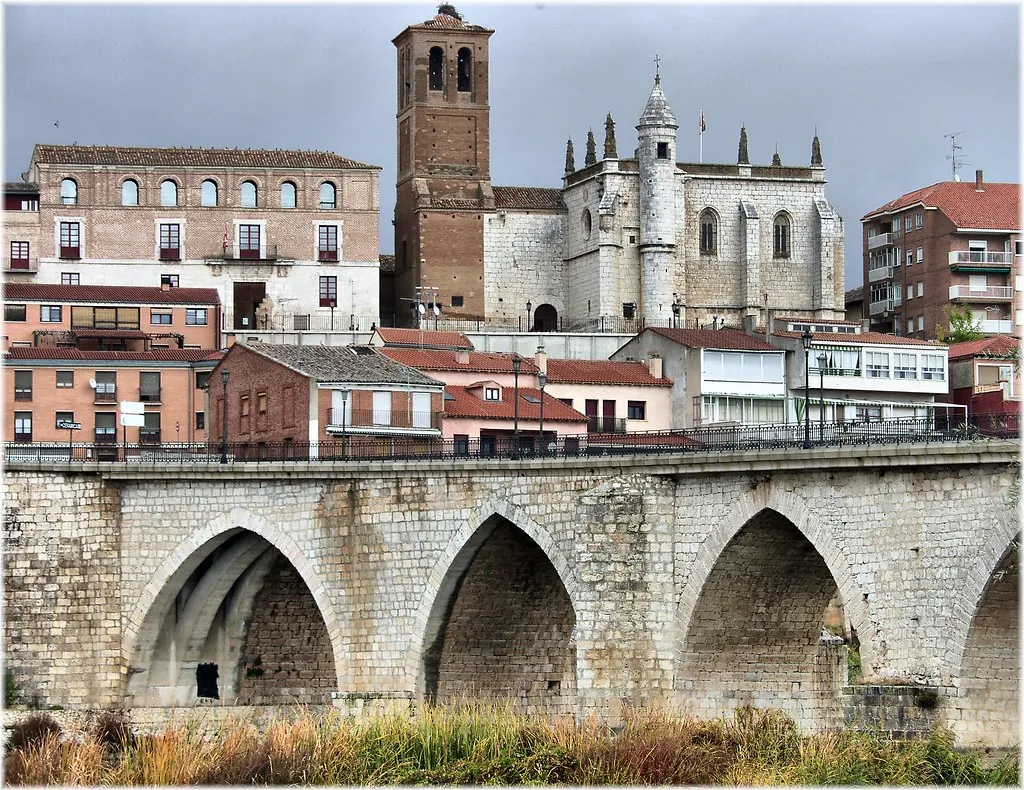
The first light hits the bell tower of San Juan Bautista, turning its stone a pale gold. Down in the square, the only sound is the scrape of a broom on pavement and the distant hum of a tractor already out among the vines. The air is cool, carrying a faint, sweet dustiness from the surrounding fields. This is how the day starts here, quietly, before the sun climbs too high.
Fresno el Viejo sits in the comarca of Tierra del Vino, in Castilla y León. Life for its roughly eight hundred residents moves with the agricultural calendar—pruning, sowing, harvest. You notice it in the worn boots by a doorway, in the slow procession of machinery down a straight street at dusk. The scent in the wind shifts with the season: damp earth after a rare rain, the dry, herbal smell of straw in summer, the dense, sugary aroma of crushed grapes in autumn.
San Juan Bautista and the rhythm of the plaza
The church is an anchor. Its sober, solid mass defines the main square, a space of worn stone benches and geometric shadows. Inside, it feels vast and slightly cool, the light falling on old altarpieces with faces smoothed by time and candle smoke. The space is uncluttered, almost austere.
Visit in the late afternoon. The low sun warms the entire façade, and the plaza begins to stir. Elderly residents take their paseo, stopping to talk in shaded corners. It’s a social hour, slow and unscripted. Check locally for opening times; the door is often locked outside of mass or by request.
The texture of adobe and hidden bodegas
Walk away from the plaza and the streets straighten out, lined with one- and two-storey houses. Many are built from adobe—sun-dried earth bricks—their walls thick and irregular beneath coats of whitewash or ochre paint. You can see where the material has eroded at the base, revealing a texture like compacted sand.
Beneath these quiet homes lies another layer: underground cellars, old bodegas carved into the earth for storing wine. They are private, part of family homes, not museums. You won’t find signs for them. But their presence, hinted at by low ventilation grates in walls or slightly raised cellar doors, is a quiet explanation for everything above ground.
Walking the line between vineyard and sky
The land here opens up abruptly. One minute you’re at the edge of town, the next you’re surrounded by a vast plain of vineyards and cereal fields. The horizon is a long, clean line. With few trees to break it, your attention divides between the neat rows of vines at your feet and the immense dome of sky overhead.
In October, the vine leaves rustle dryly, a mosaic of burgundy and burnt yellow. Come April, the new growth is a sharp, luminous green that seems to vibrate in the light. The dirt tracks between plots are flat and walkable for miles. If you go in July or August, go at dawn or wait until past six in the evening; the midday sun is relentless and shade is scarce.
The harvest: work, not spectacle
By late August or early September, a different energy hums through the area. Heavy trailers piled high with purple grapes rumble down the farm tracks, sometimes leaving a sticky, fermenting trail on the asphalt through town. Men and women move through the rows with shears and buckets, their clothes stained dark at the knees and hands.
It’s not an event put on for show. It’s strenuous, dusty work that starts early and finishes late. Being here during these weeks strips any romantic notion from the name Tierra del Vino; you see it as what it is—the core of a working economy.
Kestrels and quiet observation
The agricultural monotony is alive if you stand still. Look up: a common kestrel will often be hanging on the wind, its wings beating rapidly as it scans the ground below. In migration seasons, large flocks of starlings or lapwings may settle in a fallow field, rising and twisting in unison before settling again.
You don’t need a special route for this. Just pick a track, walk until the village shrinks behind you, and stop. The silence is deep, broken only by bird calls or the whisper of wind through barley.
If your visit coincides with fiesta
The patronal festivities for San Juan Bautista take over the village in late August. For several days, the normal quiet dissolves. The plaza fills with plastic chairs, temporary bars, and music that echoes off the church walls until late. People who moved away return; families spill into the streets.
It’s communal and loud. If that’s not what you’re after, your experience of Fresno will be entirely different during these days. For a sense of its everyday texture, come in May or October instead. The fields are active then too, but the streets belong to the pace of daily life again—a slow walk to buy bread, a conversation in a doorway, the smell of wood smoke as evening falls.