Full Article
about Nava del Rey
Known as the City of Wines; noted for its striking Baroque heritage and its wineries.
Hide article Read full article
A town shaped by vines and plain
Nava del Rey lies in the province of Valladolid, in the area known as Tierra del Vino, literally “Land of Wine”. The town stands on a gentle plain at around 750 metres above sea level, surrounded by vineyards, cereal fields and scattered pine woods. The landscape tells much of its story. Wine is not a recent addition here but part of daily life for centuries, influencing the local economy and even the shape of the town itself.
With just under two thousand inhabitants, Nava del Rey remains one of the more populated settlements in this part of the comarca. During the Early Modern period, when vine cultivation expanded across the south of Valladolid, the town gained importance through wine trading. That period left a visible mark: underground cellars, sizeable religious buildings and a historic centre where arcades and houses built in brick and stone still stand.
Today Nava del Rey also acts as one of the gateways to the wine-producing area linked to the Rueda denomination of origin. For visitors interested in Spanish wine, this places the town firmly within one of Castilla y León’s recognised viticultural zones.
Landmarks and built heritage
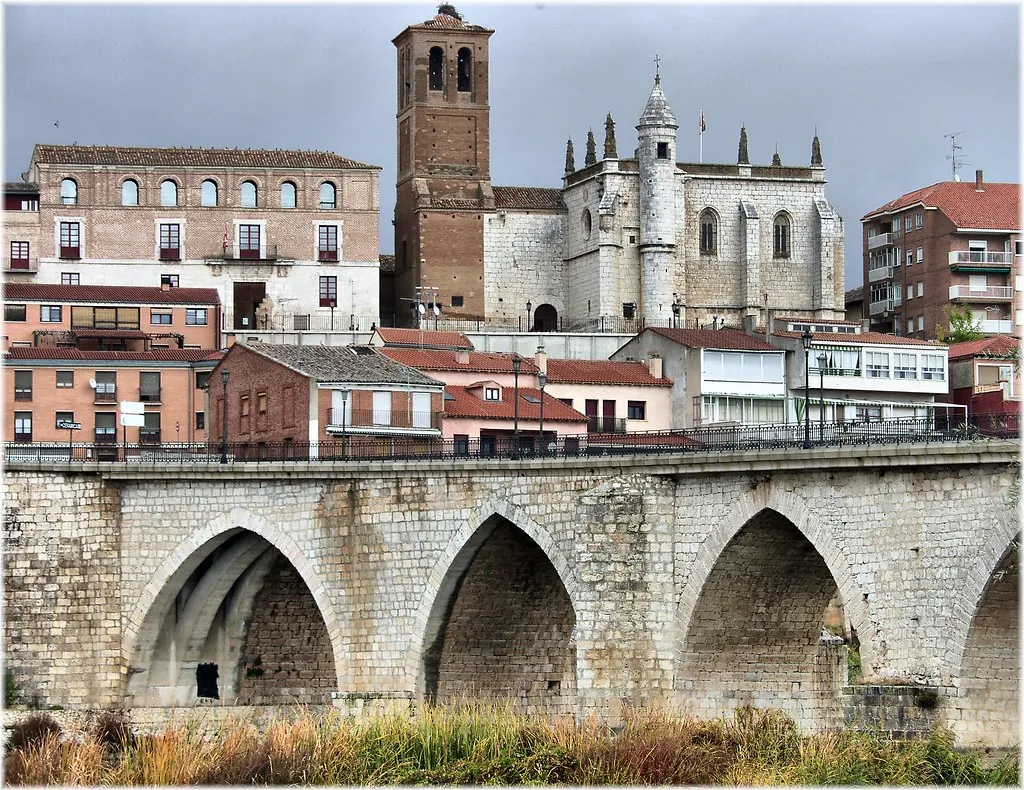
The visual reference point of Nava del Rey is the church of Santos Juanes. Built between the 15th and 16th centuries, it combines Gothic features with later Renaissance alterations. Its tower is clearly visible from the roads leading into the town, a reminder of the importance Nava del Rey once held within the region.
Inside are altarpieces and religious sculpture from different periods. It is not presented as a major museum collection, yet it offers a solid example of traditional Castilian parish heritage, reflecting the artistic and devotional tastes of earlier centuries.
The Plaza Mayor retains its traditional arcaded layout. It is not a monumental square on a grand scale, but it helps explain how public life was organised in towns like this: markets, meetings and celebrations all took place under the shelter of its portales. From the square, several streets branch off where houses still conceal wine cellars dug beneath their floors, a common feature in settlements with a long winemaking tradition.
A short distance from the centre stands the former convent of San Francisco, founded in the 17th century. Over time the complex has served different purposes, yet part of its original architecture survives. On the outskirts of town, the hermitage of Nuestra Señora de Tórtoles is often reached on foot, via a walk through fields and vineyards. The setting is open and expansive, typical of the Meseta, the high central plateau of Spain, and offers a clear sense of the agricultural landscape that frames the municipality.
There is also a small exhibition space devoted to wine, housed in former underground cellars. These galleries, excavated into the earth, were common in the area because they kept a steady temperature and allowed wine to be stored for months. Some continue in private use beneath homes in the historic centre, discreet reminders of how closely domestic architecture and wine production were once linked.
Across vineyards and open plateau
The countryside around Nava del Rey is well suited to walking or cycling. There are no major gradients and the agricultural tracks connect vineyards, cereal plots and patches of pine woodland. These are gentle routes, better suited to unhurried exploration than demanding sport.
Seasonal changes are clearly visible in the fields. In autumn, when vine leaves turn colour, the vineyards create a striking patchwork that can be seen from the paths encircling the town. In summer, the pale tone of harvested cereal and the dust of the tracks dominate the view. The overall impression remains one of space and horizontality, with wide skies typical of inland Castilla y León.
The hermitage of Nuestra Señora de Tórtoles, set beyond the urban core, provides a natural destination for a short walk. Approaching it across farmland gives context to the town’s agricultural character. The relationship between settlement and countryside is direct and easy to grasp, with no abrupt transition between built streets and cultivated land.
Wine and everyday life
Wine continues to shape activity in Nava del Rey. Several wineries operate in the area under the Rueda denomination of origin, which focuses particularly on the verdejo grape variety. In some cases visits or tastings are organised, although it is advisable to check in advance as they are not always open to the public.
Even beyond formal wine tourism, the presence of the vine is tangible. Entrances to old underground cellars appear in certain streets and on the edges of town. Many are privately owned, yet they illustrate how deeply wine production was woven into domestic and economic life.
Outside harvest time and local festivities, daily life follows rhythms that are recognisable in rural Castilla: agriculture, small-scale enterprises and a generally calm pace. The cycle of the vineyard still influences the year, with harvest marking one of its most active moments.
Traditions tied to the agricultural calendar
Patron saint festivities and celebrations connected to the grape harvest bring the greatest movement to Nava del Rey. Traditionally these occasions were closely linked to the agricultural calendar, when work in the fields eased and residents gathered in the streets.
They are not presented as large-scale tourist spectacles but as local celebrations where customs passed down through generations remain visible. The emphasis is on community rather than display, reflecting the town’s size and character.
A practical note for visitors
The urban centre can be explored easily on foot. Distances are short and the layout remains compact, with the Plaza Mayor as a natural starting point. Those interested in wine should pay attention to the entrances of former cellars that appear along certain central streets and around the outskirts. Although many are private, they help explain the extent to which wine culture forms part of Nava del Rey’s history.
In Nava del Rey, the connection between landscape and livelihood is straightforward. Vineyards, cereal fields and brick-built houses are part of the same story. The town does not rely on grand monuments or large-scale attractions. Instead, it offers a clear view of how a community in Tierra del Vino has evolved, shaped by the soil beneath it and the wine stored quietly below ground.