Full Article
about Villalbarba
Town on the Hornija plain; noted for its church and medieval bridge.
Hide article Read full article
A village shaped by land and wind
Tourism in Villalbarba begins with its setting. The village sits in the comarca of Tierra del Vino, in the south-west of the province of Valladolid, within Castilla Leon. It lies across a wide, open plain where cereal fields and vineyards have shared the landscape for centuries. With fewer than one hundred residents, it retains the scale of small agricultural settlements on Spain’s central plateau: short streets, low houses, and a close, practical relationship with the surrounding land that starts almost at the edge of the built-up area.
At around 700 metres above sea level, the terrain offers little shelter from the wind. That exposure has shaped how people built here. Traditional houses tend to have thick walls made of adobe or rammed earth, reinforced with brick at the corners. At the back, enclosed yards or corrales extend the living space into working areas tied to farming life. Many of these buildings are still standing today. Some remain occupied, while others are now empty, reflecting the population decline experienced across much of the region in recent decades.
The overall impression is of a place defined less by individual landmarks and more by its relationship with the land. The horizon is wide, the sky dominates, and the village appears as a small, human-scale interruption in a much larger agricultural setting.
San Miguel and the village core
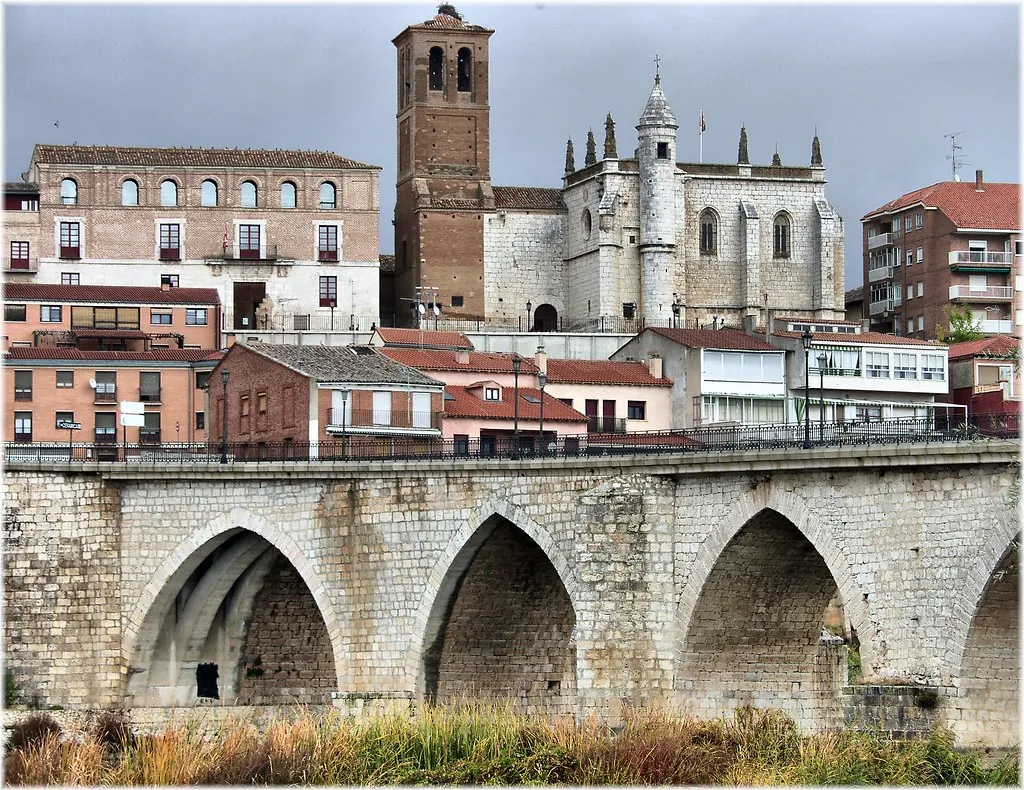
At the centre of Villalbarba stands the church of San Miguel, around which the small network of streets is organised. The building dates back to the 16th century, although like many rural churches it has undergone later modifications. These gradual changes over time are typical, reflecting shifting needs and available resources rather than a single, fixed architectural plan.
Its significance lies less in size than in presence. The tower rises clearly above the surrounding rooftops and can be seen from a distance when approaching along local roads or agricultural tracks. In such flat terrain, vertical elements like this once served a practical purpose, acting as visual reference points for orientation across the open countryside.
The space around the church forms the closest thing Villalbarba has to a centre. Streets converge here, and the scale remains intimate throughout. There are no grand squares or formal layouts, just a compact arrangement shaped by everyday use over generations.
Vineyards and underground cellars
Villalbarba belongs to an area where vineyards have long played an important role, something that remains visible in the surrounding landscape. Among the cereal fields, patches of vines appear, scattered rather than continuous, hinting at a mixed agricultural tradition rather than a single dominant crop.
On the outskirts of the village, entrances to old underground wine cellars can still be seen. These bodegas were dug into the earth, a common practice in Tierra del Vino. Their depth allowed for a stable temperature throughout the year, ideal for storing and preserving wine without modern technology.
Some of these cellars are still in use, while others have fallen out of service. Even when unused, they remain part of the agricultural landscape, quiet traces of how wine production was organised in earlier times. Their presence adds another layer to the relationship between the village and its land, linking what is visible on the surface with what lies beneath it.
Paths across the plain
The area around Villalbarba is crossed by agricultural tracks that connect it with nearby villages. These paths are simple and direct, shaped by practical needs rather than scenic design. The terrain barely changes, so walking here is defined more by distance and exposure than by gradients or technical difficulty.
Seasonal changes are noticeable despite the apparent uniformity of the landscape. In spring, the fields turn green for a short period, softening the otherwise dry tones of the plateau. This phase is brief. As summer approaches, the colours shift back towards the ochres and browns that dominate for much of the year.
During the hotter months, the lack of trees becomes more evident. There is little shade, and the sun falls directly for much of the day. Early starts are the most comfortable option for walking, before the heat intensifies across the open ground.
These routes are not marked as leisure trails in a formal sense, but they offer a way to experience the scale of the plain and the agricultural patterns that define it. Movement through this landscape is steady and uninterrupted, with long sightlines in every direction.
Night over the plateau
After dark, Villalbarba feels markedly different. The village has very little artificial lighting, and its distance from larger urban centres allows the night sky to appear with unusual clarity. On clear nights, the band of the Milky Way is often visible, something increasingly rare in more densely populated areas.
It does not take much effort to find a good vantage point. A short walk along any of the paths leading out of the village is enough to open up the horizon. With no obstacles and minimal light pollution, the sky becomes the dominant feature once again, just as the land does during the day.
This contrast between day and night is one of the defining aspects of the place. By day, attention is drawn outward across fields and tracks. By night, it shifts upward, towards a sky that feels expansive and uninterrupted.
A brief and quiet visit
Villalbarba does not have tourist infrastructure or services designed specifically for visitors. There are no facilities aimed at accommodating stays or organised activities within the village itself. The usual approach is to stay or eat in larger towns within the comarca, or in the city of Valladolid, which is a short drive away.
A visit here is simple and unhurried. The village can be explored in about an hour without rushing. Beyond that, time is best spent walking along the tracks that cross the surrounding plain, taking in the setting rather than seeking out specific attractions.
Villalbarba offers a clear example of rural life on the Castilian plateau, where landscape, architecture and daily activity are closely connected. It is a place that does not present itself through variety or spectacle, but through consistency and scale, shaped by centuries of agriculture and exposure to the elements.