Full Article
about Aldealices
Tiny village in the Tierras Altas, ringed by pasture and untouched nature.
Hide article Read full article
When the noise drops away
Some places feel like a switch being flipped. You are driving along ordinary roads with ordinary traffic, and then everything softens. That is what happens on the way into Aldealices, in the Tierras Altas of Soria. The quiet here is not poetic exaggeration. You notice it as soon as the engine stops.
Just over twenty people live in the village. It shows, though not in a dramatic or melancholy way. It appears in small, everyday details that have become rare: doors closed for much of the year, modest vegetable plots beside the houses, streets where the most constant sound is the wind.
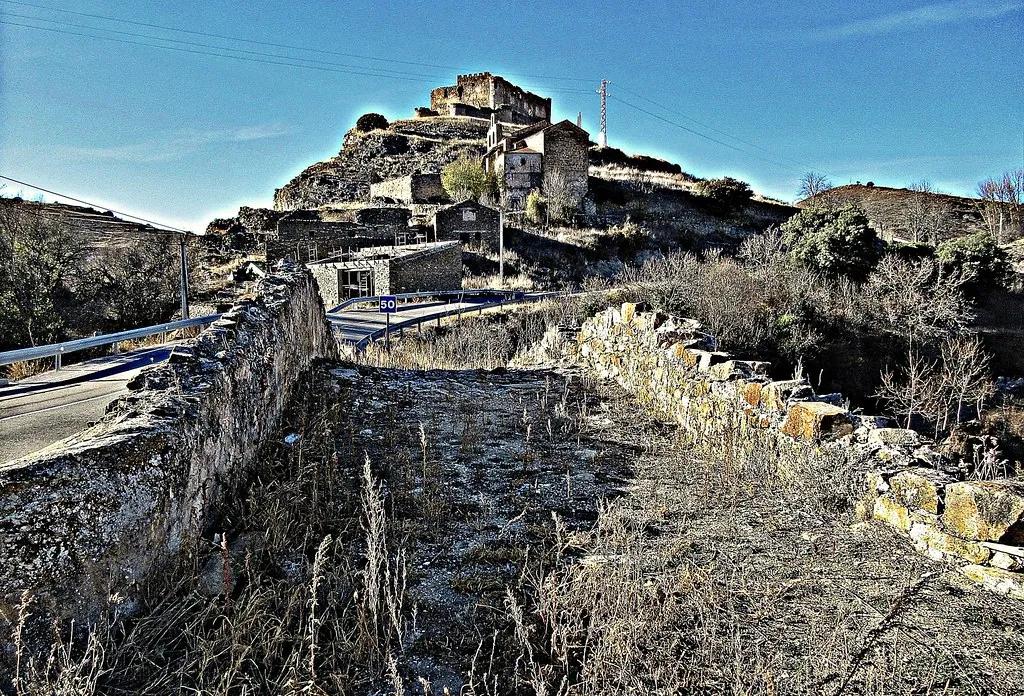
Aldealices sits at just over a thousand metres above sea level. The buildings follow a clear logic. Pale stone, dark wood, simple roofs. There is no attempt to dress the place up as a rural postcard. These are houses built to endure long winters, not to look good in photos.
The shape of the village
You can walk through Aldealices in a short time. There is a main street and a handful of narrow side lanes branching off it. Anyone who has spent time in small villages across Soria will recognise the feeling: thick walls, heavy wooden doors, façades that carry the marks of passing years without trying to hide them.
Some houses are well kept. Others seem to be waiting for someone to return one summer and give them a bit of attention. It is simply part of how the place is.
Walking slowly reveals small details that are easy to miss at first. Stone lintels with old markings, small windows designed to keep out the cold, inner courtyards that can only be glimpsed from the street. Nothing is arranged for display, yet there is a quiet coherence to it all.
San Millán at the centre
The parish church of San Millán stands in the middle of the village and works as a natural point of reference. It is not a grand building. If anything, it is defined by its simplicity.
There is a medieval feel to it, although changes over the centuries are visible. The tower is plain and can be seen from the paths leading into the village. The entrance, with its pointed arch, is the kind of feature you come across almost without noticing.
Inside, there are no widely known artworks or major pieces that draw attention from beyond the area. The church serves a different role. It remains the place around which village life gathers during celebrations, a steady presence rather than a monument.
Walking out into the Tierras Altas
The landscape around Aldealices is open, very open. Cereal fields stretch out towards the horizon, with holm oaks and junipers appearing here and there. It is not the sort of scenery that makes an instant impression in a quick photograph. It works better at a walking pace.
Tracks leave directly from the village and link it with other small settlements in the comarca, a rural district made up of scattered communities. Some sections are marked as footpaths, although the markings are not always easy to follow. It makes sense to carry a map or use an app rather than relying on guesswork.
These routes cross farmland, low rises and the occasional shallow ravine. On days without wind, the dominant sound is simply the dry ground underfoot.
In autumn, many people from the area head into nearby pinewoods to collect wild mushrooms. Níscalos, known in English as saffron milk caps, are especially common, along with cardoon mushrooms when the season is good. For anyone interested, it is worth checking local rules beforehand. In this part of Soria, mushroom gathering is regulated and not something to approach casually.
Eating in the area
There are no bars or restaurants in Aldealices. That is the reality.
Visitors usually eat in a nearby village or bring something with them if they are out walking. Across the comarca, the food remains firmly rooted in inland traditions: roast lamb, homemade cured meats, slow-cooked pulses.
Nothing elaborate, just dishes that tend to come with bread on the side and a sense of practicality shaped by the climate and the land.
Festivities and memory
Local festivities are traditionally held around San Millán, in mid-September. During those days, people with family ties or houses in the village return, and the atmosphere shifts noticeably.
There are religious events, shared meals and long conversations that spill out into the street. It is not a festival designed to draw visitors from afar. It functions more as a reunion.
Among older residents, conversations often return to the traditional pig slaughter, once carried out in winter. It was a central part of rural life, providing food for months ahead. Today it is much less common, but it still forms part of the village’s shared memory.
Getting there and what remains
Reaching Aldealices is most practical by car. The Tierras Altas is a wide area, and its villages are spread far apart.
Secondary roads cut across open countryside, and in some stretches there is very little signage. It is worth checking the route in advance and not leaving fuel too low. The journey itself reflects the landscape you are heading into: broad, quiet, and without many interruptions.
What you find at the end is something increasingly uncommon. A small village that does not try to present itself in any particular way. Aldealices continues at its own pace, with a handful of inhabited houses and a great deal of open land around them. Sometimes that is exactly what draws people in, even if they did not set out looking for it.