Full Article
about Aldealseñor
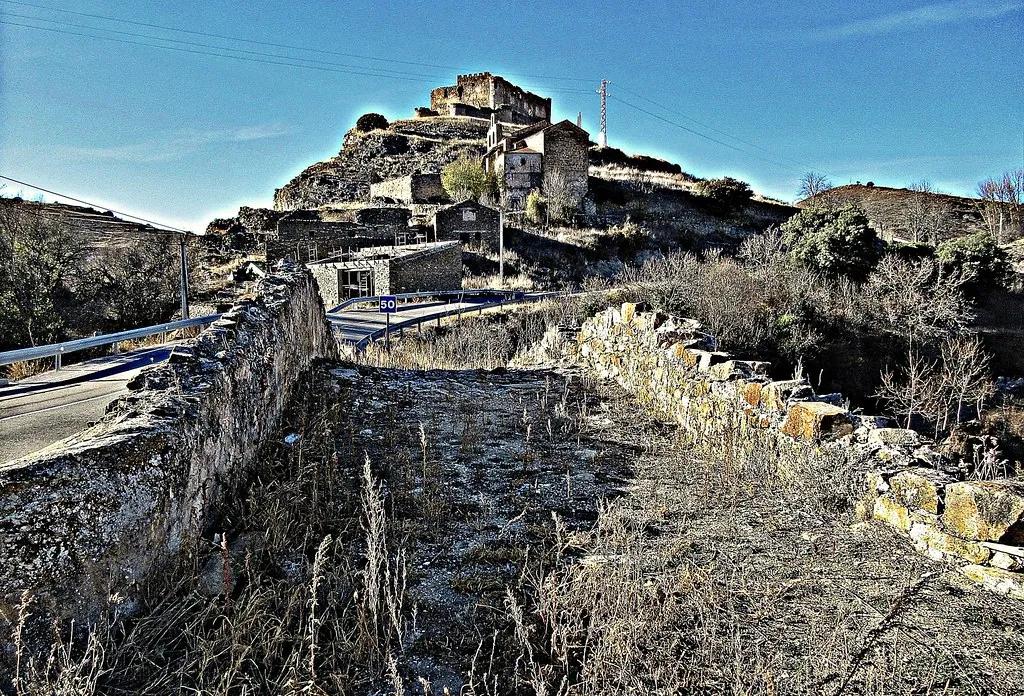
A noble village with a well-preserved fortified house and traditional stone architecture.
Ocultar artículo Leer artículo completo
The thermometer reads minus twelve when the morning flight from Stansted touches down in Zaragoza. Two hours later, after winding through roads that climb steadily through pine plantations and sudden vistas of cereal plains, Aldealseñor appears: twenty-five houses, a church tower, and a single paved street that stops dead at the cemetery wall. This is Spain's España vacía—the emptied Spain—at its most literal.
At 1,088 metres, the village sits high enough that ears pop on the final approach from the A-15. The altitude isn't just a number. It means winter starts in October and lingers past Easter, turning the surrounding fields into a monochrome study of whites and greys that would feel at home in a Northumberland landscape. Summer brings relief but never humidity; nights remain cool even when midday temperatures touch thirty. The air thins noticeably on the short climb from the church to the upper houses, enough to make smokers regret the last packet bought at the airport.
Stone, Adobe, and the Sound of Wind
Architecture here is defensive by necessity. Walls are stone to shoulder height, then adobe above, thick enough to buffer the cierzo—the northwest wind that can drive temperatures down by ten degrees in an hour. Wooden doors are small and deeply recessed, their ironwork hammered by hand. Most still carry the original metal studs, not decorative but functional: the only things preventing warping in the dry summers and damp winters. One house on the western edge has a datestone reading 1789, the year of the French Revolution, though here the only revolution has been the slow exodus of families to Soria city, then Madrid, then London cleaning jobs and Manchester warehouses.
The church of San Pedro sits at the physical centre but functions as the temporal one too. Its bell still marks the hours, though the priest comes only twice monthly from the regional capital, 47 kilometres away. Inside, the single nave is barren by English parish standards—no embroidered hassocks, no Victorian stained glass—but the walls retain a faint smell of beeswax and woodsmoke that no Anglican incense has ever matched. The door is locked outside service times; ask at the third house on the left where María keeps the key underneath a flowerpot that contains more cigarette butts than soil.
Walking the village takes twelve minutes at dawdling pace, less if the wind is up. There are no cafés, no souvenir shops, no interpretation boards with cartoon sheep. The only commercial activity is a metal workshop whose owner doubles as the unofficial mayor, postman, and emergency breakdown service. He opens when he feels like it, which is rarely before eleven and never after the bodega next door runs out of estrella.
Walking the Sky's Edge
The real reason to come lies outside the village limits. A farm track heading southeast drops gently through wheat stubble before climbing to a ridge that offers views across four provinces. On a clear day—common here, as the altitude sits above most coastal cloud—you can pick out the Pyrenees floating like a mirage on the northern horizon. The path is unsigned, marked only by tractor ruts and the occasional stone pile. Navigation is simple: keep the village water tower at your back and don't cross the drystone walls that separate fields. In April the verges are thick with wild tulips the colour of dried blood; by July everything has burned to gold except the encinas—holm oaks—whose dark green provides the only shade for miles.
Winter walking is possible but demands respect. Snow can arrive overnight in late October and stay until March. The same track becomes a ribbon of packed ice where boot prints freeze solid and create a natural crampon test. Even in April, morning frost whitens the grass until ten o'clock. The compensation is silence so complete that the click of a camera shutter feels intrusive, and the low sun turns every stone wall into a strip of LED lighting.
Birdlife favours the patient. Calandra larks rise in song flights above the cereal, their liquid trills carrying further in thin air. Red-legged partridge explode from roadside cover with a whirr that stops hearts until identification kicks in. At dusk, stone curlew call from the fallow fields—a sound like fingernails dragged down glass. Bring binoculars and a flask; there are no hides, no RSPB car parks, just the hedgeless plain and whatever chooses to reveal itself.
What to Eat When Nothing is Open
Food requires planning. The village itself offers zero hospitality, not even a vending machine. The nearest bar is six kilometres away in Lituénigo, a hamlet whose own population struggles into double figures. There, Casa Félix opens Thursday to Sunday and serves migas—fried breadcrumbs with garlic and chorizo—so substantial that lunch doubles as ballast against afternoon winds. A plate costs €8, wine included, but they close when the bread runs out, usually around three.
Self-catering is safer. Stock up in Soria before the final climb: queso de oveja from the Saturday market (€14 a kilo, wrapped in waxed paper that later makes excellent firelighters), chuletón beef steaks thick enough to feed two, and tins of white beans labelled Alubia de La Bañeza. Most village houses available for rent have wood-burning stoves whose chimneys draw fiercely; a steak takes four minutes a side and tastes of oak smoke and high pasture.
Water straight from the tap carries a faint metallic tang—perfectly safe, just different. Beer drinkers should note that estrella galicia is considered exotic here; the default is mahou served at cellar temperature because the ambient kitchen rarely climbs above sixteen degrees.
August Reversal, Winter Truth
For eleven months Aldealseñor sleeps. Then August arrives and the population swells to perhaps eighty as grandchildren appear, hired cars loaded with London school uniforms and Spanish SIM cards bought at the airport. The church holds its annual fiesta: mass at noon, followed by a comida under plane trees in the square opposite. Long tables appear from nowhere; cordero asado (whole roast lamb) is served on chipped plates that someone's grandmother brought from Zaragoza in 1962. Visitors are welcome but not announced—pull up a chair, bring your own wine, and prepare to answer questions about Brexit in Spanish that mixes Madrileño vowels with Yorkshire consonants.
By the twentieth the exodus begins. Cases are packed, goodbyes said, and the village settles back into its default rhythm of wind and footfall. The first frost usually arrives before September ends, glazing the windscreens of the few cars that remain. By November the road from the main highway can ice over for days; locals keep chains in the boot and regard the BBC weather app as charmingly naive.
Getting There, Getting Out
No trains reach this high. The closest railhead is Soria city, itself a three-hour coach ride from Madrid's Estación Sur. Hire cars there—book ahead, as fleets are small and staff lunch breaks are sacred. The final 47 kilometres take fifty minutes on the SO-820, a road so empty that oncoming traffic merits a wave. Petrol stations accept UK cards without issue; toilets require a strong stomach and 50-cent pieces.
Accommodation is scattered farmhouses converted by owners who escaped to Zaragoza but couldn't quite sell up. Expect stone floors, wood fires, and Wi-Fi that functions when the wind blows from the south. Prices hover around €80 per night for two, minimum stay usually three nights. The best option is Casa del Cura, whose bathroom underfloor heating feels like decadence after a day walking the ridge.
Leave time for the return descent. The road drops 600 metres in twenty minutes; ears pop again and the temperature rises by eight degrees. Somewhere around the 800-metre contour the first bar appears, then another, then the cereal plains give way to irrigated fruit and the whole harsh upland begins to feel like a hallucination. It isn't. It's simply Spain minus the gloss, served straight at altitude, and it lingers in the memory longer than any cathedral queue or tapas tour ever manages.