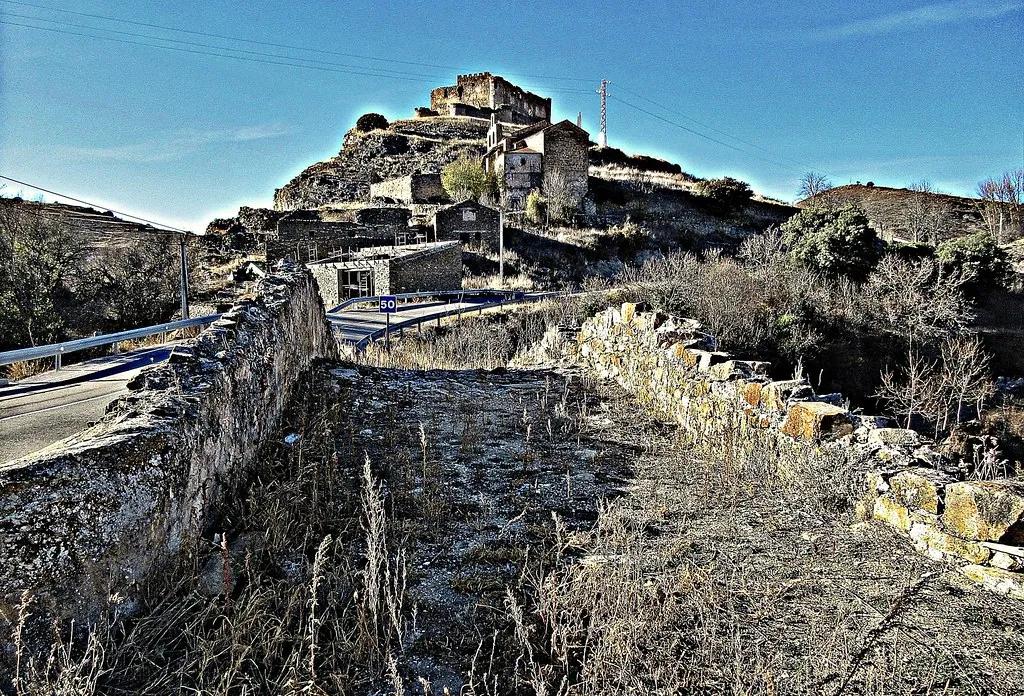
Full Article
about Arévalo de la Sierra
Mountain municipality known for the Acebal de Garagüeta, one of Europe’s largest holly groves.
Hide article Read full article
A small village in the highlands
Arévalo de la Sierra sits at 1,209 metres above sea level, in the Tierras Altas area of the province of Soria, part of Castilla y León. With just 71 registered residents, it remains very close in form and rhythm to what it was decades ago: a small agricultural and livestock-based settlement surrounded by woodland and pasture, far from the province’s more travelled routes.
The village is spread across gentle rises, set among meadows and patches of pine and rebollo oak. For centuries, this landscape was not just scenery but a working resource. Timber, grazing land and firewood all came from these surroundings. Today, parts of the woodland are still used for livestock, and also for seasonal mushroom gathering, an activity that continues to shape local routines.
Dirt tracks and forest paths lead out from the village, connecting it with other settlements in the comarca. Many follow old routes once used for moving animals between grazing areas. These paths still define how the territory is understood and crossed.
The church and the village centre
At the centre of Arévalo de la Sierra stands the parish church dedicated to San Juan Bautista. Its origins appear to date back to the 16th century, although later alterations have modified the building over time. It is a restrained structure, built in stone, in keeping with the architectural character of this part of Soria.
The bell gable rising above the façade acts as a visual marker, visible from different points around the village and its surroundings. Inside, several modest Baroque altarpieces are preserved. Their scale reflects the reality of rural parishes, where upkeep depended more on the effort of the local community than on wealthy patrons.
The church’s importance lies less in artistic detail and more in its role within village life. For a long period, it was the place where collective life was organised, from religious celebrations to meetings among residents.
Streets and traditional architecture
Arévalo de la Sierra is organised around a small number of main streets, including Calle Mayor and Calle Real. The houses follow the typical pattern of rural Sorian architecture: masonry walls, pitched roofs covered with traditional curved tiles, and large doorways designed to allow carts or livestock to pass through.
Some façades feature carved stone coats of arms, while others have wooden balconies added in later periods. These small details offer clues to how homes evolved over time, expanding or adapting as family needs changed.
The village itself is compact and can be explored without difficulty. Even so, it rewards a slower pace. Attention naturally shifts to interior courtyards, to dry stone walls on the outskirts, and to the small open spaces that appear between the streets.
The landscape of Tierras Altas
The surrounding landscape helps explain much about the village’s character. Nearby hills combine pine forests and rebollo oak, with open grazing areas in between. The terrain is not steep or dramatic. Instead, it is defined by soft hills and shallow valleys that fold into one another.
Autumn brings a noticeable change, as these woods attract mushroom pickers, reflecting a tradition that runs across the province. Anyone interested in collecting mushrooms needs to be aware of local regulations, which can vary depending on the woodland area, and to recognise species correctly before gathering them.
Traditional paths make it possible to walk towards neighbouring villages, although not all are signposted. In some stretches, mobile coverage can be unreliable, so it is sensible to have a map or a downloaded route prepared in advance.
Wildlife is part of the experience of moving through this landscape. Roe deer are relatively easy to spot, and during the rutting season it is common to hear red deer. Birds of prey are also a regular presence in these open environments.
Festivals and local life
The most attended celebrations take place in summer, when many families who live elsewhere during the year return to Arévalo de la Sierra. At that time, festivities are held in honour of San Juan Bautista, including a mass, a procession and gatherings in the village square.
These are simple events, closely tied to the community itself. There are no large-scale facilities or extensive programmes, but the atmosphere reflects how villages in the comarca once functioned when the population was higher.
Other celebrations continue throughout the year, often linked to the religious or agricultural calendar. These tend to revolve around small chapels or informal gatherings among neighbours, maintaining a rhythm that follows seasonal cycles.
When to go
Spring and autumn are generally the most pleasant times to explore the area. In spring, the meadows fill with vegetation and the weather is mild. In autumn, the woodland shifts in colour and the mushroom season begins.
Winter can be harsh in this part of Soria. Snowfall is not unusual, and temperatures drop easily, forming part of the usual pattern of life in these highlands.