Full Article
about Carrascosa de la Sierra
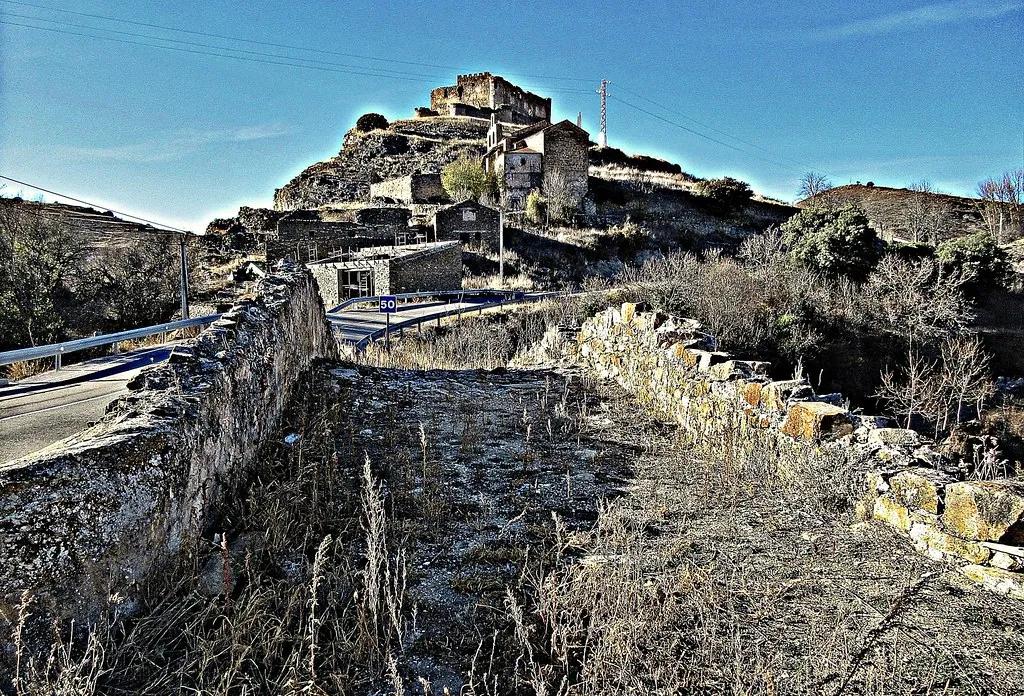
Mountain village with stone architecture and high-meadow surroundings
Hide article Read full article
A village that keeps its own pace
By mid-morning, on one of the unpaved streets that cut across the small square, the light falls directly onto the stone. There is almost no shade, apart from a short roof overhang. The air carries the smell of old firewood and damp earth, as if the ground had just been turned. Tourism in Carrascosa de la Sierra often begins like this: with the sense of having arrived somewhere that moves at its own rhythm, largely detached from whatever is happening elsewhere.
Set in the Tierras Altas of Soria, Carrascosa has barely twenty residents for much of the year. On weekdays, it is easy to walk for several minutes without seeing anyone. The houses, built with thick stone walls and curved roof tiles, follow the practical logic of places shaped by a harsh climate. There are few windows, wide gates once used for livestock, and inner courtyards where tools or firewood were kept.
Stone houses and the quiet church
The centre of the village is defined more by habit than by size. Here stands the church of San Pedro, a simple stone building that is likely several centuries old. In many villages in this part of Spain, current parish churches were built between the 16th and 17th centuries, and this one fits that pattern. It draws attention not through decoration but through its steady presence, as if it has always been there marking the passing of time.
Around it, small details reveal how life has been organised here. Heavy iron fittings on doors, low dry-stone pens, barns with sloping roofs and very small windows. Nothing appears designed with visitors in mind. Everything reflects long winters, snow and wind.
Walking out into the pinewoods
Leave the village by any of the streets that lead away from the centre and dirt tracks appear almost immediately. There are no tourist signs. These are agricultural and livestock paths, known by heart by the people who live here.
The pinewoods begin quickly. The ground is usually covered in dry needles, which give off a soft crunch underfoot that follows the whole walk. Between the trees, there are occasional clearings with old plots of land and the odd small vegetable garden still in use. Moving slowly makes it easier to notice signs of wildlife: tracks in the mud, fresh droppings, or the sudden movement of a roe deer slipping back into the forest.
Towards evening, the landscape shifts. The light lowers and turns warmer, catching in the tops of the pines and along the stone walls of the village. It is one of the quietest moments of the day.
Mushrooms, open land and long horizons
In autumn, many people come to these woods for mushrooms. The pine forests of the Tierras Altas often produce níscalos and other species, although each season varies and it helps to know what is being collected. During these months, it is not unusual to see cars parked along forest tracks.
From some of the nearby higher ground, the terrain opens out into gentle valleys. There are no high mountains, but the horizon stretches a long way, with low ranges visible in the distance. Among the pines, patches of grassland appear where livestock still graze.
Before you go
Carrascosa de la Sierra is a very small village with no services. There are no shops, bars or places to stay within the village itself, so anyone planning to spend several hours there should bring water and something to eat.
The road reaches the village without difficulty, although the final stretch crosses a sparsely populated area. It is better not to rely entirely on a mobile phone for navigation. A downloaded map or a car GPS can be useful.
Anyone looking for activity or a busy weekend atmosphere will not find it here. The usual sounds are the wind, a distant dog, and occasionally the slow engine of a tractor passing along the main street. That is the scale on which Carrascosa operates: a small place, without embellishment, where landscape and silence take up most of the space.