Full Article
about Castilfrío de la Sierra
Noted for its Celtiberian hillfort and noble stone architecture
Hide article Read full article
Morning Light in the Tierras Altas
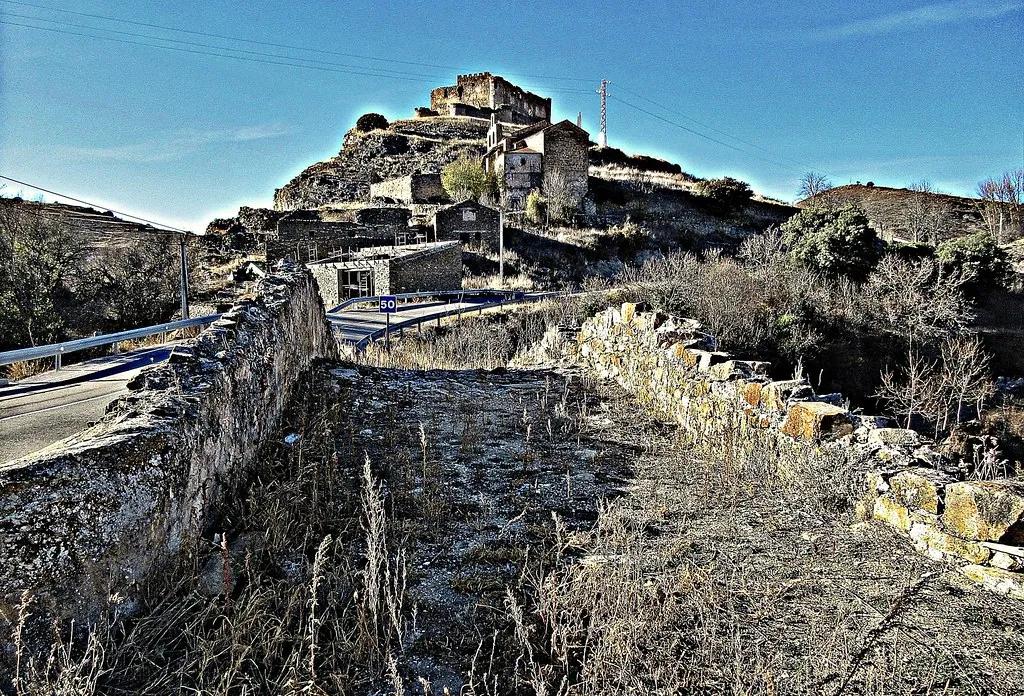
Early in the morning, before the sun has cleared the line of mountains, Castilfrío de la Sierra is almost silent. A dog barks somewhere in the distance, wind brushes through the pines, a wooden door closes with a dull thud. The houses, built of thick stone with dark roofs, stand close together at more than 1,200 metres above sea level.
Winter tends to linger here. Snow can cling to verges and shaded corners for days at a time. In summer the contrast is sharp: dry air, the scent of resin rising from the surrounding pinewoods. With around 35 residents, Castilfrío de la Sierra is part of the Tierras Altas region in the north of Soria province, in Castilla y León. Life remains closely tied to the hills and to livestock, and that shapes the rhythm of the village. Tractors pass slowly along narrow streets, animal pens sit beside family homes, and stacks of firewood lean against walls in readiness for the cold.
There is little hurry. Daily life follows the weather and the seasons rather than the clock.
Granite, Timber and a Church at the Centre
The architecture does not try to impress. Houses are solid and practical, built from local granite, with dark wooden balconies and roofs designed to withstand wind and snow. Many properties include annexes that once sheltered animals or stored hay. In some cases, old barns and wood stores are still visible, reminders of a way of life that has not entirely disappeared.
At the heart of the village stands the church of San Pedro. The current building appears to date from the late Middle Ages or the early modern period, which is typical for settlements in this part of Soria. Over time it has undergone several alterations. Its simple stone façade blends in with the neighbouring houses rather than dominating them.
When the church opens, usually during specific festivals or celebrations, the interior reveals altarpieces and religious images that have been part of local life for generations. These are not museum pieces but objects of ongoing meaning for a small community that gathers there at key moments of the year.
The overall impression is one of continuity. Nothing feels designed for display. Buildings, like the people who live among them, are adapted to climate and necessity.
Forest Tracks and Open Hills
The landscape around Castilfrío de la Sierra is both open and austere. Pine forests alternate with pasture and rounded hills that change character with the seasons. In spring the ground is covered with fresh grass and small wildflowers. By autumn the pinewoods carry the scent of damp earth and fallen needles.
There is no extensive network of signposted walking trails as you might find in more frequented destinations. Most outings involve following forest tracks or old livestock paths that leave the village and gradually disappear into the hills. Anyone planning a longer walk should take a map or GPS. On certain days fog can roll in quickly, flattening the landscape into a series of similar shapes and making orientation more difficult.
Winter brings its own considerations. Snow can cover tracks and access roads, and it is not unusual for some routes to remain impassable for several days. Conditions change rapidly at this altitude.
Yet for those prepared for its simplicity, the setting offers space and quiet in generous measure. The horizon stretches wide, and the absence of noise becomes one of the defining features of a visit.
Autumn Mushrooms in the Pinewoods
With the arrival of autumn rains, the pine forests of the Tierras Altas begin to fill with people carrying baskets. This is mushroom season. Níscalos, known in English as saffron milk caps, boletus and other species appear when humidity levels are right. For many local residents, heading into the woods to gather fungi is a long-standing practice, carried out with knowledge of the terrain and respect for what is collected.
In several parts of Soria province, mushroom picking is regulated. It is advisable to check the current rules before entering the forest and to avoid taking more than permitted. The activity is taken seriously, both as a tradition and as a resource that needs careful management.
Even for those who do not plan to forage, autumn brings a noticeable shift. Cars appear along forest tracks, conversations turn to rainfall and soil conditions, and baskets are examined with quiet concentration.
A Year Marked by Summer and Winter
The village calendar is simple and closely tied to its residents. Festivities are usually held in summer, when those who have family homes here return from elsewhere. During these weeks Castilfrío de la Sierra changes pace. There are more people in the streets, long tables set up outdoors, and conversations that continue late into the night.
These gatherings are as much about reunion as celebration. For a place with such a small year-round population, summer brings a temporary expansion of voices and activity.
Winter tells a different story. Life becomes markedly quieter. Some families still maintain customs such as the matanza del cerdo, the traditional pig slaughter that takes place when the cold sets in. It is a long day combining work and social gathering among neighbours, rooted in the practical need to prepare and preserve meat for the months ahead.
The contrast between seasons is pronounced. Summer extends the village outward; winter draws it back in.
Before You Set Off
Castilfrío de la Sierra is small and relatively isolated. There are very few services, so it makes sense to arrive with what you need if you intend to spend several hours in the area.
Access is via secondary roads that cross the Tierras Altas. They are quiet, with little traffic, but in winter patches of ice or snow can appear in shaded stretches. Checking the weather forecast before heading up is sensible, particularly in the colder months.
In return, what you find is increasingly rare: genuine silence, very dark night skies, and a landscape that shifts slowly from one season to the next. Time does not seem to move quickly here. That, more than any single sight, defines Castilfrío de la Sierra.