Full Article
about Cigudosa
Village with milder weather thanks to its lower altitude in the Alhama valley
Hide article Read full article
A Village Where Time Moves Differently
There are villages you enter and immediately think: more people live here in summer than in winter. Cigudosa, in the Tierras Altas area of Soria province, is one of them. It has very few registered residents, around fifteen, and that shows in the quiet streets, the short distances and the feeling that everything happens more slowly here than almost anywhere else.
This is not a place you reach by accident. Most visitors arrive after a long stretch on secondary roads, the kind where you start seeing more sky than cars. When the cluster of houses finally comes into view, the impression is clear: this is Soria at its most sparsely populated, without embellishment.
Stone Houses and a Modest Church
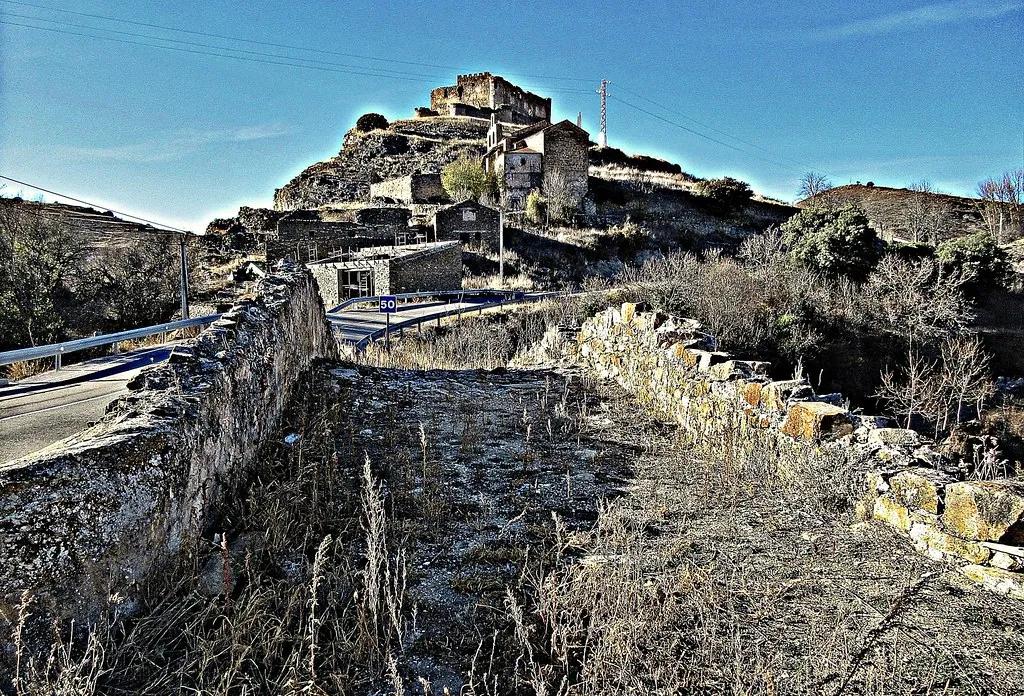
Cigudosa can be explored in very little time. The houses are built of stone, many repaired just enough to keep standing, others waiting for family members to return in summer. You will also notice fibre cement roofs and old animal pens attached to homes, something common in this part of the province and a reminder of how closely domestic and agricultural life were once linked.
The church of San Pedro stands almost in the centre of the village. It is a simple building, one that has served its purpose for centuries without drawing much attention to itself. The tower acts as a reference point when walking along the surrounding tracks. According to locals, the bells still ring at certain times of the year, although religious activity is no longer what it once was.
There is no grand architecture here, no decorative façades competing for attention. The layout is practical, shaped by weather, work and the needs of a small rural community.
Fields Without End in Tierras Altas
The landscape around Cigudosa is direct and unadorned. Cereal fields stretch out in several directions, broken by gentle hills and agricultural tracks that lead away from the village. It is the kind of terrain where you can set off without overthinking the route: choose a path and follow it.
In spring the green does not last long, but it is welcome while it does. By summer everything turns golden and the wind moves freely across open ground. Griffon vultures can sometimes be seen riding the thermals, or a kestrel hovering in mid-air as if suspended by an invisible thread.
Scattered around the outskirts are old haylofts, barns known locally as tenadas, and low stone walls that once marked small plots of land. These details tell the story of how life functioned here for generations, closely tied to farming and livestock. Even if many of those structures are no longer in regular use, they remain part of the landscape and the memory of the place.
Everyday Life with Fourteen Residents
With such a small population, Cigudosa does not operate as a conventional tourist destination. There are no accommodation options or restaurants, and you are unlikely to find shops open. Daily life depends largely on nearby villages in the comarca, where residents go for shopping and administrative tasks.
For much of the year, the village is defined by its stillness. Then summer arrives and the atmosphere shifts. Families with roots in Cigudosa return for a few weeks. Houses that have been closed for months are opened up, cars appear where there are usually none, and conversations resume on doorsteps and in the street.
The cooking associated with the village reflects traditional food from this part of Castilla y León. Substantial stews, pulses, game when available, and roasts prepared for family gatherings rather than in restaurants. It is food rooted in agriculture and the seasons, shaped by what the land provides.
With only around fourteen inhabitants for much of the year, routines are necessarily simple. The rhythm of life is marked more by weather and agricultural cycles than by events or timetables.
August: When the Village Fills Again
The patron saint festivities are usually held in August, when many of those with family ties to Cigudosa return for a few days. It is not a large-scale event designed to attract outsiders. It functions more as a reunion.
Preparations often involve opening and tidying houses that have stood empty, catching up in the street, and playing cards or dominoes in the shade. The atmosphere is informal and familiar rather than organised around a packed programme.
Processions and religious acts still take place, though in a discreet tone. In this part of Tierras Altas, celebrations tend to feel more like neighbourhood gatherings than public spectacles. The emphasis is on meeting again, sharing time and keeping certain traditions alive, even if the numbers are small.
Reaching Cigudosa
From the city of Soria, the journey takes roughly a little over an hour by car, depending on the route chosen. The final stretch is usually along quiet regional roads that cross open fields and pass through very small villages.
Again, this is not somewhere you stumble upon. You come because you are exploring Tierras Altas or because you are interested in seeing up close what these almost empty villages are like.
The drive itself becomes part of the experience. Traffic thins out, the horizon widens and the sense of isolation grows gradually rather than all at once.
Is It Worth the Detour?
Cigudosa is not a place you visit in order to tick off sights. If you are expecting monuments, museums or organised activities, you may leave with the feeling that nothing happens here.
Yet if you are curious about the most depopulated side of Soria, villages with fewer than twenty residents, agricultural tracks and genuine silence, then stopping for a while makes sense. A short walk, a look at the horizon filled with fields, the church tower of San Pedro as a point of reference, and the wind moving across Tierras Altas.
For a moment, the pace is noticeably different from that of any city. In a province often associated with depopulation, Cigudosa shows what that reality looks like on the ground: small, quiet and shaped by those who return each summer to keep it alive. Sometimes, that is reason enough to pause.