Full Article
about Estepa de San Juan
One of Spain’s smallest villages deep in the sierra
Hide article Read full article
A Village That Appears Almost by Accident
There are places you drive into without quite realising, glance at the sign and wonder, “Do people really live here?” Estepa de San Juan, in the Tierras Altas of Soria, is one of them. The road seems to head nowhere in particular and then, without ceremony, the village appears. Small. Quiet. The kind of place where life slowed down decades ago and never felt the need to speed up again.
Only a handful of people live here year round, and that becomes obvious the moment you step out of the car. There is no traffic, no shop windows, none of the constant background noise that fills daily life elsewhere. What you do find are stone and adobe houses, farmyards, and large wooden gates built to store machinery or livestock. Some homes are still occupied. Others stand closed or partly collapsed, a common sight in this part of Soria where the population gradually moved away over the years.
Estepa de San Juan sits within what Spaniards often call “la Soria despoblada”, the sparsely populated interior of the province. Visiting is less about ticking off sights and more about understanding what rural life looks like in areas that have seen decades of decline.
The Church That Anchors the Village
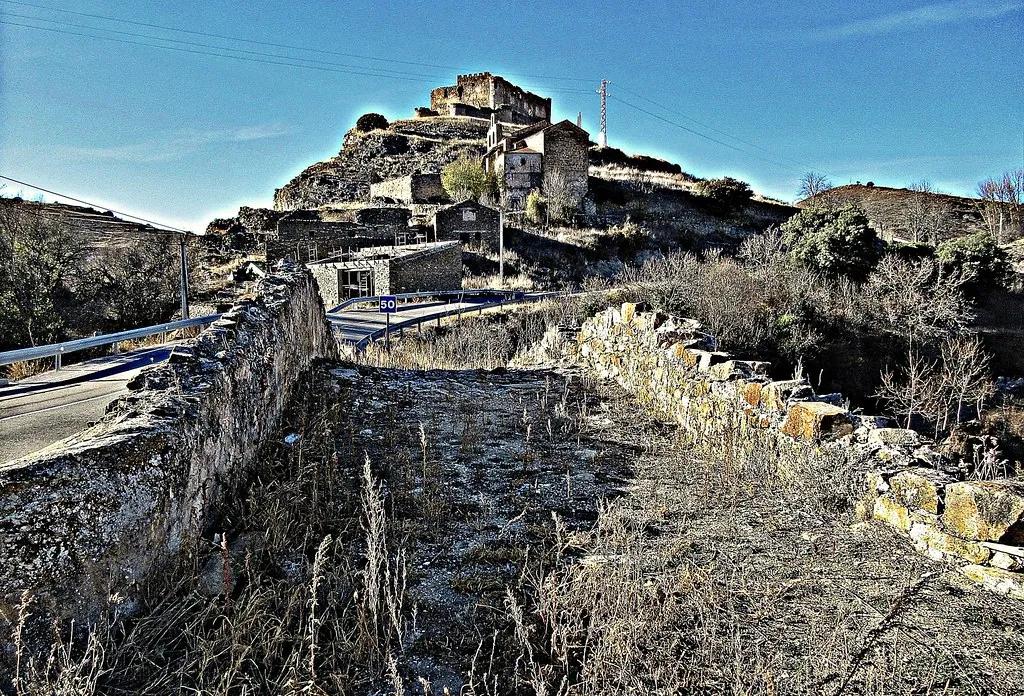
The Iglesia de San Juan Bautista is the building that draws the eye as you arrive. It is not monumental, nor heavily decorated, but it serves a familiar purpose in small Spanish villages: it provides orientation. Spot the tower and you know where the square is, or what functions as the centre. From that point, the layout makes sense.
The church follows the sober lines typical of rural architecture in Soria. Stone walls, simple forms, and the appearance of a building that has watched generations pass without dramatic alteration. It does not dominate through grandeur. Instead, it quietly anchors the settlement.
Around it, the village streets remain understated. There are no grand façades or elaborate civic buildings. The rhythm is agricultural, practical, shaped by the needs of work rather than display.
The Landscape of the Tierras Altas
What truly defines Estepa de San Juan lies beyond its houses. The Tierras Altas de Soria have a distinctive character: wide horizons and gently rolling hills. Space is the key feature here, and it stretches in every direction.
For anyone arriving from a large city, the contrast can feel abrupt. Look around and there are fields, low scrub and farm tracks fading into the distance. The wind is often a main presence in this region. When it blows hard, it makes itself known immediately, cutting across the open land with nothing much to slow it down.
The landscape changes with the seasons. In spring and early summer, small flowers appear between stones, aromatic shrubs release their scent and the fields briefly take on a greener tone. That colour does not last long. As the season advances, the plateau returns to its drier hues, the palette shifting back to browns and muted shades typical of high, inland terrain.
There are no dramatic cliffs or dense forests here. The appeal rests in the scale of the open land and the clarity of the views. It is a setting that encourages you to lift your gaze rather than focus on individual landmarks.
Walking the Traditional Tracks
Do not expect signposted routes every few kilometres. In Estepa de San Juan, the paths are the ones that have always been there: dirt tracks used for farming and moving livestock. They were not designed with tourism in mind.
That does not mean you cannot explore on foot. Quite the opposite. Walking here is straightforward. You follow a track, take your time and pay attention to what surrounds you. Birds of prey sometimes circle above the fields. With a bit of luck, and if you keep quiet, a roe deer may move through the scrub.
A map or a mobile app can help, especially if you are unfamiliar with the area. And if you happen to see a local resident out on the street, asking for directions remains surprisingly effective. In places this small, local knowledge still matters.
There are no marked viewpoints or interpretation panels. The experience is direct. Earth underfoot, wind in the air, and long views that change subtly as you walk.
Night Skies Without Glare
After dark, something else becomes apparent. Look up and the sky over this part of Soria explains why so many people mention it. The absence of artificial light allows the stars to appear with a clarity that is no longer common.
Even in summer, the temperature drops noticeably once the sun goes down. Warm days can give way to cool evenings, so an extra layer is advisable. The shift from daylight to night feels pronounced in a place where there are no streetlights competing with the sky.
For travellers used to urban glow, the difference stands out immediately. The darkness is real, and with it comes a sharper view of the constellations.
A Village With No Services
Estepa de San Juan is extremely small and has no bars, shops or restaurants. It is important to bear that in mind before visiting. The usual approach is to head to other villages in the comarca for meals or supplies.
This arrangement is not unusual in the Tierras Altas. Many settlements here function in the same way: small, quiet, connected to one another by road. Each plays a part in a wider rural network rather than operating as a self-contained destination.
There is no tourist infrastructure waiting at the entrance. No visitor centre, no queue, no timetable. The simplicity is part of the reality of the place.
Is It Worth the Detour?
Estepa de San Juan is not somewhere to come in search of major monuments or a long list of attractions. It is better understood as a snapshot of life in one of the least populated corners of Soria.
For those interested in inland Castile at its most sparsely settled, with minimal villages, open landscapes and real silence, stopping here makes sense. A short walk through the streets, a glance towards the horizon, and within less than an hour you have a clear idea of where you are.
In a village like this, that clarity is enough.