Full Article
about Las Aldehuelas
Mountain municipality in the heart of the Tierras Altas with highland architecture and a cool climate
Hide article Read full article
A Quiet Arrival in the Highlands
Early in the morning, Las Aldehuelas makes very little sound. A door closes somewhere with a dull thud, a dog barks in the distance, and the wind slips down from the hills. Approaching by the narrow road that cuts across the Tierras Altas in the north of Soria province, the first sight is a cluster of reddish roofs among pine trees. When the sun begins to warm the ground, the air often carries the scent of resin. Step off the road and into the woodland and the earth crunches underfoot.
Las Aldehuelas sits at more than 1,200 metres above sea level, and that altitude shapes daily life. For much of the year only a few dozen residents remain. Winter bites hard and the wind moves freely across the open land. The compact stone houses with their thick walls were not built for decoration. They were designed to withstand the climate.
The village itself can be crossed in minutes, though it rewards a slower pace.
Stone Houses and the Church of the Asunción
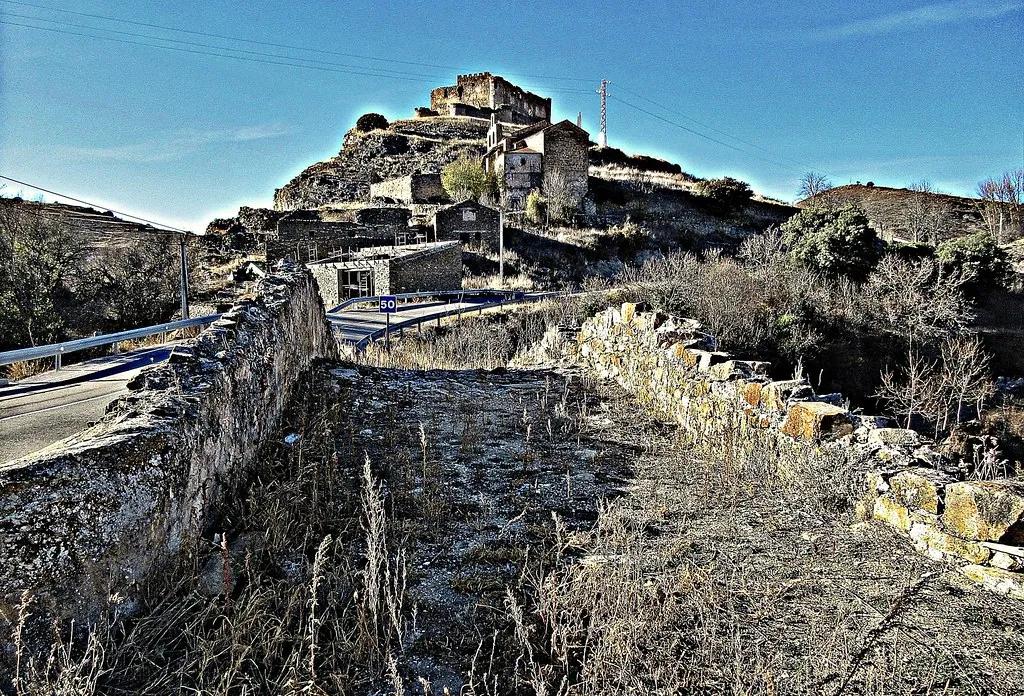
At the centre stands the Iglesia de la Asunción, the Church of the Assumption. It is a sober building in pale stone that appears almost without warning as you turn a corner. There are no grand squares or striking monuments competing for attention. What defines Las Aldehuelas is its domestic architecture: irregular stone walls, darkened wooden gates and former animal pens that now serve as courtyards or storage spaces.
Details from everyday rural life remain visible on some façades. Iron rings once used for livestock are still fixed to the walls. Small windows puncture the stone. Thresholds are worn smooth by decades of use. These are quiet traces of a livestock-based past that has long shaped this comarca, a rural district within Soria known as the Tierras Altas.
In the late afternoon, light filters in low between the houses and washes the stone in orange tones. For a while, everything seems to pause.
Open Land in the Tierras Altas
Leave the built-up area and the landscape opens almost immediately. Rolling hills are largely covered with pine forest, broken by clearings of pasture and low scrub. From some of the nearby high points, wide undulating valleys stretch into the distance for kilometres.
Many of the tracks that lead out of the village were once used to move livestock or to reach firewood and grazing land. They are not always signposted. Anyone keen to walk through the hills would be wise to carry a map or have a route downloaded on a phone, as junctions can be confusing.
The seasons are clearly marked here. In spring, the meadows turn intensely green and the ground holds moisture. Autumn brings ochre tones and a thick layer of fallen pine needles. Summer is dry, though nights cool down noticeably once the sun has set.
There is a constant sense of exposure to the elements. The wind is part of the landscape, shaping how the trees lean and how sound carries across the hills.
Raptors Overhead and a Sky Without Barriers
Space is the defining feeling in Las Aldehuelas. Look up and it is common to see birds of prey using the air currents that rise along the slopes. Vultures and eagles can often be spotted gliding for minutes at a time with barely a movement of their wings.
For visitors with binoculars or a camera, clear days offer good conditions for observation. On the higher ground, the wind can be strong even when the sun is warm, so an extra layer is useful at any time of year.
As daylight fades, the sense of openness shifts from land to sky. Once the sun drops, the village becomes very dark. Street lighting is minimal, and just a few steps beyond the last houses the darkness is almost complete. On clear nights, the Milky Way often appears sharply defined, cutting across the sky.
There is no need to search for a specific viewpoint. Simply walk a short distance away from the centre and wait a few minutes for your eyes to adjust.
Practicalities and Seasonal Rhythms
Las Aldehuelas is small, and that shapes a visit. There are no bars or restaurants in the village. Anyone planning to eat or buy supplies will need to do so in other villages in the comarca. Most visitors either arrive with food or plan their stop before or after coming here.
In winter, some secondary roads in the area can be icy first thing in the morning. If travelling by car during the colder months, it is worth checking conditions in advance.
For much of the winter, daily life is quiet, with very few residents. Smoke rising from a chimney and the sound of wind over the hills are common impressions. Then summer brings a noticeable change. Many houses reopen as families with ties to the village return for the season.
The fiestas in honour of the Asunción are usually held in August. These are days of reunion, mass in the church and long conversations in the street. Tables fill with local produce: home-baked bread, cured cheese, and sometimes mushrooms when the season has been favourable.
Once the festivities end and summer fades, Las Aldehuelas returns to its usual rhythm. Wind moves across the hills. Paths remain in place as they have for generations. The village settles again into quiet, stone and sky.