Full Article
about Magaña
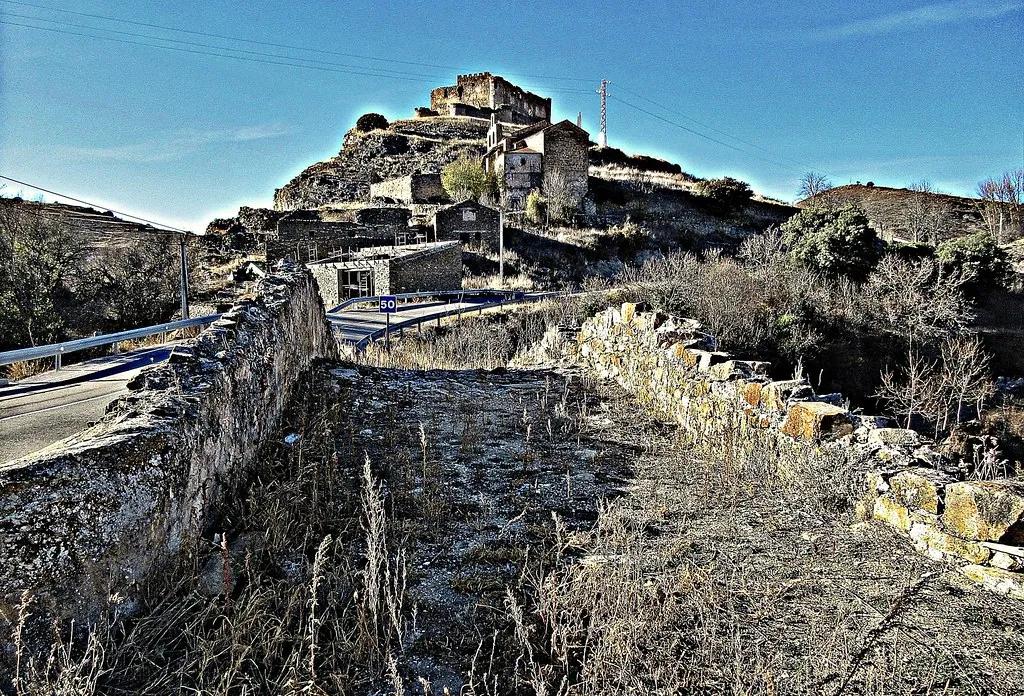
Dominated by the imposing Castillo de Magaña above the Alhama river
Hide article Read full article
Tourism in Magaña is shaped above all by its setting in the Tierras Altas of Soria. The village lies at the far northern edge of the province, close to the border with La Rioja, at an altitude of around 1,000 metres. Here the landscape has dictated daily life for centuries.
Today Magaña has little more than fifty inhabitants. In the Middle Ages, however, it held a certain importance within this strip of interior frontier, a shifting boundary between kingdoms and lordships in what is now northern Spain. That past can still be read in the outline of the village.
Magaña gathers around a rise crowned by a medieval castle that dominates the valley below. From the foot of the hill, its purpose is easy to grasp: watching over the natural passes between these sierras and controlling the routes that once linked Soria with the territory of La Rioja. The fortress, visible from almost anywhere in the surrounding area, continues to define the village’s profile.
The Castle and the Hillside Homes
The castle occupies the highest point. Its walls and towers, much altered over time, recall the strategic character this enclave once had in the Middle Ages. It is not an isolated stronghold. The houses clustered along the slope beneath it, taking shelter from that elevated position.
The architecture matches what might be expected in a village of the Tierras Altas. Stone predominates, with balconies and wide eaves designed to withstand long, harsh winters. Some façades retain elements of traditional mountain architecture, particularly on the upper floors, where wood was used for galleries and covered walkways.
At the centre stands the parish church, sober in construction. Its importance lies less in its size than in its role within local life. For generations it served as a meeting point in a sparsely populated territory, where small hamlets were scattered and distances between villages could be considerable.
Walking through the streets, the relationship between castle, church and houses becomes clear. Everything adjusts to the slope and to the need for protection, whether from the weather or from the uncertainties that once shaped life along this internal frontier.
Landscape of the Tierras Altas
Magaña’s surroundings form part of the characteristic landscape of the Tierras Altas, a highland comarca in the north of Soria province. Nearby hills alternate between pinewoods and oak groves, with ravines and gentle ridges unfolding towards the north. The relief is not dramatic, yet it rises high enough for the climate to mark clear differences between the seasons.
In autumn the hills change colour quickly, particularly in the areas of oak. Winter often brings snow, and the silence of the landscape deepens. In spring the meadows and small streams around the village regain water after the thaw, softening the outlines of the hills.
From some of the nearby high points there are wide views over much of the Tierras Altas and, to the north, towards the first ranges of La Rioja. The sense of space is constant. Villages are few and far between, and the horizon tends to stretch without interruption.
This is a landscape that has shaped patterns of settlement and movement. Livestock routes and local paths developed in response to the terrain, linking communities across valleys and ridges. Even today, the geography explains why Magaña feels both connected and remote.
Walking the Surroundings
The simplest way to understand the area is to follow the rural paths that once connected Magaña with other villages in the comarca. Many were used for moving livestock or travelling between municipal boundaries. They can still be recognised on the ground, although they are not always signposted.
It is advisable to get your bearings before setting out, especially if planning a longer walk. Distances can be deceptive in this part of Soria. Between wooded hills and open valleys it is easy to lose clear reference points.
Autumn brings another familiar activity in the pinewoods around Magaña: mushroom foraging. As in the rest of the province, collecting is usually regulated, and it is sensible to check the current rules in advance. The sight of people searching the forest floor forms part of the seasonal rhythm of the Tierras Altas.
Walking here is less about ticking off landmarks and more about observing how settlement and landscape fit together. The castle remains in view for much of any route near the village, a constant reminder of the hilltop origins of Magaña.
Before You Go
Magaña is a very small village with few permanent services. A visit typically involves strolling through the centre, climbing towards the castle and exploring one of the surrounding paths through the hills.
A morning or an afternoon is enough for an unhurried visit. It is worth taking the time to move slowly. In places like this, interest lies not in accumulating stops but in understanding how people have lived for centuries in these mountains of northern Soria.
The altitude, the climate and the distances between settlements have all left their mark. Stone houses with broad eaves, a church that gathered together a dispersed population, a castle overseeing natural passes: each element reflects practical needs shaped by geography and history.
Magaña does not present itself as a large destination with extensive facilities. Its appeal is tied to its position in the Tierras Altas and to the traces of its medieval past that remain visible in its skyline. For anyone exploring the north of Castilla y León, it offers a concise introduction to a highland landscape where history and terrain continue to define everyday life.


