Full Article
about Rebollar
Small village surrounded by oak and rebollos
Hide article Read full article
Getting There and Getting Your Bearings
Rebollar lies in the Tierras Altas of Soria, in the north of Castilla y León. Reaching it involves a drive of around 50 kilometres from the provincial capital, Soria, along secondary roads that cut through open countryside. There is no regular public transport to the village, so access is essentially by car.
The village itself is very small, home to just a few dozen residents. There are no shops and no tourist services waiting for visitors. Park at the entrance or in one of the wider patches along the street, then continue on foot. In five minutes you can cross the entire settlement from one end to the other.
This is not a place designed for long stays or packed itineraries. It works on a different rhythm, one set by landscape and seasons rather than by visitor demand.
A Mountain Village Reduced to the Essentials
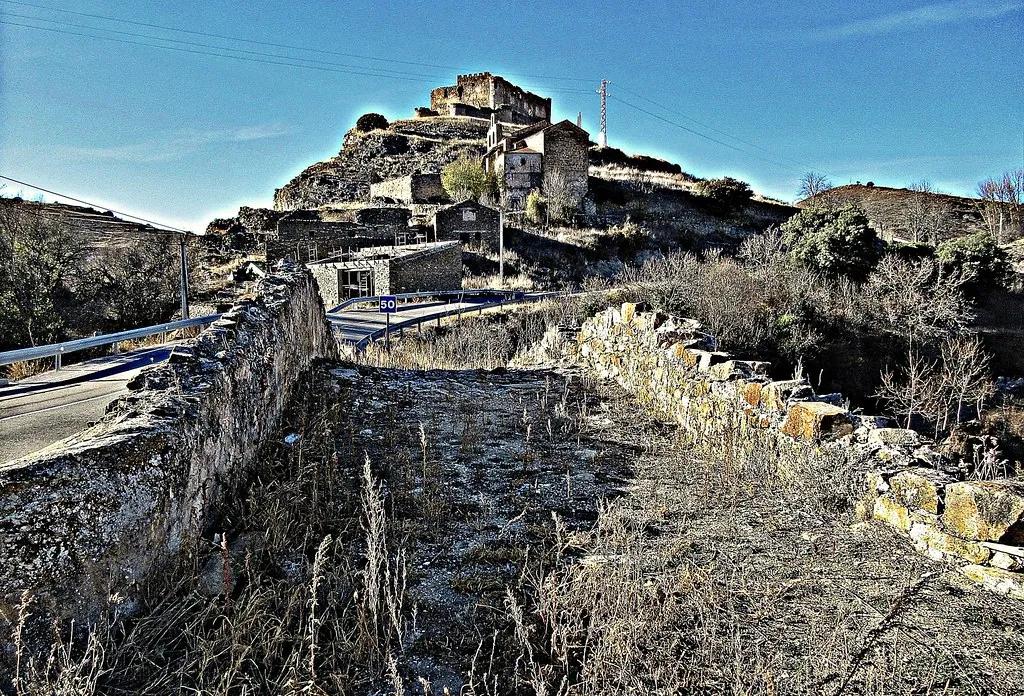
Rebollar clusters around a tiny square and a handful of short, sloping streets. The houses are built in stone, with thick walls and small windows. This is the typical construction of a cold upland area, built to withstand long winters rather than to impress.
There are no monuments and no information panels explaining the past. Rebollar is an ordinary mountain village that has gradually lost population over the years, a pattern shared by many settlements in the Tierras Altas.
Close to the centre stands the church of San Andrés. It is a sober building, compact in volume, with a side bell tower. Decoration is minimal. The church fulfils its function and little more, blending into the restrained character of the village.
Everything here feels reduced to what is necessary. Streets slope gently, walls hold their line against the weather, and daily life moves quietly. Visitors looking for architectural landmarks or curated heritage experiences will not find them. Rebollar offers something simpler: a glimpse of rural continuity in an area shaped by climate and distance.
Walking the Tierras Altas
The real interest begins beyond the built-up area. The land around Rebollar mixes holm oaks, oaks and high meadows that for centuries served as grazing ground for livestock. This is working countryside, shaped over time by herding rather than by tourism.
Marked trails are few. Many of the tracks are old routes between villages. Some remain clearly visible, while others fade into vegetation. Anyone planning to venture away from the village should carry a map or GPS. Wayfinding cannot be taken for granted.
The landscape is open. From several low hills you can see across much of the Tierras Altas. On clear days, Moncayo often appears on the horizon. Moncayo is the highest peak in the Iberian System and a familiar reference point across this part of northern Spain, even from a distance.
Summer brings more visible wildlife. Birds of prey take advantage of rising air currents over the ravines. With patience and quiet, roe deer or red deer may move across the open ground. Encounters are never guaranteed, but the sense of space and exposure is constant.
Silence forms part of the experience. Wind across grass, distant animal movement and the occasional call of a bird replace traffic or urban noise. The appeal lies less in specific sights and more in the broad, uncluttered views that define the Tierras Altas.
Life with Few Residents
With so few permanent inhabitants, daily activity in Rebollar remains limited. Much of the year passes quietly. Social life tends to concentrate in summer, when families who still own houses in the village return for holidays. At that time, doors open and streets briefly regain some of their former energy.
The patron saint festivities usually take place in August. The format is straightforward: mass, a shared meal and music at night. It is a simple structure that continues to hold. There is no elaborate programme or large-scale spectacle, just a community gathering that marks the calendar.
Some romerías, traditional pilgrimages to nearby hermitages, and other religious celebrations still take place in the surrounding area. Participation has declined over time, but the events have not disappeared entirely. They form part of a cultural framework that links small villages across the Tierras Altas, even as populations shrink.
Outside these moments, life returns to its quieter pace. The village does not reinvent itself for visitors. It remains what it has long been: a small settlement in a high, cold landscape.
Before You Set Off
Rebollar is not a destination in its own right. It works best as a brief stop if you are already travelling through the Tierras Altas. Park, walk for a while through the surrounding countryside, then continue your route.
The interest here lies in the landscape and in the silence. The village itself offers very little in terms of services or attractions. Expectations should match that reality. Anyone seeking cafés, guided tours or cultural centres will not find them.
For those already exploring this corner of Soria, however, Rebollar provides a clear example of how these upland villages are structured and how they endure. Stone houses gathered around a small square, a modest church, old paths leading out towards grazing land and distant hills. The experience is brief, but it reflects the wider character of the Tierras Altas.
Rebollar asks for little more than time to walk and to look. Beyond that, the road continues.