Full Article
about San Pedro Manrique
Capital of the Tierras Altas, known for the Paso del Fuego
Hide article Read full article
A village that keeps its own rhythm
Some places seem arranged for a quick photo. San Pedro Manrique does not work like that. You arrive, park, and the first thing you notice is the wind. In the Tierras Altas of northern Soria it slips through everything, a cold reminder of where you are.
With just over six hundred residents, San Pedro Manrique sits in a fairly remote corner of the province. There are no streets designed for visitors or shopfronts set up to catch attention. Instead you find stone houses, slopes that rise and fall without much order, and people who know each other by name. The place still functions as a living village rather than a backdrop.
Clues from the past in the streets
The town centre carries signs that San Pedro Manrique once held more weight than it does today. The church of San Pedro makes that clear. Its base is Romanesque, with later additions that are common in this part of Spain. From the outside it looks solid, almost defensive. Inside, there are Baroque altarpieces and small details worth taking the time to notice.
Another building that draws attention is the Palacio de los Gómara, built in the 16th century. The façade is not showy, yet a closer look reveals coats of arms, mouldings and a Renaissance feel shared with other towns in Soria from the same period. It is privately owned, so it can only be seen from the street.
Walking through the centre, more houses appear with heraldic shields and narrow arcades. They are scattered along streets such as Calle Mayor and around the square. They do not form a grand monumental set, but they hint at families who once had influence and wealth here.
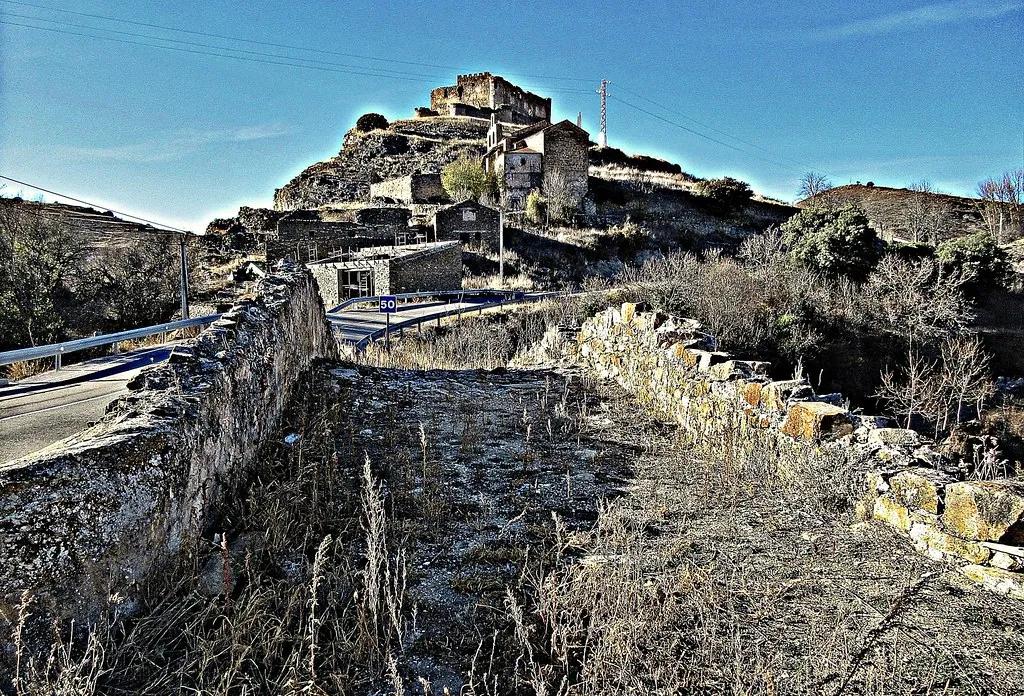
Just outside the village, perched on a rocky outcrop, stands the hermitage of the Virgen de la Peña. Many locals go up as much for the view as for devotion. From the top, the valley of the river Manrique opens out, along with much of the surrounding Tierras Altas landscape: dry hills, patches of holm oak, and a wide horizon. The walk up from the village is short and straightforward.
There is also the hermitage of San Juan Bautista, closely linked to the celebrations at the start of summer. At that time of year, the atmosphere changes noticeably as people return who live elsewhere for the rest of the year.
Beyond the buildings, the wider setting defines the place. The landscape around San Pedro Manrique follows the pattern of this part of Soria: holm oak woods, stony ground and ravines carved by small rivers. Nearby lies the Sierra de Alcarama, known for the presence of vultures and other birds of prey. It may not fit a classic idea of dramatic scenery, yet it has a strong identity, with open skies and a sense of quiet that is hard to miss.
Paths through fields and hills
Several paths leave the village, historically used to move between kitchen gardens, grazing land and neighbouring settlements. Some of these routes are now marked.
The most common walk is the one leading up to the Virgen de la Peña. It is easy to follow and does not take long, though parts of the ground are uneven. From the top, the position of the village on its hill becomes clear.
Longer paths appear if you keep exploring. Some head down towards the river Manrique, others weave through holm oak woodland. In autumn, many people from the area come out to look for mushrooms, and it is easy to come across old tracks once used for livestock.
These are not heavily managed mountain routes. The land is still used by local people and shepherds, which shapes how the paths feel and how they are maintained.
Food shaped by the climate
The local cooking follows the pattern of inland Soria: filling dishes with little fuss. Roast lamb has a strong tradition in the area. There are also migas, game stews when the season allows, and spoon dishes suited to cold weather.
Autumn brings mushrooms to the forefront. Boletus and níscalos often end up in simple stews or lightly fried dishes. The approach is straightforward. Cooking here relies on nearby produce and slow methods that have been used for generations.
The night of the Paso del Fuego
If there is one event that has brought recognition to San Pedro Manrique, it is the Paso del Fuego, held on the night of San Juan. During this ritual, participants walk barefoot across a carpet of glowing embers while carrying another person on their shoulders.
Seen in person, it leaves a stronger impression than expected. It is not staged as a show for visitors. The tradition runs deep in the village and is treated with respect. For a few hours, San Pedro fills with far more people than usual.
Once the celebration passes, the village returns to its usual pace. Quiet streets, neighbours talking by their doorways, and a stillness that settles in as evening arrives.
San Pedro Manrique does not try to draw attention to itself. You arrive, take a walk, climb up to the rocky viewpoint, and quickly get a sense of its rhythm. From there, it is up to each visitor how long to stay. Some pass through briefly. Others remain longer than planned, which is something that happens here quite often.