Full Article
about Santa Cruz de Yanguas
Mountain village with a dinosaur footprint park
Hide article Read full article
Morning Light in the Tierras Altas
By mid-morning, if you pause in the main square of Santa Cruz de Yanguas, the silence is broken only by the creak of an old door and the distant call of a crow. The light arrives softly, brushing the stone façades and dark roof tiles. This is the Tierras Altas of Soria, more than 1,200 metres above sea level, and the altitude makes itself known in the clean air and the unhurried rhythm of the place.
With around 56 residents, Santa Cruz de Yanguas belongs to that small group of villages that still follow an older logic: long winters, short summers and plenty of open land all around. Houses with thick walls and wooden gates gather along narrow streets that climb gently uphill. It is best to walk slowly here, especially on the slopes. There are no tourist signs or marked routes within the village itself. Santa Cruz is understood simply by walking through it.
Stone Houses and High-Altitude Quiet
The buildings respond directly to the demands of the climate. Solid walls, few large windows and steeply pitched roofs help snow slide away rather than linger. Many homes still have adjoining corrals or small vegetable plots, a common feature in livestock villages in these mountains.
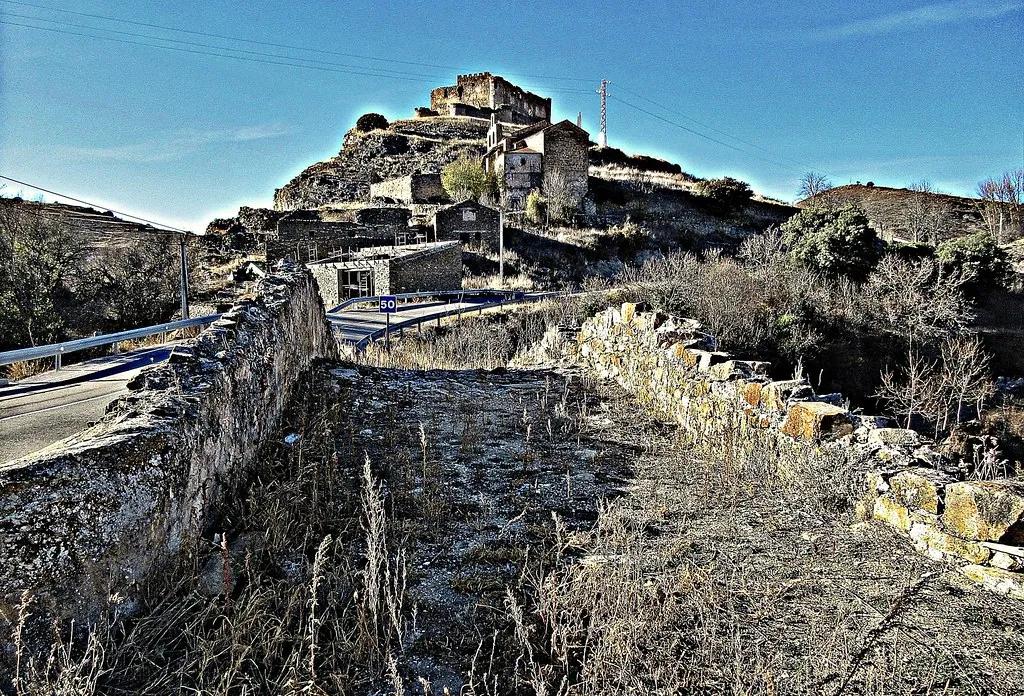
The parish church dedicated to the Santa Cruz stands in one of the village’s more visible spots. It is a simple structure, likely built over earlier remains, its stone darkened by decades of harsh winters. This is not a monumental church that draws attention through grandeur. What matters more is the overall fabric of the village than any single landmark.
Climb towards the upper streets and the landscape opens almost immediately. Wide meadows spread outwards, patches of pine woodland break up the terrain and gentle hills roll towards the horizon. In autumn the fields turn ochre and reddish tones. In winter the wind sweeps across the slopes and it is not unusual for snow to settle for several days at a time.
The sense of height is constant. The air feels sharper, the views broader, the human presence lighter against the scale of the surroundings.
Paths Between Villages
Several traditional tracks leave Santa Cruz de Yanguas, linking it with other small settlements in this part of the Tierras Altas. For decades these dirt roads and footpaths were used by livestock farmers and neighbours travelling on foot from one village to another.
They are not always signposted, so carrying a map or a digital track is sensible if the area is unfamiliar. The terrain is open and relatively easy to read, yet distances can be deceptive because everything appears closer than it really is.
Walking here often means spotting roe deer moving between low shrubs or hearing birds of prey circling above the fields. The silence has a particular quality. It is never complete. There is usually wind, livestock somewhere in the distance or the faint clink of a cowbell.
In winter and early spring some tracks can become muddy or icy. If arriving by car, it is wiser to leave it in the lower part of the village and continue on foot.
The experience is less about reaching a defined viewpoint and more about being within a wide, elevated landscape where sound travels and the horizon seems to stretch without interruption.
A Short Distance from Yanguas
Just a few kilometres away lies Yanguas, historically the main settlement in this area of the Tierras Altas. Its heritage is more visible and more concentrated. Remains of town walls, a castle and several churches point to the importance the town once held over the centuries.
Many visitors arrive in Santa Cruz after first stopping in Yanguas. The contrast is striking. One is a small town with traces of administrative and historical weight. The other is a tiny settlement where traffic noise is almost absent and daily life moves quietly between house and field.
Seen together, they offer two perspectives on the same highland territory. Yanguas presents its history in stone fortifications and religious buildings. Santa Cruz de Yanguas expresses it in its scale, its layout and the way it continues to function with very few inhabitants.
Mountain Cooking and September Gatherings
Food in these mountains has always been hearty and straightforward, shaped by cold weather and agricultural work. Dishes such as migas and lamb stews remain part of the table in many homes in the area. When autumn arrives, wild mushrooms also take their place in local cooking.
It is important not to assume that services will be available year-round in villages this small. Anyone planning to spend the day walking in the surrounding countryside should bring water and something to eat.
Local celebrations tend to centre on mid-September, when the Santa Cruz is commemorated. During these days sons, daughters and grandchildren of the village return, houses reopen and the square regains some movement.
There are no large stages or packed programmes. Instead, the focus is on long shared meals, conversations in the street and simple processions that pass along the same lanes that remain quiet for the rest of the year. For a brief period, the village expands, not in size but in sound and presence.
These gatherings underline how places like Santa Cruz de Yanguas function. Even with a small permanent population, ties to the village extend far beyond those who live there throughout the year.
When to Visit
Summer and early autumn are the most forgiving times to discover Santa Cruz de Yanguas. Skies are usually clear and the tracks dry underfoot. The light at this altitude can be crisp without being harsh, and walking between villages is more straightforward.
Winter brings a landscape of considerable force, yet the cold here is serious and roads can become complicated when snowfall arrives. Snow may linger for days, and the wind across the hills can be biting.
Anyone coming to Santa Cruz de Yanguas should do so without hurry. This is not a destination approached with a checklist of sights. There are no ticket offices, no circuits to follow, no sequence of monuments demanding attention. It is a place to wander slowly through narrow streets, to climb to the upper edge of the village and look out across the open land, and to listen to how the wind moves across these mountains of Soria.
In that listening, and in the wide views that begin just beyond the last house, Santa Cruz de Yanguas reveals its character.