Full Article
about Suellacabras
Mountain village with a remote Romanesque chapel of great value
Hide article Read full article
At seven in the morning, the light in Suellacabras is thin and pale, the colour of old bone. It slips through small windows and lays a long, cold stripe across the thick stone of a wall. The only sound is the wind moving through empty pens and the slow creak of an old beam contracting in the frost. Snow can stay on the roofs here for a week.
This is a village of thirty-two people, in the Tierras Altas de Soria. The altitude, around twelve hundred metres, is felt in the air and seen in the landscape. A short line of houses, some shuttered for most of the year, faces the open plateau. There are no shops. No bar. Just a few streets where the wind has room to move.
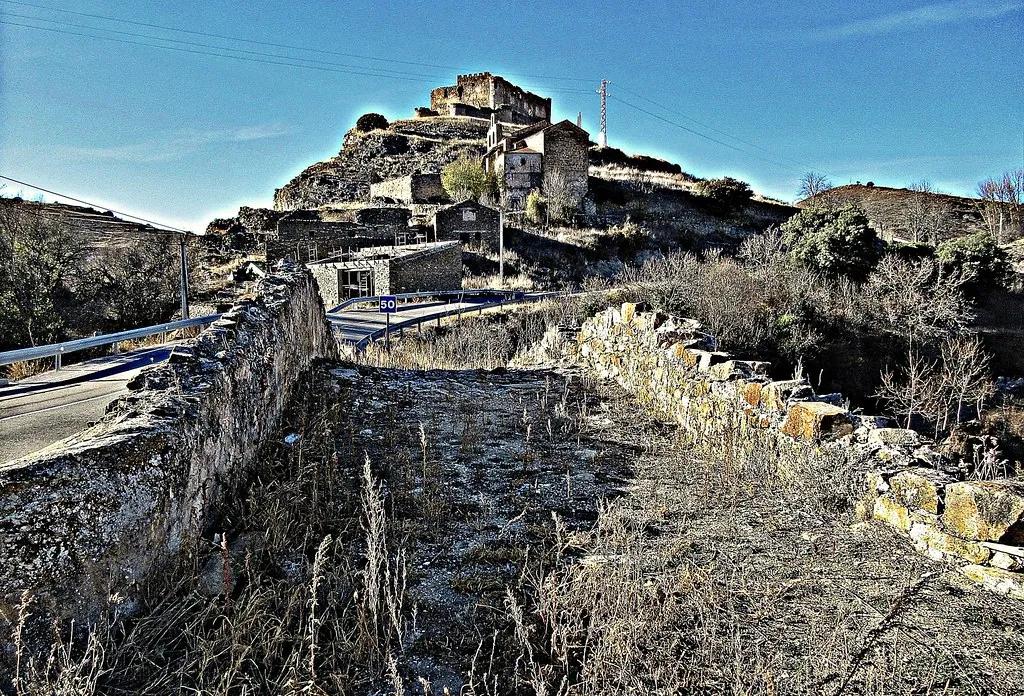
The buildings are made from irregular masonry, their timber darkened by decades of sun and cold. The eaves are built deep, to keep snow from piling against doorways. You see repairs everywhere: stones of different shades, newer mortar, a replaced beam. The parish church, dedicated to San Caprasio, has a simple espadaña and walls so thick they seem to absorb sound.
Stone and Memory
A slow walk through the compact centre is a lesson in local history told through stone. Livestock pens are built right into the sides of houses; some stand empty, others hold rusted tools or shelter a ewe. The corners of doorways are rounded smooth from generations of use and the abrasion of winter ice.
Look up, and you’ll see the haylofts with their large wooden doors, often set at an angle for carts. Many planks have warped, turning a silvery grey. You might find dry grass still piled against a wall, or see the ghost of an old internal partition. This was a working village, not so long ago. The tracks were busy with flocks and carts. That movement has mostly gone, but the buildings haven’t forgotten.
The Páramo
Step beyond the last house and the world opens into a wide páramo. In winter, it feels severe. The wind has a constant presence, snow can obscure paths, and temperatures drop easily below freezing. Check the forecast before you come, and take warnings about road conditions seriously.
Come in late spring, and the palette softens. Muted greens appear in the ochre soil between scattered junipers. Rosemary and thyme grow low to the ground, adapted to the dryness. The old dry-stone walls that seam the landscape tell you where fields once were.
The view from almost anywhere in the village is vast. Clouds scud quickly across an enormous sky. There are no visual barriers out here—few trees, no other villages close enough to break the horizon line.
Practicalities: Getting Here and Getting By
You’ll need a car. Suellacabras is reached from Soria via regional roads that eventually become narrower lanes. They’re generally passable in fair weather, but there is no regular public transport.
Fill your tank in Soria or Ágreda before heading into this comarca. Distances between villages aren’t huge, but services are sparse. Plan ahead: bring water, food, and whatever else you’ll need. There’s nowhere here to purchase supplies.
Walking Without Signposts
Several livestock tracks lead from the village into the fields. They are not official hiking routes—just old paths to pasture. They start broad near the houses, then grow fainter as they climb toward higher ground where the wind hits you squarely.
If you plan to walk any distance, carry a proper map or a downloaded GPS track. When fog rolls across these plains, every fold in the land looks the same, and it’s easy to lose your bearing. The appeal is in that self-reliance and the simple, unmediated terrain.
The Depth of Night
After sunset, Suellacabras is profoundly dark. Public lighting is minimal, and there’s no city glow on any horizon. On a clear night, especially with a low moon, the sky has a depth you forget is possible.
In summer, walk five minutes past the last house and sit on the dry grass. The Milky Way is a visible smear overhead. This darkness isn’t an attraction; it’s simply how night is here, and it becomes one of the strongest sensations of a stay.
Rhythm of a Very Small Place
With so few permanent residents, the rhythm is slow for most of the year. In August, it shifts. Former neighbours return, the square gathers voices for a while, and the church opens for the patron saint’s day. Someone might organise a shared meal.
The rest of the time, it’s quiet. What you find is landscape and weather and a tangible sense of remoteness. Tourism here isn’t about sights or services. It’s about noticing things: how noon light hits one specific wall, how buildings are shaped by cold, how long you can watch a cloud’s shadow move across the páramo before you feel the need to speak