Full Article
about Valtajeros
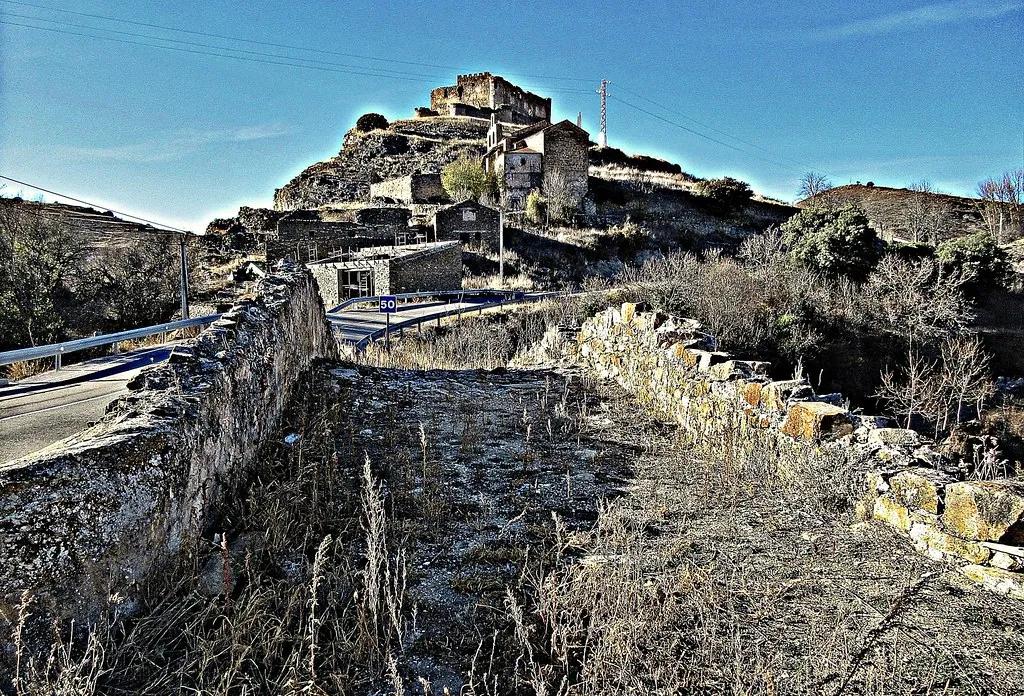
Mountain village with a unique fortress-church
Hide article Read full article
A slow morning in stone
At daybreak, the stone walls of Valtajeros take on a cold, almost bluish grey, as if the night is still clinging to the façades. At that hour, silence feels heavier. There might be a single early bird, and if the wind comes down from the pinewoods, the soft brushing of treetops. Tourism in Valtajeros follows that same rhythm: slow, quiet, and slightly apart from everything else. Sitting more than 1,200 metres above sea level, the village carries on at its own pace, largely untouched by whatever is happening beyond it.
A small settlement in the Tierras Altas
Valtajeros lies in an open stretch of the Tierras Altas of Soria, a highland region where wide plains alternate with gentle rises covered in pine. The view stretches far because there is very little to interrupt it: dry farmland, patches of woodland and a wide sky that feels especially clear in winter.
The village itself is compact. Stone houses, some with thick walls and dark wooden gates, cluster around the Iglesia de la Asunción, built in the 16th century. Its bell tower has a slight lean, noticeable when the late afternoon light falls across it and picks out the lines in the masonry.
A walk through Valtajeros does not take long, but it rewards a slower pace. The streets are narrow, with uneven stone underfoot, and many end in livestock pens, haylofts or small enclosed yards edged by low walls. Details hint at older ways of living: iron hooks fixed to façades, worn stone basins shaped by years of water, doors that have seen many winters pass.
Pinewoods, open ground and old paths
The pinewoods begin almost immediately beyond the last houses, forming a defining part of the surrounding landscape. These are stands of Scots pine, dense in places, with a ground layer of dry needles that soften each step. Between the trees, clearings open up to broad valleys and the occasional stream winding through meadowland.
Several rural tracks lead out from Valtajeros. Some were used for decades to reach neighbouring villages and can still be followed on foot or by bike. They are not always signposted, but they are easy enough to recognise on the ground: pale strips of earth cutting through the pines or paths marked by the passage of livestock.
After a short walk, it is easy to find complete solitude. At times, the only signs of life are roe deer tracks, a rabbit crossing the path or the sharp tapping of a woodpecker against a trunk.
Raptors above and dark skies below
The open landscapes of the Tierras Altas favour birds of prey. On clear days, it is not unusual to spot an eagle circling high overhead or the quick silhouette of a sparrowhawk moving between the pines. Binoculars come in handy for birdwatching, as these sightings often happen at a distance.
At night, the sky changes completely. Light pollution is minimal, and when the air is clear, the Milky Way stands out with surprising clarity. It only takes a short walk away from the centre of the village and switching off a torch to see it properly.
Traces of a livestock past
The landscape around Valtajeros still carries the imprint of livestock farming. Stone pens, haylofts and wooden enclosures sit alongside fields and pinewoods as part of the same working environment. At certain times of year, flocks can be seen grazing on the nearby slopes.
Conversations with residents, if they happen naturally, often turn to stories of winter pig slaughters, the care of animals or what winters were like when the village had more people. Memory here remains closely tied to agricultural life.
When to go and what to expect
Spring and early autumn are usually the most comfortable times to walk in the area. Temperatures are mild, the pinewoods carry a resin scent, and even at weekends there is plenty of quiet.
Winter brings sharper conditions. Frost can last for several days, and snow is not uncommon, which can affect access by road. Checking the weather before setting out is advisable, and arriving with daylight helps, as temperatures drop quickly once evening sets in.
Valtajeros has very few services. It is common to stop in a larger village in the area before or after visiting if anything is needed, whether that is fuel, supplies or somewhere to eat.
A pause in the Tierras Altas
Many travellers move through this part of Soria from one village to the next. Within that scattered map, Valtajeros appears as a brief pause along the way: a cluster of stone houses, pinewoods at its edge and a silence that shifts with the time of day.
Some people stop for a few minutes and continue on. Others stay longer, sitting on a bench in the square or walking out towards the edge of the pines as the light begins to fade. The landscape here does not demand attention, yet it tends to linger in the memory.