Full Article
about Yanguas
One of Spain’s prettiest villages, with mountain medieval architecture.
Hide article Read full article
First Glimpse: The Castle Above the Valley
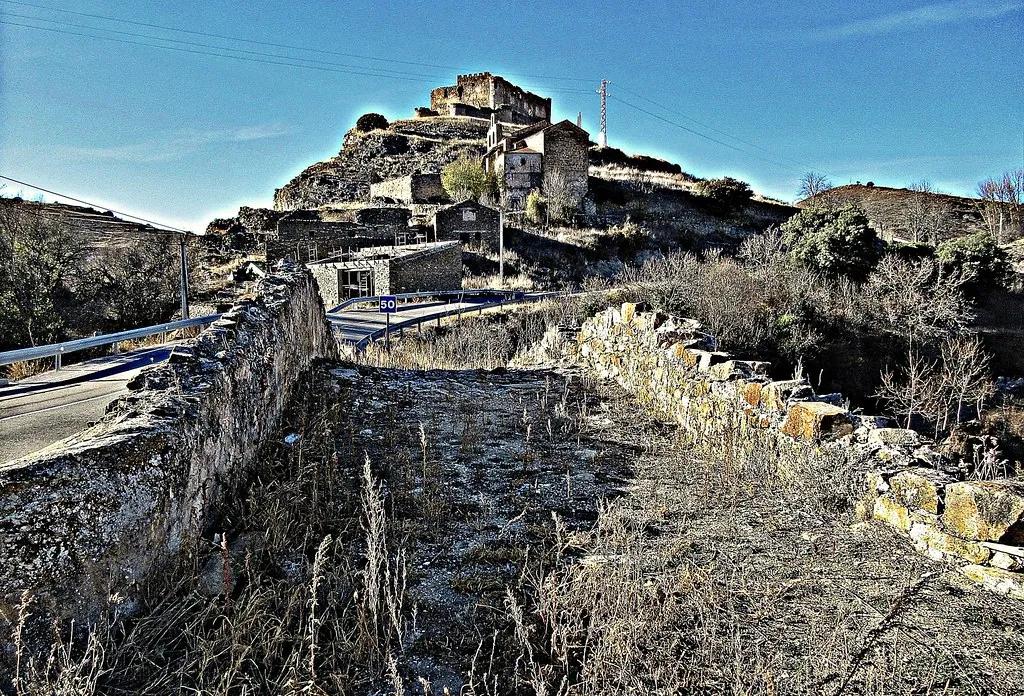
By mid-morning the wind often climbs the hillside and whistles against the stones of Yanguas castle. From below, the broken tower appears among scrub and lichen, as if the ruin were still watching over the valley. For many visitors, that is the first image of Yanguas: a rocky promontory, masonry darkened by damp, and beneath it the Cidacos tracing a slow curve through the meadows.
The castle was built in the Middle Ages and today remains as a consolidated ruin. Sections of wall still stand, along with part of the tower. It does not take much imagination to grasp its purpose. This was a strategic corridor through the Tierras Altas, a highland area in the north of Soria province that long functioned as a frontier and a route of passage. Control of movement through the valley mattered, and the fortress reflects that.
The setting explains much about the village. Yanguas is small, with just over a hundred inhabitants, and the landscape around it feels open and exposed. The sky seems broad, the wind constant, the stone weathered.
The Main Street and the Arcaded Plaza
The layout of Yanguas can be understood in a matter of minutes. A single main street slopes down towards the plaza mayor. Underfoot, worn cobbles form an uneven surface that becomes slippery on rainy days.
The square retains its stone arcades. Beneath the dark beams it is easy to picture the activity of former markets. For centuries this was a meeting point for livestock farmers and traders arriving from scattered villages in the surrounding sierra. The Tierras Altas have always been sparsely populated, and places such as Yanguas acted as small hubs within that wider rural network.
Several façades display carved coats of arms. Some are heavily eroded. It is worth looking up as you walk, since many of these details go unnoticed at street level. They hint at families who once held status here, and at a past in which even a small settlement could accumulate symbols of local importance.
Life today moves quietly. Outside the early September celebrations, the streets are calm and there is little traffic. The sense of scale is intimate, and distances are short.
Santa María and the Hermitage Nearby
The bell tower of the church of Santa María rises above the rooftops and acts as a visual anchor in the village. The building has medieval origins, although its interior brings together elements from different periods. Much of the sculptural work is concentrated in the archivolts of the main doorway, where carved stone frames the entrance.
Inside, the atmosphere shifts. The thick walls keep a coolness even in summer, and light filters through narrow windows. The effect is subdued rather than dramatic. Materials and proportions reflect the long history of the church, shaped by additions and alterations over time.
A few steps away stands the hermitage of the Virgen de los Remedios. It is usually closed except during specific celebrations. The dedication is important locally, as the Virgen de los Remedios is at the centre of the village festivities held at the beginning of September. During those days Yanguas changes rhythm and residents who live elsewhere return, increasing the population and altering the pace of daily life.
The Stone Bridge and the Cidacos
A short walk from the centre leads to the stone bridge over the Cidacos. The river moves slowly between reeds and poplars. When the water level is low, the sound of stones shifting under the current can be heard.
Old livestock routes once crossed here. For centuries transhumance, the seasonal movement of herds between summer and winter pastures, shaped the economy and calendar of this region. The Tierras Altas were part of those routes, and traces of paths can still be recognised leaving the village towards the nearby hills.
Sitting on the low parapet of the bridge offers a clear sense of Yanguas in proportion. There are few cars, few voices, and a great deal of open sky. The landscape dominates. Fields stretch outwards and the river bends gently away, reinforcing the impression of space.
Paths Through the Tierras Altas
Around Yanguas, footpaths cross oak woods and slopes covered in pasture. Mobile phone coverage is not always reliable, something common in this part of Soria. It is sensible to allow enough time for a walk and avoid leaving too late in the day if unfamiliar with the terrain.
Spring and autumn are good seasons for observing birds of prey that ride the air currents. Over the open fields, kites and occasionally small eagles can be seen scanning for prey. A pair of binoculars helps to distinguish them as they circle above the plateau.
On cold mornings, mist sometimes settles in the valley. From the higher ground nearby, the village appears half concealed, with the church tower rising through the haze. The scene shifts quickly as the sun strengthens and the fog lifts, revealing the compact outline of Yanguas against the surrounding fields.
The broader landscape of the Tierras Altas is defined by exposure and altitude. Wind sweeps across the plateau and the light changes rapidly. It is a place where distances feel greater than they appear on a map.
Food and the Rhythm of the Year
Local cooking remains tied to what has long been eaten in these sierras. Stewed lamb features prominently. Migas, made from stale bread and revived in the pan, are another traditional dish. When the season arrives, wild mushrooms find their way into the kitchen.
Autumn also brings products from the matanza, the traditional pig slaughter that supplied preserved meats for the colder months, along with cheeses from the area. These foods reflect a way of life adapted to altitude, winter cold and relative isolation.
Outside the fiestas of the Virgen de los Remedios in early September, Yanguas moves at a slow pace. The streets are quiet and there is little sense of urgency. In summer, it is advisable to arrive early in the morning or later in the afternoon. At midday the sun falls directly on the stone and there is very little shade in the open streets. Here, the day makes most sense when followed through the changing light, from cool early hours to the warmth that settles over the valley.