Full Article
about Cabañas de Polendos
A municipality that champions crafts and culture; it hosts workshops and a well-kept setting.
Hide article Read full article
Morning light slips through the narrow openings of the church of San Lorenzo. The thick stone still holds the cool of the night, and inside there is almost no sound, just the faint creak of wood or the echo of footsteps. At that hour, in Cabañas de Polendos, the few streets in the centre remain empty, and the air carries a mix of damp earth and old firewood.
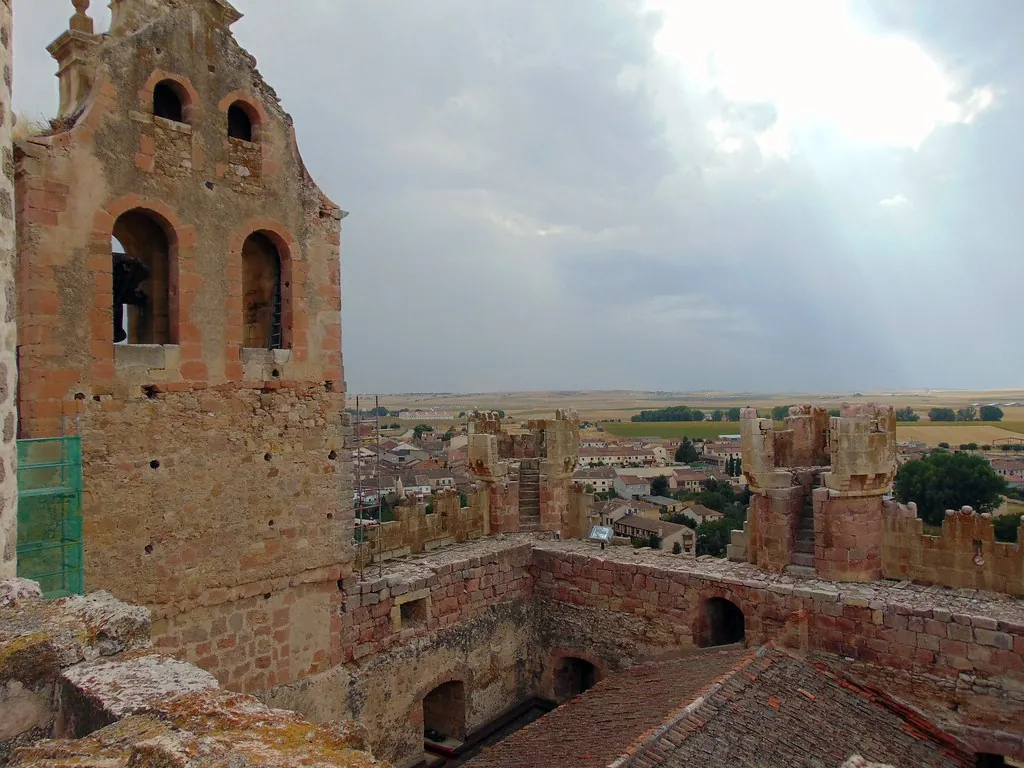
The village stands just under a thousand metres above sea level, in an area of Tierras de Segovia where gentle hills open into cereal fields and patches of pine forest. A little over two hundred people live here, many still connected to farming or livestock. That pace of life shapes the place. Stone houses with heavy gates line the streets, topped with traditional curved clay tiles, and behind the walls there are courtyards that can only be guessed at from the outside.
The streets are narrow and slightly irregular, as if they grew without a plan. Walking slowly brings small details into focus: a worn stone trough at a fountain, the sound of bells from a nearby enclosure, or a section of adobe wall gradually breaking down under winter rain.
Where the village gathers
Everything converges in the small square in front of the church. Its pale façade stands out against darker beams and woodwork, and from this point the ground slopes gently down towards the fields.
On clear days, the view stretches across slopes dotted with holm oaks, and further still to the line of the mountains. When there is a bit of wind, the sounds carry cleanly: leaves shifting, a distant tractor, and little else.
A short walk beyond the centre brings out features closely tied to rural life in this part of Segovia. Circular dovecotes appear among the fields, along with wine cellars dug into the ground and several fountains still in use. They are not set apart or presented as historical landmarks. They remain part of everyday surroundings.
Paths across open land
The area around Cabañas de Polendos is easy to explore on foot or by bike, following agricultural tracks that link it with nearby villages. These are straightforward routes, often taking half a day, passing through open farmland and stretches of pine forest where the air smells of resin when the heat builds.
Light changes noticeably with the seasons. Spring brings a brief burst of green that does not last long but is clearly felt. In autumn, the fields turn more golden and the sun sits lower over the rolling land.
Early in the morning or towards evening, there is often movement in the sky. Kestrels hover almost motionless in the wind, while harriers trace wide circles above the crops. Walking quietly helps if you want to notice these details.
Food and everyday cycles
There are usually few services within the village itself, so it is common to drive to nearby towns. In this part of Segovia, the food remains closely tied to winter and local produce. Dishes such as roast lamb, slow-cooked judiones, a large local bean, and cured meats are still common, many prepared by families following the traditional pig slaughter season.
That domestic calendar continues to shape life here: the pig slaughter in winter, vegetable gardens in summer, and cereal harvests later in the season. It is a rhythm that still feels present in daily routines and in what appears on the table.
Quiet roads for cycling
For those who prefer to travel by bike, there are secondary roads with little traffic. The gradients are not usually steep, though the north wind can quickly change how a ride feels.
A loop of around forty to fifty kilometres through the surrounding region is enough to leave a mark on the legs, especially on cold, clear days.
When the village shifts pace
Summer brings a slight change in rhythm. In August, many residents who live elsewhere return, and for a few days the streets fill with more activity. There is music at night, tables set out in the square, and long gatherings that stretch into the evening.
Outside those dates, or during the week, Cabañas de Polendos returns to its usual scale. There are few voices, the light falls cleanly on the stone, and the most constant sound is the wind moving across the surrounding fields.