Full Article
about Escobar de Polendos
Includes the village of Peñarrubias; known for the Pirón valley landscape and its chapel.
Hide article Read full article
A Small Settlement on the Segovian Plains
Escobar de Polendos lies in the Tierras de Segovia, a rural area within the province of Segovia in Castilla Leon. Set at around 900 metres above sea level, it stands in a landscape shaped by cereal farming and wide horizons. With just over 170 inhabitants, it belongs to that group of Segovian villages that have changed slowly over time. The layout of its streets and buildings still reflects an agricultural economy and a way of life tied closely to the rhythm of the fields.
This is not a place of rapid development or large-scale attractions. Instead, Escobar de Polendos offers a clear sense of continuity. The countryside determines daily life, and the village structure remains closely linked to the needs of farming.
Gathered Around the Church
The village is organised around its church and a small square that continues to serve as a meeting point. From here, narrow streets extend outwards, most of them now paved. The houses are built from masonry and rammed earth, materials long used in rural Castile. Thick walls, small windows and curved roof tiles are common features.
These architectural choices are practical as much as aesthetic. Winters in this part of inland Spain are cold, while summers are dry and hot. Solid walls and limited openings help regulate indoor temperatures, keeping interiors cooler in summer and more sheltered in winter. The result is a built environment that responds directly to climate.
The Iglesia de San Nicolás is the village’s main building. Constructed in the 16th century and later reformed, it has the restrained exterior typical of many rural parishes in Segovia. Decoration on the outside is minimal, in keeping with local tradition. Inside, there is a modestly proportioned main altarpiece in the Baroque tradition. As in many small Spanish villages, the church usually opens for religious services, but outside those times it is not always possible to find it accessible.
The square and surrounding streets remain the social heart of Escobar de Polendos. Even in a small community, these shared spaces continue to play a role in everyday interaction.
The Horizontal Landscape of the Interior
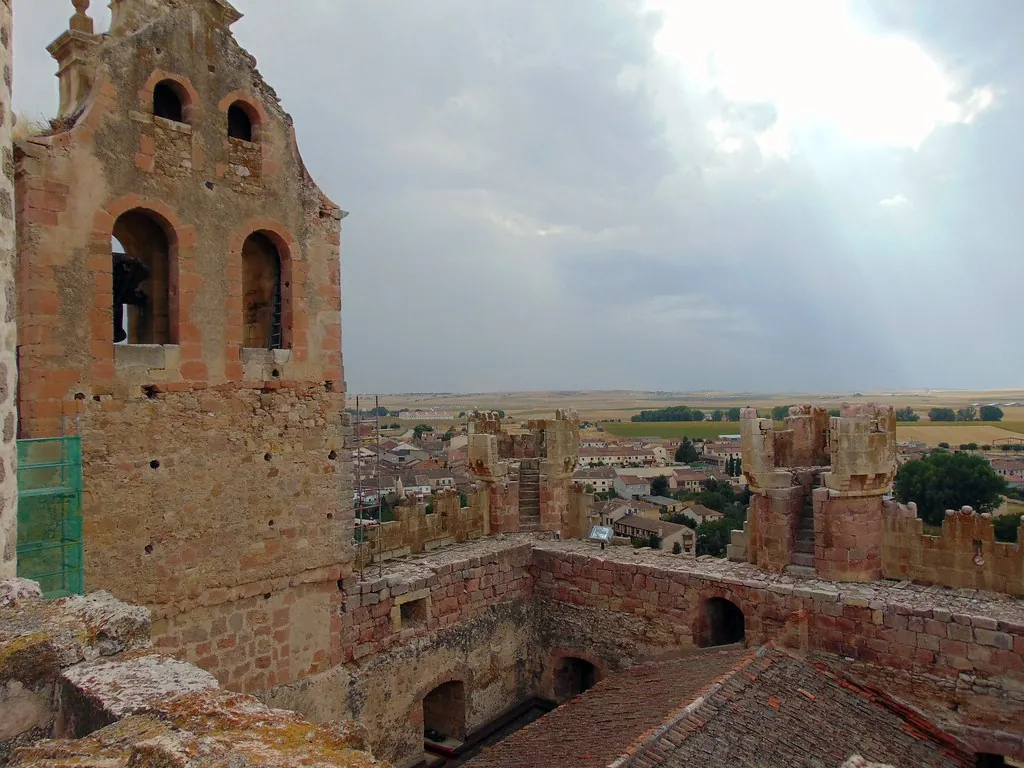
Beyond the houses, the defining feature of Escobar de Polendos is its landscape. This is the interior countryside of Segovia: large cereal fields stretching across gently undulating ground, scattered holm oaks and occasional agricultural buildings punctuating the view. The dominant sensation is horizontality.
There are no dramatic mountains or dense forests here. Instead, the land opens out into broad horizons that shift with the seasons. In spring, green crops cover most of the fields, softening the lines of the terrain. As summer advances, the tones turn golden and the landscape takes on the dry, luminous appearance so closely associated with Spain’s central plateau, known as the Meseta.
The changes across the year are visible and gradual. Ploughing, sowing and harvesting shape both the colours and the textures of the surroundings. The countryside is not a backdrop but an active space of work.
Paths Linking Nearby Villages
From the edge of the village, several agricultural tracks lead out towards neighbouring settlements such as Polendos and Valdevacas. These are straightforward routes, with no significant gradients, and they offer a direct way to understand the territory.
Walking along them, the pattern of cultivated plots becomes clear. Fields extend in broad sections, occasionally interrupted by a farm building or a stretch of old stone wall. In some places, traditional enclosures and former livestock pens can still be seen. They provide traces of earlier farming practices that existed alongside cereal cultivation.
In these open plains, it is relatively common to spot birds adapted to steppe environments. Their presence varies depending on the time of year and on agricultural activity. The absence of dense woodland creates conditions suited to species that favour open, dry terrain.
The experience of moving through this landscape is defined by space and light. With few obstacles to block the view, distances seem to stretch further than expected.
Festivities and Local Traditions
The patron saint of Escobar de Polendos is San Nicolás, and the main celebrations are dedicated to him. They traditionally take place in summer, when many former residents return to the village for a few days. This seasonal increase in population briefly alters the rhythm of daily life.
Processions form part of the festivities, along with shared meals and activities organised by the inhabitants themselves. In small communities such as this, local participation is central to keeping traditions alive. The celebrations are less about spectacle and more about maintaining social ties.
At other points in the year, including Semana Santa and Christmas, the village also observes simple rituals that continue to bring families together. These occasions reinforce continuity across generations, even as the population remains small.
Visiting Escobar de Polendos
Escobar de Polendos is compact and can be explored in a short time. There are no large monuments or significant tourist infrastructures. Its appeal lies elsewhere.
A visit makes most sense as a calm stop within a wider route through the Tierras de Segovia or among the surrounding villages. It offers an opportunity to observe rural architecture that has evolved in response to climate and agricultural needs. Paying attention to the traditional houses in the centre and to the agricultural buildings on the outskirts helps explain how people have lived and worked here for centuries.
More than any individual monument, it is the landscape that provides context. The broad cereal fields, the seasonal shifts in colour and the steady presence of farming define Escobar de Polendos. For travellers interested in rural Castile and the character of Spain’s interior plateau, this small village presents a clear and unembellished example of life shaped by the land.