Full Article
about La Matilla
Small town ringed by junipers and sabines; noted for its quiet.
Hide article Read full article
A village shaped by altitude and quiet
Early in the morning, when the sun is still low and dew lingers on the cereal crops, La Matilla is almost completely silent. The only sounds tend to be a tractor starting somewhere in the distance or the creak of a farm gate. The village appears suddenly among wide, open fields, sitting at over 1,000 metres above sea level, with low houses built from stone and adobe, materials well suited to the cold winds that sweep across this part of the province of Segovia.
Tourism in La Matilla has little to do with ticking off sights. There are no major monuments and no long streets designed for wandering aimlessly. What defines the place is the landscape, the horizon and a way of life still closely tied to agriculture and livestock.
The streets are few and short. Some still show barns, enclosed yards with thick wooden gates and slightly uneven stone walls, built in a time when the priority was to endure long winters and dry summers rather than aesthetics.
The church and the centre of village life
The village is organised around the Iglesia de la Asunción. It is not a large building, yet its tower is visible from the surrounding fields and acts as a useful point of reference when walking back along the agricultural tracks.
If the door happens to be open, the interior is usually simple: wooden pews, religious images that have been there for decades, and a calm atmosphere typical of a small rural parish. It is not always accessible, so it is worth assuming that a visit might be limited to the exterior.
From the edges of the village, the view opens up almost immediately. A short walk is enough to find yourself surrounded by plots of cereal crops that shift in colour through the year. In spring they are a bright green, in advancing summer they turn a pale gold, and later, when the land rests, the tones become more muted and brown.
Walking the agricultural tracks
The most natural way to explore La Matilla is simply to follow any of the agricultural tracks leading out of the village. These are wide dirt paths used by tractors and trailers, generally easy to walk as long as the ground is dry.
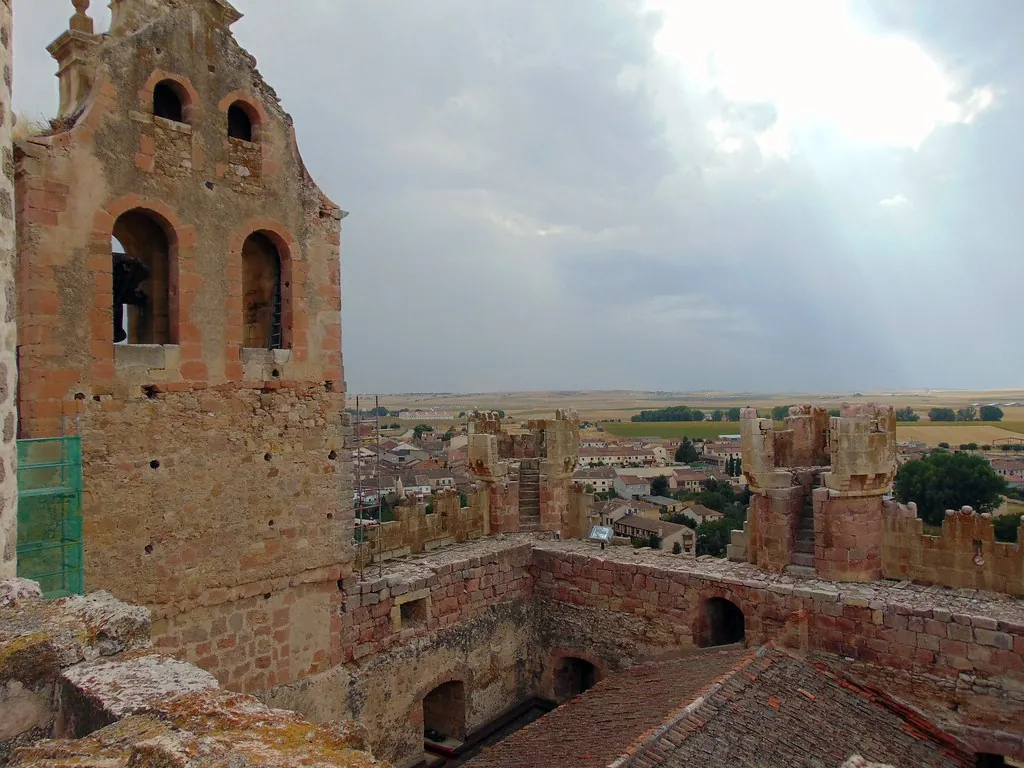
There are no marked routes or tourist signposts, but they are hardly needed. The landscape is so open that losing your bearings is unlikely. As you move further away from the centre, the village shrinks to a small cluster of houses, with the church tower rising above the reddish roofs.
In summer, the middle of the day is best avoided. Shade is scarce and the sun falls directly across the fields. In return, sunrise and sunset bring a very clear light. Wheat reflects golden tones, while the stone walls of the village take on a warm colour that lasts only a few minutes.
Nights under a wide sky
Once night falls, La Matilla becomes almost completely dark. Street lighting is minimal, and beyond the built-up area there is total darkness.
On clear nights in summer or early autumn, the sky is filled with stars. The milky band of the Milky Way can be seen crossing overhead, something that is now difficult to spot in more populated areas. For those interested in night photography, villages like this in the Segovian countryside offer good conditions.
Food shaped by the land
The cooking in this part of inland Segovia follows long-established traditions: substantial dishes designed to sustain long working days outdoors. Legumes, lamb, cured meats and dense bread that keeps well for several days are typical.
In villages as small as La Matilla, it is common for there to be no bars or restaurants open on a regular basis. Anyone passing through is best off arriving having already eaten or bringing something to snack on, and bearing in mind that services are very limited.
Festivities and the rhythm of the year
Around mid-August, celebrations linked to the Asunción take place, as in many villages across the province. These are usually days when residents gather alongside people who return in summer: a mass, a procession through the streets, and shared meals.
For the rest of the year, life is quiet. With only a few dozen inhabitants, activity depends largely on agricultural work and the changing seasons.
Reaching La Matilla
La Matilla lies in the north-eastern part of the province of Segovia, within the Tierras de Segovia region. From the city of Segovia, the journey takes around an hour by car, combining the N-110 with local roads.
The final stretch follows small, paved rural roads that are easy to drive, with very little traffic. Public transport in this area is usually limited, so arriving by car is the most common option.
Anyone planning to walk in the surrounding area should bring water and some form of sun protection. The landscape is open, with very few trees, and in summer the heat can feel stronger than expected once you step away from the car.
La Matilla does not try to attract attention. It is one of those small villages in the Segovian countryside where the pace is set by the land itself: sowing, harvest, silence and a wide horizon. The appeal lies in stopping for a moment, looking around, and understanding how this landscape works.