Full Article
about Muñoveros
Historic village linked to Juan Bravo; noted for its fortified Romanesque church.
Ocultar artículo Leer artículo completo
The thermometer drops six degrees between Segovia and Munoveros. One minute you’re admiring the aqueduct in a T-shirt; twenty minutes later you’re hunting for a jumper as the car climbs onto the shallow ridge that carries the SG-232 over the páramo. At 965 m the air thins, the stone walls turn a colder grey, and the only sound beyond the window is the wind combing through cereal stalks. This is not dramatic mountain country—no jagged summits, no plunging ravines—yet the plateau feels loftier than many peaks. The horizon sits at eye level and the sky begins at your feet.
A village that forgot to hurry
Munoveros measures barely three streets and a church tower. One hundred and twenty permanent residents, plus a handful of returnees who reopen their grandparents’ houses for July and August. The place keeps Castilian hours: the bar opens at seven for coffee, shutters at two, reappears at six for beer, and closes when the last customer leaves. There is no cash machine, no Sunday supermarket, no souvenir shop. If you need milk after nine o’clock, you drive fifteen kilometres to Carbonero el Mayor and apologise to the cashier for the late rush.
What the village does have is stone the colour of burnt cream, timber doors wide enough for a mule, and the smell of bread drifting from a house whose owner still bakes weekly for neighbours. Walk the single pavement—yes, there is only one—and you will pass a tractor parked outside number 14, a cage of chickens at number 23, and a neatly swept patio where a retired shepherd suns himself beside a radio muttering the bullfighting results. Nobody hurries; nobody stares either. Visitors are noted, not fussed over.
When the fields become the monument
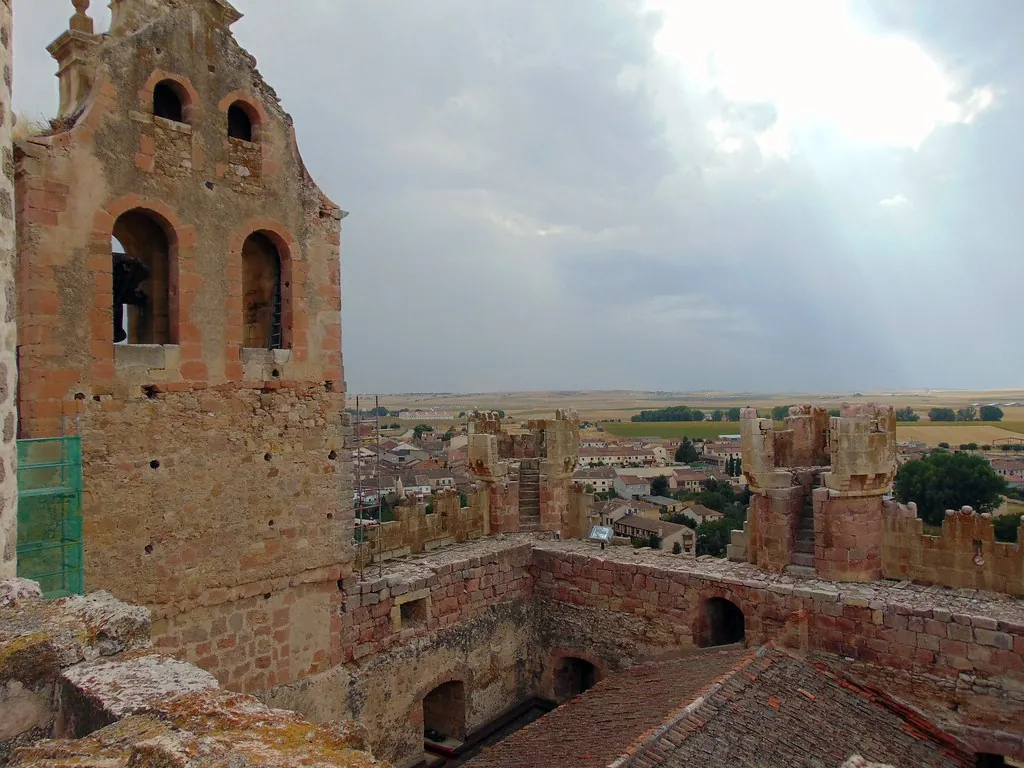
The church of San Juan Bautista squats at the top of the rise, its bell tower a later add-on bricked onto a twelfth-century nave. The door is usually unlocked; push it open and the interior smells of wax and mouse, the floor slopes 8 cm from left to right, and the fresco over the altar is flaking like old emulsion. There are no tickets, no guides, no postcards. Still, the building anchors the village more firmly than any cathedral anchors a city. From the tiny choir loft you can see straight down the nave, through the open doorway, across the wheat, all the way to the blurred edge of the plateau. The view is the steeple, the landscape the transept.
Outside, the real fabric is the land itself. In early May the wheat is ankle-high and emerald; by late June it turns bronze and whispers like dry rain. After harvest the stubble looks shaved and tired, then September rain brings a fuzz of green shoots that start the cycle again. The tracks that slice the fields are farm roads, not footpaths, yet no one objects if you walk them. Just remember to leave gates as you find them and to step aside when a combine trundles past—the drivers raise a hand in thanks, the same greeting they have used since their grandfathers worked with mules.
Walking without waymarks
There are no glossy panels depicting local butterflies, no steel railings, no “You Are Here” maps. Instead, the GR-88 long-distance trail passes within 3 km of the village, and a lattice of agricultural lanes links Munoveros to three abandoned threshing floors and a derelict stone shelter where shepherds once overnighted. A circular route of 9 km heads north to the ruins of Ermita de la Soledad, returns along the banks of the dry Río Pollos, and takes roughly two hours—longer if you stop to watch harriers quartering the stubble.
Winter walking is possible: skies are cobalt, the air sharp enough to make your eyes water, and the crunch of frost beneath boots replaces the summer whisper of wheat. Snow arrives rarely but when it does the roads are cleared last; carry a shovel and be prepared to spend the night if the wind picks up. Spring and autumn provide the kindest conditions, though May can bring a week of horizontal rain that turns the clay lanes into glue. Summer hikes start at dawn; by eleven the heat shimmers and the only shade is the wafer-thin shadow of a telegraph pole.
What you eat depends on the day
The village itself has no restaurant. The bar serves tortilla the size of a cartwheel and coffee that tastes of burnt toast; if you want lunch you order the previous day so Pilar can defrost lamb. Most visitors eat in the neighbouring towns. In Navas de Riofrío, 12 km south, Asador José María roasts suckling pig over holm-oak embers and charges €24 for a quarter portion; arrive before two or queue with coach parties from Madrid. Closer, in Palazuelos de Eresma, the factory shop of the local brewery, La Virgen, sells a litre of amber lager for €2.80 and will fill your own bottle like a petrol station.
Self-caterers should shop in Segovia before driving up—the village grocery closed in 2018. The Friday market in the capital’s Plaza del Azoguejo is good for manchego, morcilla spiced with cinnamon, and jars of honey from Guadarrama. If you rent one of the two village houses available on booking platforms, the owner will probably leave you a dozen eggs still warm. Accept them; refrigeration is a city habit.
August fireworks and November silence
Fiestas take place during the third weekend of August, when the population quadruples. The programme is printed on a single A4 sheet taped to the church door: Saturday evening mass followed by a procession, a foam party for children in the square, and a dance that finishes when the band packs up at six in the morning. Sunday brings a communal paella; you buy a €5 ticket from the mayor’s cousin and carry your own chair. Visitors are welcome but not announced—just turn up with appetite and the ability to clap in time.
The rest of the year is quieter. In November the village smells of diesel and wood smoke; old men in flat caps carry bundles of pruned vines to feed their stoves. December daylight is barely nine hours long, the sun a silver coin wedged low in the southern sky. January frosts can last all day; by March the first green laces the fields and swallows stitch the sky. Each season announces itself plainly—there is no soft transition on the plateau.
How to arrive, how to leave
Madrid-Barajas lies 110 km south. From the airport take the A-1 north for an hour, turn off at junction 109 towards Carbonero el Mayor, then follow the SG-232 for 19 km of empty road. Car hire is essential; buses from Segovia reach the turn-off at Cabanillas del Monte but leave you 7 km short with no taxi service. Fill the tank in the city—village pumps close at eight and many only accept Spanish cards.
Accommodation is limited. One three-bedroom house has been restored with underfloor heating and Wi-Fi that flickers when the wind is in the north. Expect exposed stone, beams blackened by two centuries of smoke, and a shower powerful enough to rinse shampoo but not city stress. Price: €90 a night with a two-night minimum. There is no hotel, no pool, no spa. The balcony looks over wheat; at dusk a pair of red kites drift overhead, their wing-tips finger the sky like conductors counting rest beats.
Leave before sunrise at least once. Stand beside the stone cross at the entrance, face east, and watch the plateau appear line by line: first the road, then the church, finally the fields rolling away until the curve of the earth cuts them short. You will hear your own heart, and the small, dry sound of wheat waking. After that, motorways feel crowded and lowlands seem starved of oxygen. It is not a dramatic place, Munoveros, but altitude has its own gravity; many visitors find themselves plotting a return before they have reached the bottom of the hill.