Full Article
about Segovia
UNESCO World Heritage city, known for its Roman aqueduct and fairy-tale Alcázar.
Hide article Read full article
The Sound of a Shutter at Dawn
At eight in the morning, the Plaza del Azoguejo smells of fresh bread and damp stone. Sunlight has just begun to touch the upper arches of Segovia’s aqueduct. The granite still holds the night’s chill. The sounds are practical and brief: quick footsteps, the hiss of a bus door closing, the sharp rattle of a metal shutter being raised on a bakery. For an hour, the monument is not a postcard. It is just there, part of the city’s waking up.
A little later, the first groups arrive and the scene shifts. But that early moment, when the city seems to yawn, tells you how Segovia breathes.
The City’s Granite Spine
The aqueduct is not simply something to look at. It feels more like the skeleton of the city. It runs through the centre with an ease that is hard to explain: granite blocks set one on top of another, without visible mortar, held together by a balance that still puzzles many.
From below, the scale is clearer. Looking up, the sky appears framed between the stones. Many visitors place a hand on the lower blocks, worn smooth by centuries of contact. Up close, you see it is not about perfection. There are small cracks, uneven edges, and the occasional tuft of grass pushing through a joint. The stone expands and contracts with the cold of winter and the dry heat of summer. That constant tension is part of what has allowed it to endure.
It is easiest to take it in early or late. By mid-morning, the square operates like a pedestrian roundabout, a constant flow of people moving through.
Turning Away from the Flow
A short walk away, the layout changes. Streets narrow and begin to slope uphill, leading towards the old Jewish quarter. It is not always clearly signposted. You can turn into almost any street and suddenly the noise fades.
The Casa de los Picos appears almost without warning. Its façade is covered with hundreds of carved granite points, as if the wall had been turned into armour. They say there are more than six hundred. No one seems entirely certain of the exact number.
A little further uphill, you find the story of the Jewish community that lived here until the end of the 15th century. The space occupies a building that was once a synagogue. Inside are maps and everyday objects. It feels less like a formal lesson and more like a quiet reminder that these streets had a different life before the expulsion.
A View from the Tower
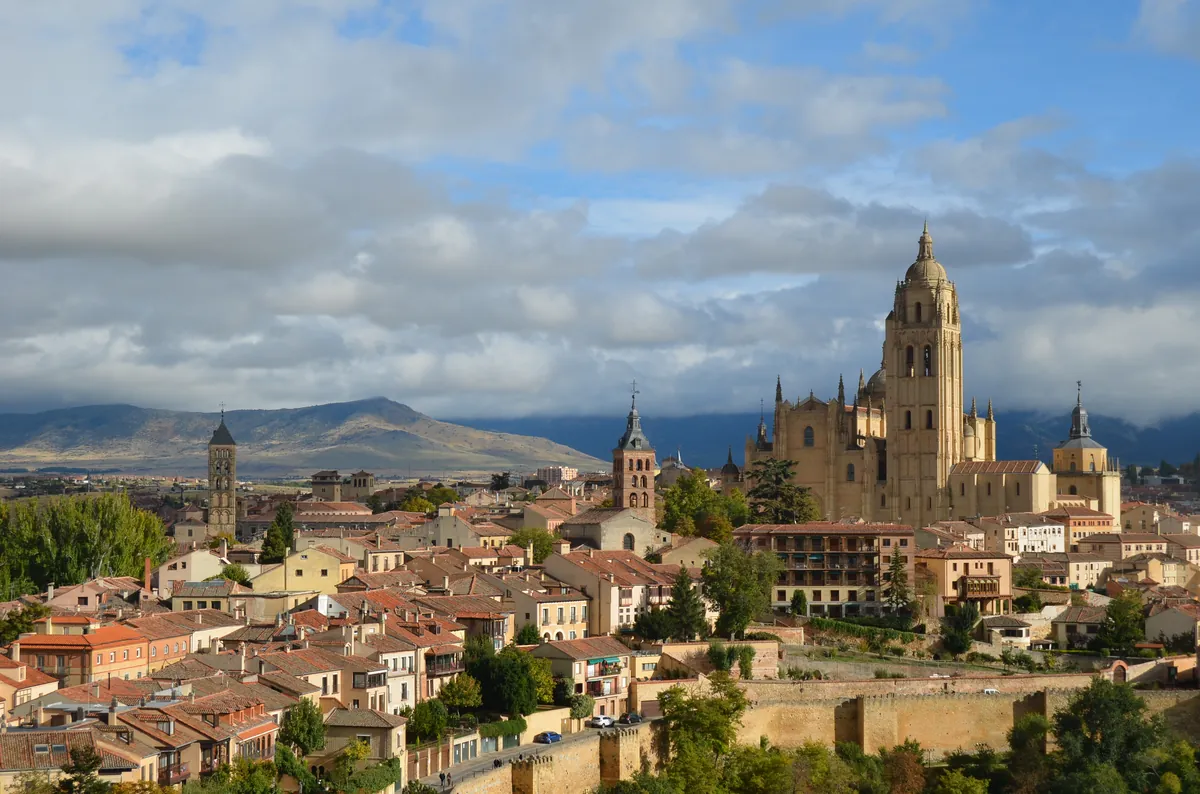
The cathedral stands in the Plaza Mayor with a presence that suggests it is watching over the whole city. From a distance it seems almost light, but closer up its true scale becomes clear: high walls, buttresses and a tower rising above the rooftops.
Climbing the tower means tackling a long, narrow spiral staircase. It is not a quick ascent. Halfway up, cold air begins to filter in through the upper windows. At the top, Segovia opens out: dark roofs, chimneys, the outline of the Alcázar in the distance, and the valley of the Eresma closing the city on one side.
Inside, the cathedral carries that familiar scent found in many old churches, a mix of wax, wood and damp stone. Construction began in the 16th century, when Gothic architecture was already fading elsewhere in Europe. Here, they continued with high vaults and coloured stained glass, as if time moved more slowly on this plateau.
The Weight of a Ceramic Plate
Around one o’clock or a little later, the centre begins to smell of wood-fired ovens. In many traditional dining rooms, cochinillo is cooked slowly until the skin turns crisp and amber. There is a custom of cutting it with the edge of a ceramic plate to prove it is ready. A dry crack can be heard, repeated across different rooms.
Judiones arrive in earthenware dishes with a thick, dark broth. They are sizeable beans, almost like old coins. Afterwards often comes ponche segoviano, a layered cake with a sweet topping lightly caramelised on its surface.
It is substantial cooking. In winter it feels fitting. In August, it demands an unhurried pace and perhaps a long walk afterwards.
Light and Crowds
Segovia shifts noticeably with the day and season. Summer weekends bring heavy crowds around the aqueduct and Alcázar; moving calmly through those areas becomes difficult.
During the week, especially early in the morning or towards evening, central streets become half-empty again and granite glows with soft golden light.
Autumn tends to suit this place well: fewer people and cool air coming down from nearby mountains. Winter has its own atmosphere. On some days fog settles between arches making everything quieter as if city had lowered its voice for few hours. If you come then wear shoes that grip wet cobblestones. That practical detail matters more than any list of sights