Full Article
about Vegas de Matute
Mountain village with historic lime kilns; surrounded by holm-oak groves.
Hide article Read full article
Early in the morning, when the air still drifts down cold from the sierra, Vegas de Matute is defined by footsteps and birdsong. A shutter lifts slowly. The ground in the narrow streets holds on to the night’s damp, and the stone façades in earthy tones catch a pale light that takes its time to warm the village.
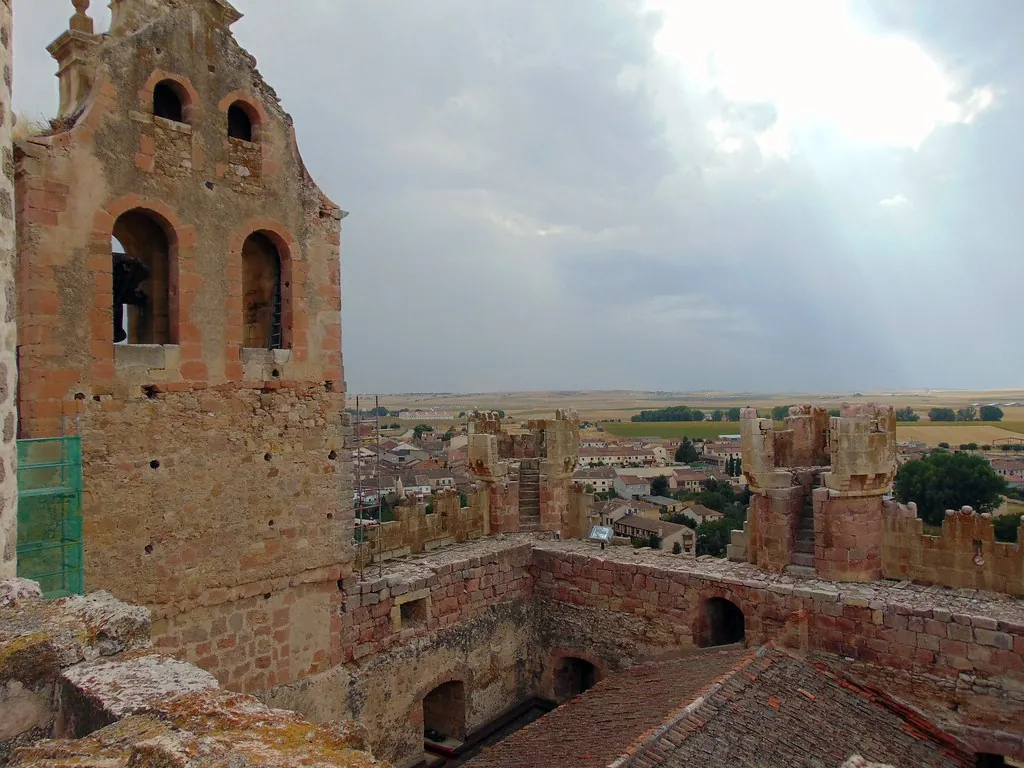
With only a few hundred inhabitants, life moves at an unhurried pace. Vegas de Matute lies in the Tierras de Segovia, at just over a thousand metres above sea level. The landscape sets the tone: open fields, plots of cereal crops and gentle hills where the wind moves freely, rarely meeting any real obstacle.
Morning in the Tierras de Segovia
The tower of the iglesia de San Andrés marks the centre of the village. It is easy enough to find your bearings, at some point it will appear between the houses. The bell sounds throughout the day, mixing with blackbirds and the scrape of a gate or the thud of a courtyard door.
In the early hours there is still a steady trickle of activity. People head out to tend vegetable patches, chicken coops or small holdings. In winter, the smell of firewood lingers in the air. When sowing season begins, the scent shifts to freshly turned earth.
This rhythm feels closely tied to the land. Daily routines follow light and weather rather than strict timetables. The village does not present itself as a place of spectacle, but as a working rural community shaped by altitude and seasons.
Fields and the Fuensanta Reservoir
The countryside around Vegas de Matute changes noticeably as the months pass. In spring, the fields become a dense green. By midsummer, yellow dominates as the cereal ripens, and the air carries a dry, faintly sweet smell.
Agricultural tracks lead out from the village, crossing low hills with very little shade. Anyone walking here during the hottest months should carry water. The terrain is open, and the sun falls directly for much of the day. There are few trees to soften the heat, and the horizon often feels wide and uninterrupted.
A few kilometres away lies the embalse de la Fuensanta. On clear days, its water reflects the clouds and briefly breaks the visual rhythm of cultivated land. The reservoir introduces a different texture into a landscape otherwise defined by crops and open ground.
These surroundings are typical of the interior of Castilla y León, where altitude and exposure shape both agriculture and daily life. The sense of space is constant, as is the wind that moves across the fields.
Stone Houses and Village Memory
The historic centre preserves many traditional houses. Walls combine stone and adobe, thick wooden doors guard the entrances, and small windows were designed to retain warmth during long winters.
Many homes include an interior courtyard or old stables attached directly to the living quarters. This layout speaks clearly of a time when livestock and farming were woven into everyday domestic life. The boundary between home and work was often no more than a doorway.
Among the buildings, the so-called Casa del Maestro stands out. It is a simple structure that recalls a period when the village school formed a focal point of social life. In small communities like this, the classroom was more than a place of lessons. It brought families together and anchored the rhythm of the year.
Walking through the streets, the materials tell their own story. Stone dominates, with little in the way of decoration. The emphasis is on solidity and practicality. These are buildings made to withstand cold winters and strong winds rather than to impress passers-by.
The Iglesia de San Andrés
The iglesia de San Andrés probably dates back to the 16th century, although it has undergone several renovations over time. Its interior is restrained. There is a single main nave, a wooden roof structure and a modest retablo behind the altar.
From the outside, the tower is visible from various points in the village. The façade carries no elaborate ornamentation. Bare stone prevails, and the overall impression is of a building intended to endure.
As in many Spanish villages, the church remains a visual and symbolic centre. The sound of its bell travels easily along the streets, marking hours and gatherings. It is a presence that connects the different parts of the village, whether residents are in their homes, in the fields or passing along the agricultural tracks.
Paths Towards the Páramo
Tracks leave Vegas de Matute in several directions, linking it with nearby villages in the area. These are dirt paths that cut through cultivated fields and small patches of low scrub.
Walking along them is a straightforward experience: boots on gravel, wind moving through cereal crops and, with a little luck, a bird of prey gliding over the plots. Anyone carrying binoculars may spot species typical of the steppe-like landscapes of inland Castilla. The open terrain makes it easier to follow their flight against the sky.
The word páramo in Spain refers to a high, open plain with sparse vegetation. The paths leading out of the village gradually approach this kind of terrain, where exposure to wind and sun shapes both plant life and farming patterns. It is not a dramatic landscape, but one that reveals its character through light and distance.
When to Visit
Vegas de Matute shifts with the seasons. In summer, the low evening light falls across the fields and highlights the textures of soil and old roof tiles. It is a good time to wander slowly through the streets, when the heat begins to ease and shadows stretch along the stone walls.
The village’s celebrations in honour of its patron, San Andrés, usually draw back many former residents during those days. Outside these dates, the atmosphere is much quieter.
It is worth bearing in mind that services within the village itself are limited. If planning to spend the day in the area, it makes sense to organise meals in advance or look towards nearby towns for options.
Vegas de Matute does not try to command attention. What it offers is a small settlement open to the surrounding countryside, where time is still measured by light, harvests and the sound of a bell carrying through the streets.