Full Article
about Alcubilla de Avellaneda
Town on the border with Burgos, noted for its Renaissance palace and quiet setting.
Hide article Read full article
A village where silence is literal
A dirt track, with a couple of sheep grazing alongside, leads towards the square. On clear days the sun bounces off the pale stone paving and makes you narrow your eyes. Alcubilla de Avellaneda, in the area known as Tierras del Burgo in the province of Soria, is one of those villages where silence is not a figure of speech. What you hear is the wind nudging a loose sheet of metal, the distant engine of a tractor, the sharp cry of swifts swooping low overhead.
Just over a hundred people live here. The horizon stretches out without interruption, a sweep of cereal fields that shift in colour with the seasons. At around 900 metres above sea level, the altitude makes itself felt, especially towards evening. Even in summer, the air turns cool once the sun drops behind the low hills. Depending on the direction of the breeze, it may carry the scent of dry straw or old timber.
The name Alcubilla is often linked to Arabic roots. “Al‑qubba” would refer to a vault or covered structure. Avellaneda appears in many place names across Castile and usually points to former woodland or areas with hazel trees. Today the landscape is more open, dominated by cereal crops with scattered patches of holm oak.
Stone, wood and unhurried streets
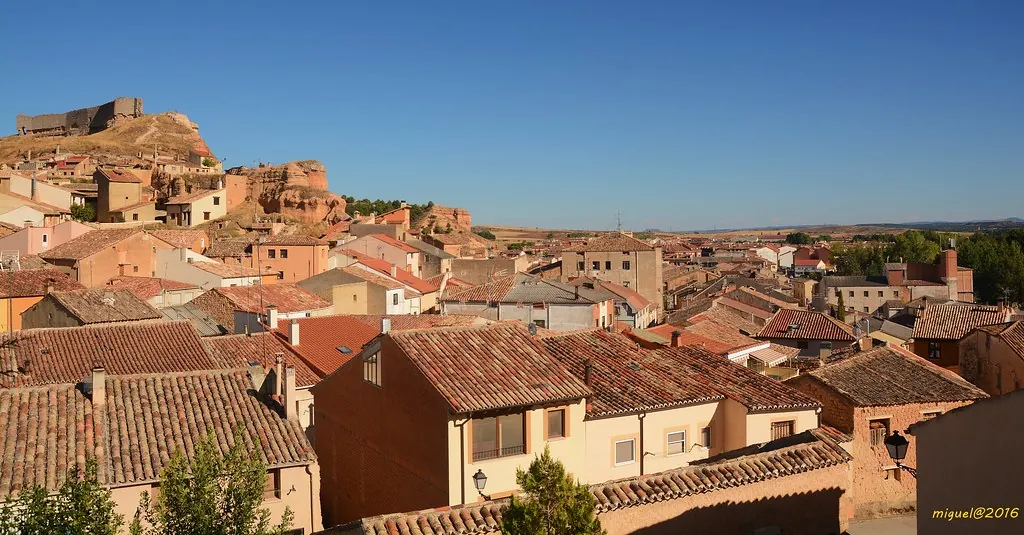
It does not take long to walk around Alcubilla de Avellaneda. The streets are short, the layout compact. Houses follow the sober style typical of this part of Soria: thick stone walls, heavy wooden gates, the occasional worn coat of arms set into a lintel. Nothing is oversized or showy. The materials come from the surrounding land, and it shows.
At the centre stands the parish church. It is a simple building, constructed from local stone, with a square tower rising above the village roofline. When it is open, which is not always the case, the interior feels austere. Wooden pews line the nave and the altar clearly bears the marks of time. There are no grand decorative schemes, just the quiet presence of a space that has served the community for generations.
Alcubilla does not offer major monuments or sites designed for long visits. Interest lies in the details: the rough texture of a façade, uneven roof tiles, a yard still in use, a bicycle leaning against a whitewashed wall. These are signs of a village that continues to function on a small scale. Life here has not been curated for visitors. It simply goes on.
The plateau beyond the last houses
Step beyond the final row of buildings and agricultural tracks begin almost immediately. The view opens out at once. This is an undulating plateau where cereal crops dominate for most of the year. In spring the green is intense and fresh. By late summer the fields turn gold and ochre. Winter strips the colour back. Greys take over and the wind moves freely across the open plots.
The sky often draws the eye. Birds of prey use the air currents above the low rises. Kestrels hover, and the occasional eagle circles while scanning the stubble below for movement.
From certain nearby high points, more gentle elevations than true hills, the scale of the territory becomes clear. Kilometres of open farmland extend in all directions, punctuated by isolated holm oaks, the odd apiary and, further away, lines of pine woodland. There are few visual barriers. The sense of space is constant.
Rural paths and long perspectives
Several rural tracks lead out from Alcubilla, routes that for decades, perhaps centuries, have linked fields, neighbouring villages and old livestock drove roads. They are straightforward walks, without steep gradients. The terrain is forgiving underfoot, though it is wise to judge distances carefully. On this plain, what looks close can take far longer to reach than expected.
Early morning and late afternoon tend to be the most comfortable times to set out, especially in summer. Light falls at an angle across the fields and the heat is less intense. On windy days the character of the landscape shifts. The sound of air moving through cereal or over dry stubble accompanies each step, a steady background rhythm.
There is little shade once outside the village boundary. The openness is part of the appeal, yet it demands a certain respect for conditions. Water is not available along the tracks, and there are no marked fountains beyond the built-up area.
Autumn mushrooms and wide skies
In autumn, some of the surrounding pinewoods attract people heading out to look for mushrooms. As in much of Soria, mushroom picking is usually regulated, so it is advisable to check the current rules before entering woodland. It is also worth remembering that not every year is a good one. The season depends heavily on rainfall.
For those carrying a camera, the first hours of the day work particularly well. Dawn light strikes the stone walls from the side and stretches shadows across the square and the nearby threshing floors. There are not many elements in the landscape. Precisely for that reason, light becomes the main subject. Subtle shifts in tone across stone and field can transform an otherwise spare scene.
Throughout the year, the sky plays a central role. With so few vertical features, clouds and changing weather patterns feel closer and more present. In winter especially, when the palette narrows and the wind runs unobstructed, the atmosphere can seem stark. In spring and summer, colour returns in layers, first green, then gold.
Before setting off
Alcubilla de Avellaneda is small and services are limited. Anyone planning to eat out or shop will generally need to drive to nearby towns in the wider comarca. Bringing water is sensible if heading out on foot, as there are no signposted fountains outside the village centre.
The quiet rhythm changes briefly in August during the festivities of San Bartolomé. At that time, residents who live elsewhere return and the village livens up for a few days. Beyond that period, the pace remains calm, sometimes very calm.
For travellers looking for constant activity or a packed itinerary, Alcubilla may feel too still. For those content to walk for a while, listen to the wind and watch how light alters the colour of cereal fields, it offers exactly that. The appeal lies in simplicity: open horizons, solid stone, and a way of life scaled to the land that surrounds it.