Full Article
about Caracena
Medieval town with two Romanesque churches and a spectacular castle over a canyon.
Hide article Read full article
A Village That Fits in a Single Glance
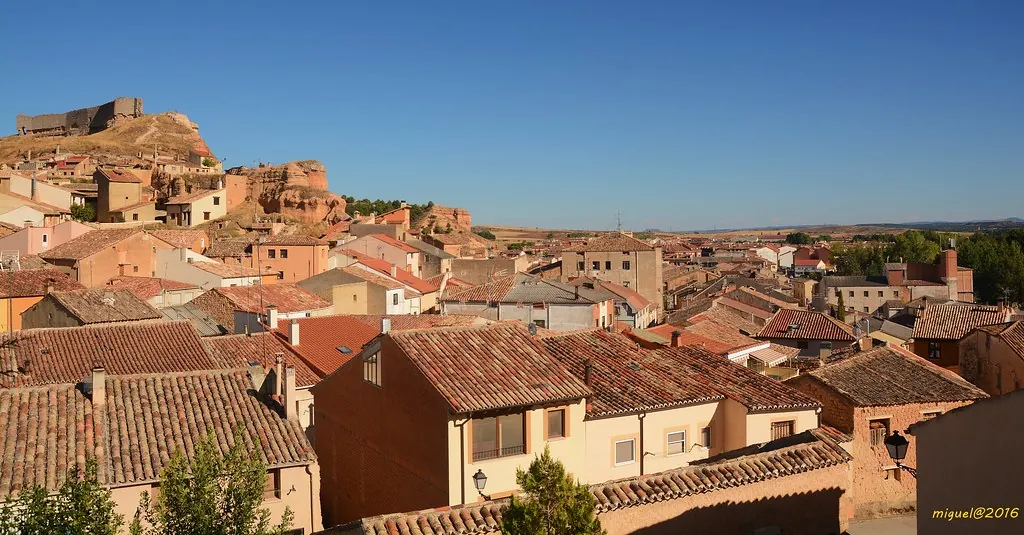
There are places where, within minutes of arriving, it feels as though several centuries have quietly slipped away. Caracena is one of them. The road climbs steadily, parking is wherever space allows, and then the realisation comes: the entire village fits into a single sweep of the eyes. Today barely a dozen people live here, yet the stone tells a far bigger story.
Caracena lies in Tierras del Burgo, in the north of the province of Soria, set on a rocky promontory more than 1,000 metres above sea level. There are no explanatory panels on every corner and no overt sense of staged tourism. What you find instead is silence, stretches of crumbling wall and a medieval street plan that remains surprisingly clear. A short walk is enough to understand that centuries ago this was more than a cluster of houses.
As you approach, towers come into view, fragments of defensive walls and grey stone homes that appear suspended in another era. During the Middle Ages the town held considerable importance in the area and had a population far larger than today’s. What remains is the framework: narrow streets, houses bearing coats of arms on their façades and religious buildings that recall a time when decisions affecting the surrounding territory were taken here.
Walking through the centre can feel like stepping into a model village built at full scale. Details invite closer attention: a worn heraldic shield, an arched doorway shaped by time, the stone of the rollo jurisdiccional. This stone pillar symbolised the authority of the town in past centuries, a visible reminder that Caracena once exercised its own jurisdiction.
Romanesque Churches and the Outline of Power
Caracena is known in the province for its two Romanesque churches. The Iglesia de San Pedro usually attracts the most attention, particularly for its portico with carved capitals. Anyone with an interest in Romanesque art will want to pause here. The carvings still retain a good level of detail, offering a tangible link to the medieval craftsmen who shaped them.
A few steps away stands the Iglesia de Santa María. It is also Romanesque in origin, although later additions have altered parts of the structure. The semicircular apse remains clearly recognisable and helps to picture how the complex might have looked when the village was far more animated than it is now.
Access to the interiors is not always straightforward. In very small villages like this, keys are often held by the town hall or a local resident, and opening times are not fixed in the way travellers might expect. Anyone keen to go inside would be wise to make enquiries in advance or be prepared to admire the buildings from the outside.
Above the houses rise the castle and the remains of the town walls, still defining Caracena’s silhouette. They are largely in ruins, yet their position makes the original strategy obvious. From the higher ground the entire valley is visible, along with the rocky cliffs carved by the river Caracena far below. The terrain underfoot is uneven, with loose stones in places, so sturdy footwear makes the visit easier.
Another striking feature is the number of noble houses scattered through the historic centre. Many are partly abandoned, though their façades continue to display carved heraldic shields. In a settlement with so few inhabitants today, the concentration of these marks of status is unexpected and underlines how different Caracena’s fortunes once were.
The Canyon of the River Caracena
The landscape surrounding Caracena carries almost as much weight as the village itself. Beside the built-up area, the canyon of the river Caracena cuts a deep fissure into the terrain, its rock walls rising steeply from the valley floor. Descending towards the river clarifies why the settlement was established precisely here. From below, the rock face resembles a natural defensive wall.
Simple footpaths lead down towards the bottom of the canyon or along parts of the valley. They are not especially demanding routes, yet a measured pace is sensible, as some sections pass close to steep drops. In a couple of hours it is possible to enjoy a rewarding walk and return to the village without any rush.
Those with an interest in birdlife may want to look up from time to time. Griffon vultures are often seen gliding along these rocky walls, riding the air currents that rise from the canyon. Sometimes all it takes is sitting quietly for a while before their broad wings come into view.
The setting reinforces the sense that Caracena’s story is inseparable from its geography. The rocky promontory, the defensive views over the valley and the protection offered by the canyon all explain why this small place once held such weight in the region.
Time, Stone and Stillness
Caracena is not a destination built around a packed schedule. There are no long lists of activities competing for attention. The experience is simpler. A walk through the streets, a pause by the Romanesque churches, a climb towards the castle ruins, then a detour to the edge of the canyon. An hour passes, then another, without any particular plan.
The quiet is part of what defines the visit. With so few residents, daily life unfolds at a different rhythm. The absence of crowds or commercial noise allows the architectural details to stand out more clearly. The worn shields on the façades, the texture of the stone walls and the outline of the apse against the sky all become easier to notice.
Caracena’s present-day scale contrasts sharply with its medieval prominence. In the Middle Ages it had a much larger population and a significant role in the surrounding territory. Today what remains is the physical imprint of that period. Rather than reconstructed grandeur, there is a certain rawness to the ruins and walls, a sense that history here has not been polished for display.
A simple piece of advice suits the place: do not arrive in a hurry. Caracena does not reward speed. It is better approached as somewhere to wander without urgency, to lean on a low wall and look out across the valley, to follow the line of the old walls with the eye and imagine the life that once filled the streets.
By the time you leave, the impression lingers that the village has revealed enough. Not through grand exhibitions or detailed explanations, but through its layout, its churches, its ruined castle and the canyon at its side. In a settlement that can be taken in at a glance, there is still more than enough to hold the attention.