Full Article
about Castillejo de Robledo
Located at the far west, with a Templar castle and Ribera del Duero vineyards.
Hide article Read full article
Where the plateau begins to shift
Castillejo de Robledo sits at the south-eastern edge of the province of Soria, within the Tierras del Burgo area. Here, the high central plateau of Spain begins to soften and fold slightly as it approaches the Duero valley. The village lies at around 960 metres above sea level, surrounded by cereal fields and patches of oak woodland that give the place its name.
Today, roughly a hundred people live here. That figure says a lot about both the scale of the village and its pace of life. This is a place shaped by routine rather than urgency, where the landscape and the seasons still set the tone.
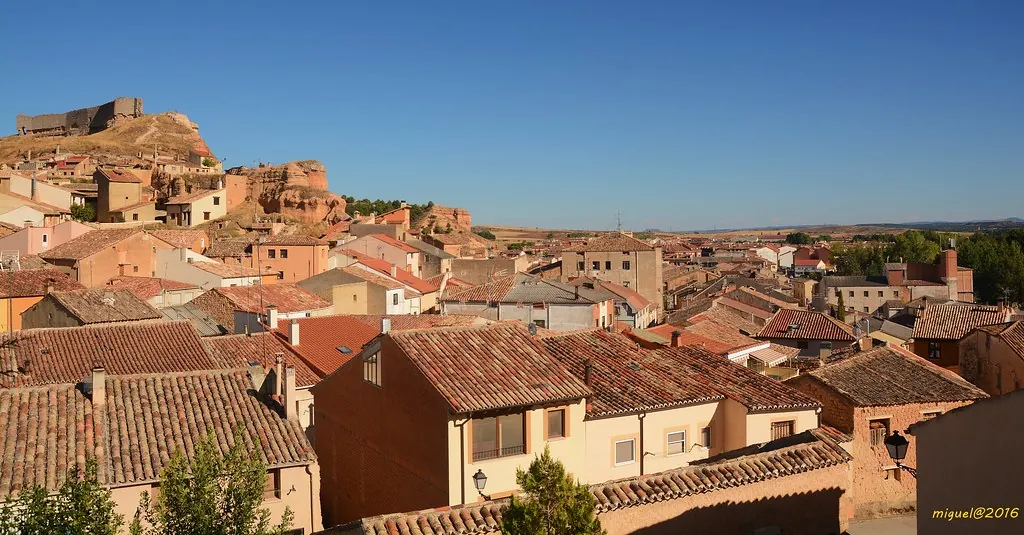
Historically, Castillejo de Robledo has been tied to dryland farming and livestock. The layout of the village reflects that background. Houses are practical rather than decorative, often with adjoining pens and outbuildings designed for work. Across this part of Soria, architecture tends to follow the same logic: local materials, thick walls to deal with winter cold, and buildings that adapt to the terrain rather than forcing it into a rigid plan.
The church and the heart of the village
The most visible structure is the parish church, originally built in the 16th century and altered at different points afterwards. Its stone tower defines the skyline from a distance and still acts as a central reference point for the settlement.
Inside, the space is simple. There are elements from different periods, including a stone baptismal font and a Baroque altarpiece, which reflect gradual changes rather than a single grand design. This is typical of churches in the area: solid, functional, and closely tied to everyday life over the centuries.
Around the church is a modest square and a handful of short streets that link into the rest of the village. The houses combine stone, adobe and curved roof tiles. Large wooden gates can still be seen, once built to allow carts through, along with spaces used to store grain or keep animals. On some walls, old iron fittings and marks of wear remain visible. They offer a direct sense of how rural life was organised, without needing any explanation.
A settlement shaped by work
Castillejo de Robledo does not follow a clear urban plan. Like many small villages in the province, it developed in response to practical needs over time. One house was built next to another, with pens behind and barns at the edges.
That mixture becomes clear when walking through the streets. Some houses have been restored, while others retain their original structure. The contrast is part of the character of the place, where change has happened slowly and unevenly.
On the outskirts, traces of traditional agricultural life are still easy to spot. Threshing floors, small vegetable plots and farm buildings remain scattered around the village. They show how work was organised until relatively recently, and how closely daily life was tied to the surrounding land.
Oak groves, open fields and quiet paths
The landscape around Castillejo de Robledo alternates between cultivated plots, oak woodland and low scrub. It is not rugged terrain, but it is gently uneven. Once a short distance away from the village, there are open views across the plains of Soria.
Several rural tracks leave from the village, linking fields and neighbouring settlements. These routes were originally used for agricultural access and are still easy to follow today. They are not marked as official walking trails, but their purpose remains clear, and many are now used for walking or cycling.
In autumn, when the rains arrive, nearby pine forests and wooded areas attract people interested in mushroom foraging. As in the rest of the province, this activity is usually regulated, so it is worth checking the local rules beforehand.
Local life and seasonal gatherings
The village calendar revolves around religious celebrations connected to the parish. The main festivities usually take place in summer, when people who have moved away return for a few days. During that time, Castillejo de Robledo briefly becomes busier and more animated.
There are no large-scale events or programmes aimed at tourism. What happens during these celebrations follows the rhythm of local traditions and neighbourhood gatherings, rather than being designed for visitors.
Visiting with simple expectations
Castillejo de Robledo is a very small village with limited services. It makes sense to arrive prepared, especially if planning to spend several hours there or explore the surrounding countryside.
A visit itself does not take long in terms of sights. The most rewarding approach is to walk slowly through the streets, noticing the details of the buildings and how they connect to the land. From there, heading out along one of the rural paths gives a fuller sense of the place.
Out among the fields and oak groves, the relationship between the village and its surroundings becomes clear. This is where Castillejo de Robledo is best understood, not through landmarks or attractions, but through the quiet continuity between settlement and landscape.