Full Article
about Espeja de San Marcelino
Municipality near the Cañón del Río Lobos Natural Park with marble quarries
Hide article Read full article
First Impressions That Stay True
Some places build expectations that fall apart on arrival. Espeja de San Marcelino does the opposite. What you imagine is largely what you find. Tourism here is not about ticking off landmarks or chasing standout sights. It leans more towards recognising what has always been there: stone buildings, open countryside, and a kind of silence typical of Soria that almost feels audible.
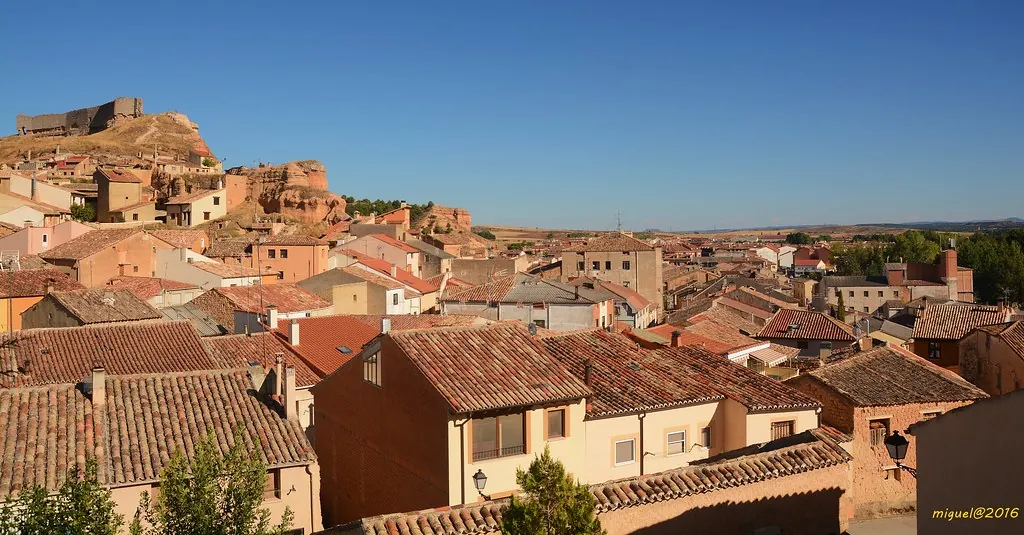
The village sits in the Tierras del Burgo area and has around 160 residents. Arrival is straightforward. A main street runs through it, lined with fairly austere stone houses, and the church marks the centre. There is no attempt to impress. Everything feels direct and unadorned.
A Village That Keeps Its Pace
Espeja has never been a place shaped by heavy visitor traffic, and that shows. Life here has revolved for generations around farming and livestock. The houses reflect that way of life. Builders used what was close at hand: local stone, wooden beams, and courtyards designed more for work than display.
Walking through the streets reveals small, telling details. An old doorway marked by years of use. Wine cellars cut into the rock. Chimneys that in winter likely send up smoke for most of the day. This is not a monumental setting. It is a place that has continued to function without much concern for how it might appear to outsiders with cameras.
The Church and Traces of Earlier Times
The Iglesia de la Asunción stands out as the most prominent building. Its square bell tower and simple façade set the tone. Over time, the structure has been altered to meet the needs of the community, resulting in a building that reflects gradual change rather than a single design.
Inside, attention often goes to the coffered ceiling and several old altarpieces. They are not elaborate. Instead, they feel like objects that have remained because they still serve a purpose. The overall impression matches the rest of the village: practical, restrained, and tied to continuity rather than display.
Open Land and Unhurried Walks
The landscape around Espeja de San Marcelino is typical of this part of Soria. Open meadows stretch outwards, broken by patches of oak trees. Agricultural tracks cross the terrain, usually with gentle slopes rather than dramatic climbs.
This is not a destination for high peaks or demanding routes. What it offers is space. A short walk often brings little more than a passing tractor or grazing livestock. The quiet is part of the experience.
Birdlife adds another layer for those who pay attention. Birds of prey are often visible circling above the fields. With a bit of patience, species such as kites or sparrowhawks can be seen, particularly towards the end of the day when activity picks up.
Food Rooted in Tradition
Cooking in the area follows a direct approach, shaped by cold weather and long working days. Meals are filling and based on what has been available locally over time.
Roast suckling lamb, known as cordero lechal asado, appears frequently during celebrations or family gatherings. It is often prepared in traditional ovens found in the village or nearby. Alongside it, Castilian soups remain common, as do homemade cured meats and products from the annual pig slaughter, a long-standing rural tradition in many parts of Spain.
Autumn brings another seasonal element. Mushrooms begin to appear in the surrounding countryside when conditions are right. Boletus, níscalos, and other varieties are gathered in nearby woodland areas, especially in wetter years.
Festivities and a Transhumant Past
Summer changes the rhythm of Espeja. Residents who spend much of the year elsewhere return, and the main square becomes more active. The traditional festivities centre on the Virgen del Rosario, with processions and shared meals among families forming the core of the celebrations.
The village also has a history linked to transhumance, the seasonal movement of livestock between grazing areas. For centuries, herds travelled along established routes, and those paths still leave a mark on the landscape. Some of today’s trails follow lines very similar to those once used by shepherds moving their animals across the region.
A visit to Espeja de San Marcelino does not demand much time, and that is part of its character. A walk through the streets, a look across the surrounding fields, and the pace of life becomes clear quite quickly. In a place like this, that understanding is often enough.