Full Article
about Fuentecambrón
Town in the Pedro valley with well-preserved natural surroundings
Hide article Read full article
A village where time slows
At seven in the morning, a dense silence settles over the stone houses, still damp from the faint breeze that crosses the páramo, the high plateau typical of inland Spain. Early light slips between the walls and softens the colours of the façades until they almost fade. In that moment, the village seems to pause, as if time moves at a different pace in this corner of Soria.
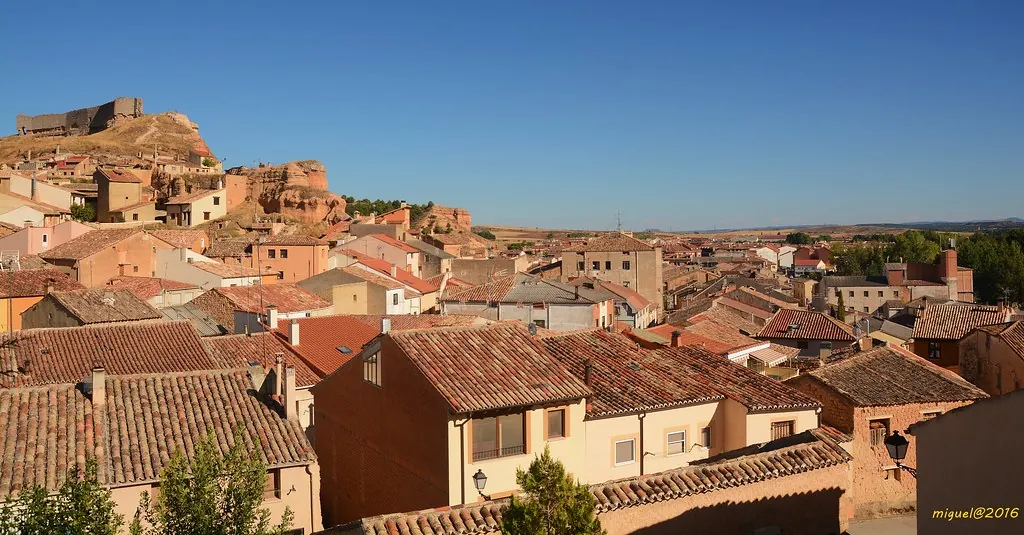
Fuentecambrón sits at 1,016 metres above sea level in the area known as Tierras del Burgo. It is a very small place, with just twenty-nine registered inhabitants, yet it holds a presence that does not rely on ornament or spectacle. Homes built from stone and adobe line its narrow streets, with aged wooden doors and conical chimneys designed to withstand long winters and many years of use.
A walk through the village becomes an exercise in noticing detail. A worn inscription above a doorway, a coat of arms eroded by time, or a recent repair set into an older structure all hint at stories that are still embedded in the place. Nothing announces itself loudly. The past appears in fragments, quietly, in the textures of walls and the shape of everyday objects.
The centre of village life
The parish church stands in the middle of Fuentecambrón. It is modest in size, but it carries weight through its role rather than its architecture. For generations, it has been a place where neighbours gather, sometimes to celebrate, sometimes to share silence. Its simplicity reflects that continuity.
The square around the church becomes more animated in summer. People return to the village, often maintaining family or emotional ties despite living elsewhere. Those weeks bring a different atmosphere, though the rhythm remains unhurried. Conversations stretch out, and time seems less structured. The sense of community becomes visible again, not through organised events but through shared presence.
Festivities follow that same tone. Summer is the main period for celebrations, when returning residents fill the streets and reconnect. These are restrained occasions, shaped by religious acts and shared meals rather than large public spectacles. Stories circulate between laughter and pauses, often under a clear night sky. August marks a peak in this seasonal change, when the usual routine gives way to a more festive mood.
Holy Week also takes place with a similar sobriety. Short processions move slowly through the streets, accompanied by low voices and measured steps. The atmosphere leans towards reflection rather than display, offering a moment to feel the connection between the village, its traditions and the land that surrounds it.
The landscape of the páramo
The natural setting around Fuentecambrón defines much of its character. The surrounding páramos open out into wide views, with horizons that seem to stretch indefinitely. At sunrise and sunset, the light reshapes the landscape into tones of ochre and gold. These transitions are gradual, and they reward patience.
Wildlife forms part of this environment. Birds of prey are often visible gliding above fields and grasslands. With a pair of binoculars, it becomes easier to follow their movements as they search for food or simply ride the currents of air. The ecosystem still retains a certain degree of purity, shaped more by natural cycles than by heavy human intervention.
Water appears in small but meaningful ways across the area. Springs and watering troughs remain scattered throughout the landscape, reminders of a time when livestock formed the core of daily life. Some of these still serve nearby enclosures and grazing areas. Others remain as traces of a way of living that has not entirely disappeared. The presence of water, along with the smell of damp earth, accompanies any walk and reinforces the sense that time moves more slowly here.
Paths between villages
Traditional paths connect Fuentecambrón with neighbouring villages. These routes are simple, with gentle changes in elevation and limited signposting. They invite a slower pace, where the journey matters more than the destination.
Spring and autumn bring particular character to these walks. In spring, wildflowers spread across the fields and introduce fresh colours and scents. Autumn shifts the palette towards deep ochres, with dry leaves underfoot and milder temperatures that make long walks more comfortable. The air often carries the smell of soil and vegetation, grounding the experience in the landscape itself.
Birdwatching can easily become part of these walks. Raptors and other species typical of the páramo appear regularly in these open spaces. The terrain allows for wide visibility, which makes observation accessible even without specialised knowledge.
Nightfall offers a different kind of experience. The absence of artificial light means the sky remains clear and dark. On cloudless nights, it takes only a short distance from the village to see the Milky Way stretching across the sky, sharply defined against the darkness. The stars appear in large numbers, uninterrupted by urban glow.
Food, seasons and the wider route
The surrounding area allows for a day that includes local produce. Roast lamb, cured meats and sheep’s cheeses form part of the regional food culture. These are tied closely to the agricultural and pastoral traditions that have shaped life in Tierras del Burgo.
Fuentecambrón works best as part of a broader route through this region rather than as a destination with extensive services of its own. Each stop in Tierras del Burgo reveals a fragment of a rural world that continues to exist, even if on a small scale. The village fits into that wider context, offering a way to understand how these landscapes and communities connect.
Choosing when to visit matters. Spring introduces fresh greens and new growth, along with lighter air. Autumn brings stronger colours and comfortable conditions for walking. Winter can transform the village into an even quieter setting, where the main sounds come from the wind moving between stone buildings and the occasional birdsong.
Fuentecambrón does not rely on major attractions or elaborate narratives. It offers something more restrained: a place to observe how life continues in a rural setting shaped by tradition, landscape and time.