Full Article
about Liceras
Mountain village on the Segovia border with a Muslim watchtower
Ocultar artículo Leer artículo completo
The church bell strikes noon, yet nobody appears. Not a soul emerges from the stone houses lining Liceras's single street, no café terraces fill with lunchtime chatter, no shops flip their signs to cerrado. At 1,128 metres above sea level, this tiny Sorian village keeps its own rhythm—one where silence isn't absence but presence, where the loudest sound might be a tractor grinding through distant cereal fields or the wind moving across the páramo.
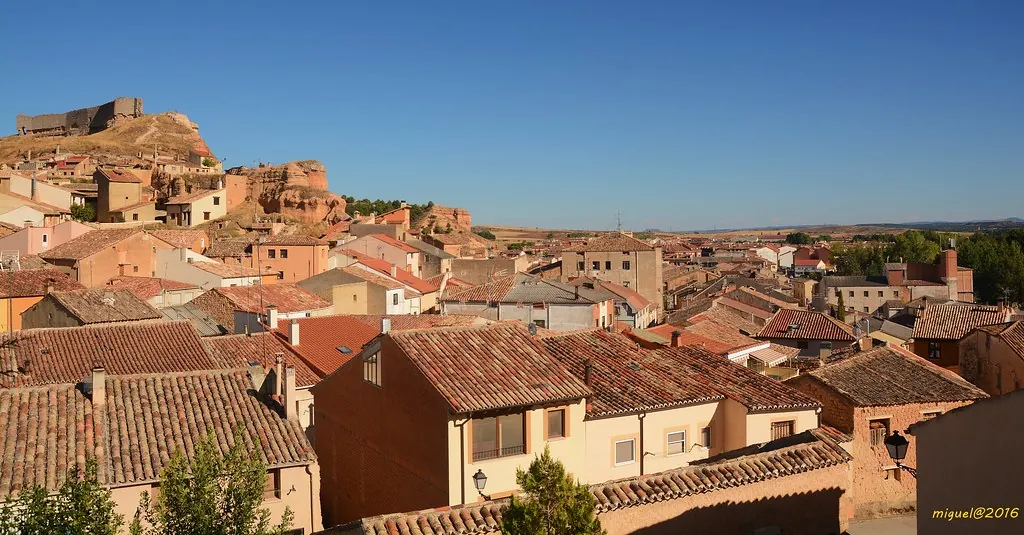
With forty-nine registered inhabitants, Liceras represents the extreme end of rural depopulation. Houses stand shuttered against winter; many open only in July and August when los de fuera—those from outside—return for holidays. The result feels less like abandonment, more like suspended animation. Stone walls weather, adobe facades flake, yet the village refuses to become a museum piece. Instead it exists in honest limbo: part working agricultural hamlet, part seasonal retreat for families maintaining ancestral ties.
Stone, Sky and Silence
The approach road winds through classic Castilian countryside—rolling plateaux patched with cereal crops, scattered holm oaks providing the only vertical punctuation against horizon that stretches forty kilometres on clear days. At this altitude, the air carries noticeable thinness; even fit walkers find uphill gradients more demanding than anticipated. Summer brings intense ultraviolet; winter can trap the village beneath snow for days, the access road impassable without four-wheel drive.
Liceras itself clusters around its modest parish church, dedicated like many here to local patron saints rather than grand biblical figures. The building won't feature in architectural guides—rough-hewn stone, irregular proportions, a tower added piecemeal across centuries. Yet standing in the empty plaza before it, visitors grasp something guidebooks rarely capture: how faith and community sustained these marginal settlements through centuries of harsh climate, poor soils and political upheaval. The church door remains locked outside service times; nobody staffs tourist offices because none exist.
Residential architecture follows agricultural logic. Houses orient south-east for winter sun, their deep-set windows minimising heat loss. Ground floors once housed livestock; families lived above, warmth rising through wooden floors. Many properties retain original stone troughs, iron rings for tethering animals, bread ovens recessed into thick walls. Some conversions have occurred—Londoners or Madrilenos creating weekend retreats—though most remain family holdings, maintained just enough to prevent collapse.
Walking the Empty Tracks
Real exploration begins where asphalt ends. A network of unmarked caminos radiates across surrounding municipal land, used mainly by farmers accessing scattered plots. These tracks offer superb walking for those comfortable with self-navigation. Distances deceive: a barn appearing ten minutes distant requires forty-five across undulating terrain. Carry water—summers exceed thirty degrees—and download offline maps; mobile signal vanishes in valleys.
One recommended circuit heads south towards the seasonal Arroyo de Valdelavilla, dry most of the year but supporting rich riparian vegetation when winter rains arrive. The six-kilometre loop passes abandoned grain threshing circles, stone walls now serving as perches for little owls. September brings spectacle: stubble fields burn under controlled conditions, columns of smoke visible twenty kilometres, the smell of straw carbonising drifting across the plateau.
Birdlife rewards patience. Throughout the year, booted eagles and short-toed eagles patrol overhead; their calls—sharp whistles against wind—often provide first indication of presence. Stone curlews haunt fallow fields, their nocturnal wailing unsettling after dark. Bring binoculars but leave bird-call apps switched off; silence remains Liceras's defining characteristic.
The Seasonal Shift
Timing visits proves crucial. Spring arrives late; frosts continue into May, yet the subsequent explosion of wildflowers transforms cereal fields into impressionist canvases of poppies, cornflowers and wild marigold. Local farmers complain about crop damage whilst simultaneously posting Instagram photos—the contradictions of modern rural life.
Autumn delivers perhaps the finest experience. Daytime temperatures settle around twenty degrees, hawthorns redden along field boundaries, and mushroom foragers appear in surrounding oak woodland. Chanterelles and penny bun mushrooms emerge after September rains, though regulations require permits for commercial collection. Casual picking for personal consumption generally passes unchallenged, yet always check current restrictions—forestry patrols issue on-the-spot fines.
Winter brings brutal beauty. When la gota fría—the cold drop—sends Atlantic systems inland, snow transforms the landscape into something approaching tundra. Temperatures plunge below minus fifteen; even daytime struggles to rise above freezing. Such conditions create extraordinary photographic opportunities but demand preparation. The nearest hotel accommodation lies twenty-five kilometres distant in El Burgo de Osma; roads become impassable before ploughs arrive from provincial depots.
Summer attracts returning families, temporarily inflating population to perhaps two hundred. Children ride bicycles along empty roads, grandparents supervise outdoor meals extending past midnight. Yet even August maintains relative tranquillity—no bars blast music until dawn, no souvenir stalls clutter streets. The village's very lack of amenities preserves its atmosphere.
Eating and Sleeping (or Not)
Practical considerations limit conventional tourism. Liceras contains zero commercial establishments—no bar, no restaurant, no shop, no petrol station. The last grocer closed during the 2008 financial crisis; villagers now drive weekly to Burgo de Osma for supplies. Self-catering becomes essential unless invited into private homes, still common for those tracing family roots.
Accommodation options follow similar patterns. No hotels, hostels or official rentals operate within village boundaries. A handful of houses offer informal summer lets through word-of-mouth or basic Facebook listings, typically €60-80 nightly for entire properties sleeping six. Expect rustic conditions: wood-burning stoves, limited hot water, questionable Wi-Fi. Book directly with owners; no management companies handle arrangements.
Dining requires forward planning. The twelve-kilometre drive to El Burgo de Osma provides several decent options. Try Asador de la Villa for exemplary roast suckling lamb—around €22 per portion, ordered by weight. Their house red, from nearby Ribera del Duero, offers remarkable value at €14 per bottle. Closer alternatives exist in San Esteban de Gormaz, ten kilometres north, though quality varies dramatically.
The Honest Verdict
Liceras won't suit everyone. Those seeking boutique hotels, Michelin recognition or curated experiences should divert to Segovia or Salamanca. The village offers instead something increasingly rare: unfiltered rural reality, where beauty emerges through endurance rather than restoration, where silence carries weight rather than absence.
Visit with appropriate expectations. Bring supplies, download maps, prepare for weather extremes. Engage locals respectfully—many elderly residents speak only Spanish, their dialect retaining archaic vocabulary. Offer greetings; accept that conversations may extend far beyond British comfort zones. In return, experience a Spain largely vanished elsewhere: agricultural cycles dictating pace, community measured in shared history rather than shared facilities, landscapes that humbled generations before Instagram arrived.
The road leaving Liceras climbs gradually towards the N-122, the main artery connecting Soria with Portugal. Looking back, the village appears insignificant against vast horizon—cluster of stone cubes dissolving into brown fields. Yet memory persists: how silence felt almost physical, how sky seemed larger, how time stretched beyond watch faces. Some places reward through grand monuments; others, like Liceras, through subtraction—removing noise, haste, expectation until only essential elements remain: earth, sky, stone and the slow rhythm of lives continuing despite everything.