Full Article
about Montejo de Tiermes
Known for the Celtiberian-Roman archaeological site of Tiermes
Hide article Read full article
A village on the high plains of Soria
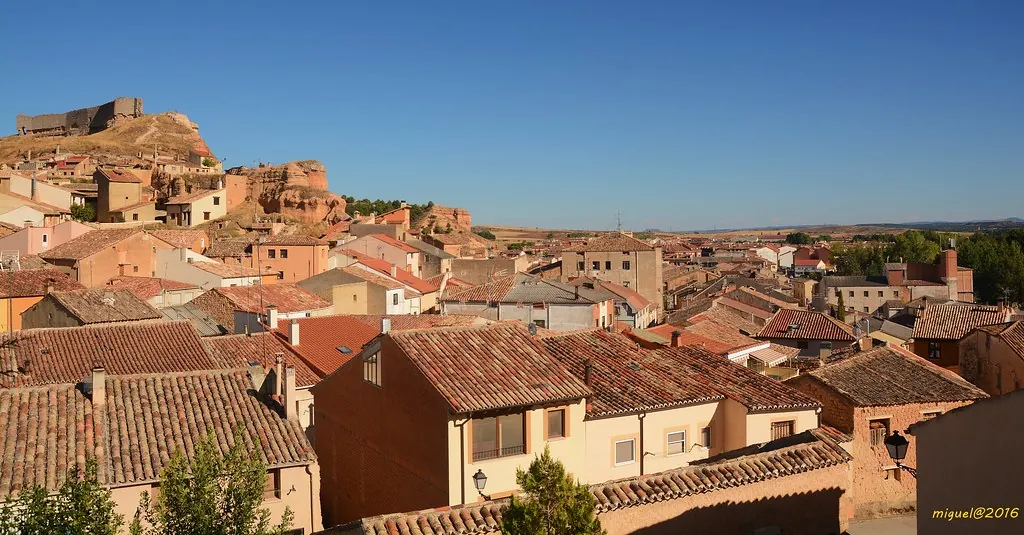
At around 1,150 metres above sea level, Montejo de Tiermes sits in the Tierras del Burgo area of Soria, a landscape defined by open plains and sandstone ravines dotted with holm oaks and junipers. The village has just over a hundred residents, a figure that reflects how this part of the province has changed in recent decades, with a steady decline in population.
The main reason people come here is the archaeological site of Tiermes, one of the most distinctive Celtiberian and Roman settlements in Castilla y León. Montejo itself remains quiet and functional, shaped by its agricultural roots. Short streets and houses built from local stone form a simple layout, typical of villages in this region. Daily life still revolves around farming and livestock.
The wider Tierras del Burgo area is sparsely populated and largely devoted to dry cereal farming and sheep grazing. Across its villages, the same architectural patterns appear: reddish masonry walls, large gateways once used for carts, and old stables integrated into the home. Montejo today acts as a base for visiting Tiermes and exploring a landscape that has changed very little over the centuries.
Tiermes, a city carved into stone
A short distance from the village, the archaeological site of Tiermes occupies a sandstone platform overlooking the surrounding land. It began as a Celtiberian settlement and later became a Roman city. What sets it apart is how the rock itself was used: instead of building extensively with cut stone, many structures were carved directly into the sandstone.
Among the most recognisable remains are dwellings hollowed out of the rock, along with a tiered seating area and various spaces that once formed part of the urban layout. Sections of water channels, also cut into the stone, are still visible and give an idea of the hydraulic system that served the settlement. Walking through the site reveals how closely the city adapted to the natural shape of the rock platform.
Next to the ruins stands the hermitage of Nuestra Señora de Tiermes. The current building incorporates remains of an earlier Romanesque monastery that once occupied the same spot. Its location is deliberate, overlooking both the valley and the broad sandstone surface where the city developed.
The Interpretation Centre is housed in buildings linked to that former monastic complex. Inside, artefacts recovered from excavations are displayed alongside explanations of the site’s history, from its Celtiberian origins through its Roman phase and eventual abandonment.
Back in Montejo, the church of San Pedro preserves Romanesque elements connected to the medieval repopulation of this part of southern Soria. It is not a large or elaborate structure, but it reflects the rural architectural style that spread across the Castilian frontier over many centuries.
Walking through sandstone country
The landscape around Tiermes is best understood on foot. Paths near the site cross sandstone cliffs and small gorges where the terrain shifts abruptly. Many stretches are rocky, so sturdy footwear and water are advisable, especially during the drier months.
From certain points along these routes, the layers of rock that form the ravines are clearly visible. On the nearby plains, vultures and other birds of prey can often be seen gliding on air currents rising from the canyons.
Light plays an important role here. Towards the end of the day, the reddish tones of the sandstone become more pronounced, and the marks left by ancient excavations stand out more clearly across the rock surface. It becomes easier to see how the inhabitants shaped the stone to create a functioning city.
Traditions that connect past and present
Montejo de Tiermes remains quiet for much of the year, but local celebrations bring a change of pace. The feast of San Pedro, the village’s patron saint, usually takes place at the end of June. During these days, families return, and simple events are organised around the church and the main square.
Another long-standing tradition is the pilgrimage linked to the hermitage of Nuestra Señora de Tiermes. The route to the sanctuary reflects an enduring connection between the village and the historic site that defines its surroundings.
These occasions offer a glimpse of community life in an area where population is low and distances between settlements are often large.
Planning a visit
Montejo de Tiermes itself can be explored quickly, with most time typically spent at the archaeological site. Access is via local roads, and services in the area are limited, so it is sensible to arrive prepared with essentials such as fuel and water.
For those interested in archaeology or in how landscapes influence human settlement, Tiermes stands out. Few ancient cities in the Iberian Peninsula show so clearly how architecture can be shaped directly by the rock beneath it.