Full Article
about Rioseco de Soria
Town with a rustic golf course and a nearby Roman villa
Hide article Read full article
A village that moves at its own pace
There are moments when driving along a secondary road in Soria when a village suddenly appears that seems to follow a different rhythm. Not in the sense of a postcard-perfect stop, but more like a place where daily life has carried on much the same for decades. Rioseco de Soria gives exactly that impression.
This is a small municipality in the Tierras del Burgo area, with just over a hundred residents. It sits at a little over 1,000 metres above sea level, and that altitude shapes everything: long winters, dry summers, and a landscape that shifts noticeably with the seasons. It is not somewhere designed with tourism in mind. That, in itself, is part of the appeal.
Everyday life, unchanged
The first thing that stands out in Rioseco is the quiet. Not because it has been staged to feel rural, but simply because few people live here and everyone gets on with their own routines.
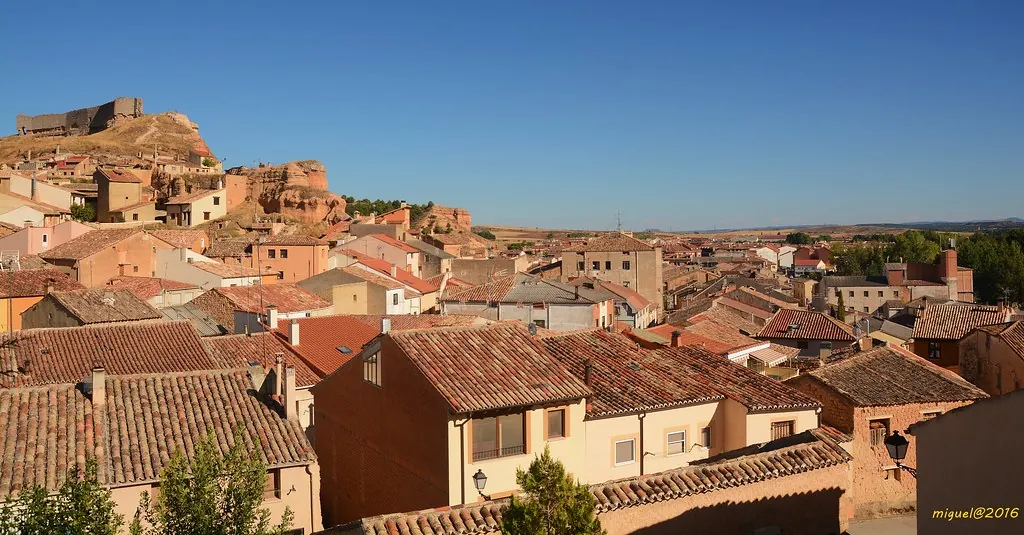
The streets are short and calm. Many houses still have solid stone walls, large wooden gates and inner courtyards that were once used for animals or tools. Walking slowly through the village, small details come into view: old pens, modest vegetable plots beside the homes, chimneys that must be working constantly during the colder months.
The parish church, dedicated to San Pedro, is the most prominent building. Built in sandstone, it reflects what is common across many villages in Soria, with elements from different periods combined over time. Inside, some Baroque altarpieces remain, showing clear signs of age. This is typical of rural churches, where upkeep often depends heavily on the local community.
Fields, trees and open sky
The landscape around Rioseco de Soria feels distinctly Castilian. Open cereal fields stretch across gentle hills, with patches of holm oak and oak trees scattered throughout. It is not dramatic in the sense of steep mountains, but it has a quiet pull, especially for those who enjoy walking in still surroundings.
There are agricultural tracks and paths that have been used for generations, originally for reaching farmland or moving livestock. Locals still walk along them, and early in the day it is not unusual to spot roe deer crossing the fields or to hear birds of prey circling above the valley.
In autumn, the area draws visitors interested in wild mushrooms. In the nearby woodland, sought-after varieties appear when the season has been wet enough. There is, however, an unspoken rule that tends to be taken seriously: if you are not sure how to identify them properly, it is best not to fill a basket.
Food shaped by the land
The food typical of this part of Soria is closely tied to the countryside and the colder months. Expect hearty dishes: stews, pulses, garlic soup and lamb raised in the surrounding area. It is not elaborate cooking, but rather the kind of food that suits a morning spent outdoors.
The tradition of the matanza, the seasonal preparation of pork products, is still very present. From it come chorizos, morcillas and other cured meats that many families continue to make, either for their own use or to share with relatives who return to the village during festive periods.
A base within Tierras del Burgo
Rioseco de Soria is not somewhere you come to tick off a long list of sights. It works better as a quiet stop within a wider route through this part of the province.
Within less than half an hour by car, there are larger towns in the Tierras del Burgo area where the architecture becomes more prominent. Romanesque churches, broader squares and better-preserved historic buildings begin to appear. Many visitors take this approach: pause here for a while, walk through the village, then continue on to explore nearby places.
When the village fills with life
For much of the year, the atmosphere remains very calm. In summer, though, things change noticeably. Like many villages in Soria, the main festivities take place towards the end of August, when people who have moved elsewhere return.
These days are centred on reunions, long meals and activities organised by the residents themselves. The village shifts from its usual quiet to a brief period of energy and movement.
Winter brings a very different mood. The cold is dry, the streets are sparsely lit, and everything seems to slow down even further.
Is it worth stopping in Rioseco de Soria?
That depends on what you are looking for.
If the aim is to visit a place filled with major landmarks or a long list of attractions, it will likely feel limited. On the other hand, if the idea is to drive through the quieter parts of Soria and see places where rural life remains largely intact, Rioseco fits naturally into that journey.
It is not a destination in itself, but it does offer something useful: a way of understanding what this part of Castilla is really like. For many travellers passing through, that is reason enough to stop.