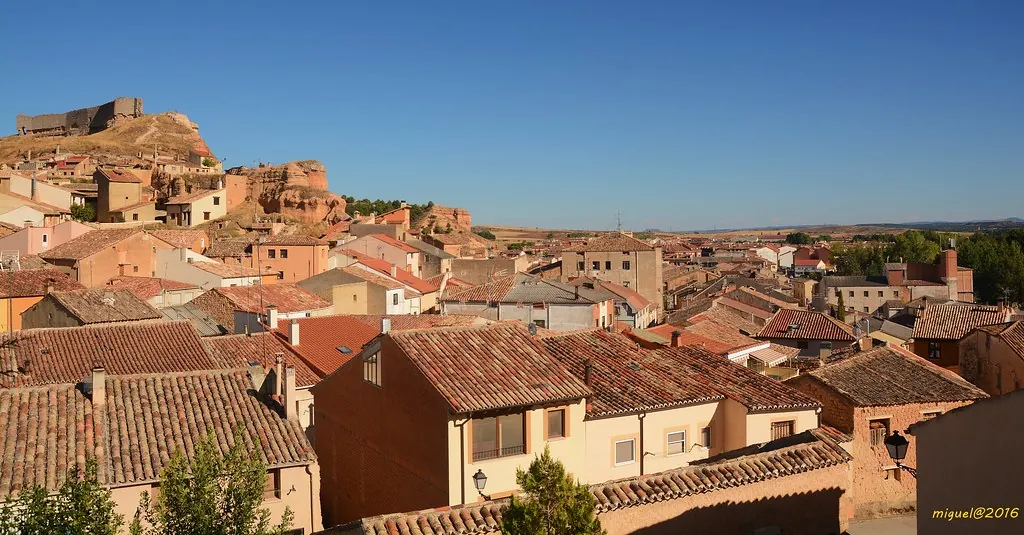
Iglesia de Santa María de las Hoyas.JPG
Castilla y León · Cradle of Kingdoms

Santa María de las Hoyas

The only traffic jam in Santa María de las Hoyas happens at 08:00 when the farmer crosses the single street with fifty sheep on their way to the co...

112 inhabitants · INE 2025
1071m Altitude

Why Visit

Mountain Church of the Asunción Hiking in the Cañón

Best Time to Visit

summer

Holy Christ of Miranda (September) agosto

Things to See & Do
in Santa María de las Hoyas

Heritage

  • Church of the Asunción
  • Hermitage of the Santo Cristo

Activities

  • Hiking in the Cañón

Festivals
& & Traditions

Fecha agosto

Santo Cristo de Miranda (septiembre)

Las fiestas locales son el momento perfecto para vivir la autenticidad de Santa María de las Hoyas.

Full Article
about Santa María de las Hoyas

Municipality near the Cañón del Río Lobos with traditional architecture

Ocultar artículo Leer artículo completo

The only traffic jam in Santa María de las Hoyas happens at 08:00 when the farmer crosses the single street with fifty sheep on their way to the commons. After that, the village returns to a hush broken only by wind scraping across the stone houses and, if you’re lucky, the rasp of a golden eagle somewhere above the 1,070-metre ridge.

Soria province has Spain’s lowest population density, and this hamlet—113 residents on a good census—feels it. There is no gift shop, no glossy menu in English, no bus on Sundays. What you get instead is the sudden realisation that “nothing to do” can be a selling point: the mobile signal drops to one bar, the nearest cashpoint is ten minutes away by car, and night arrives so dark that Orion looks close enough to snag on the chapel roof.

Stone, adobe and cereal seas

Houses here are built from what lies around: ochre-coloured adobe blocks, hand-split limestone, roof tiles the colour of burnt toast. The walls are thick enough to swallow summer heat and winter cold; shutters are painted the same institutional green you see all over rural Castile. A couple of newer builds have glass balconies and PVC windows, proof that this is still a working place, not a film set. Children’s bicycles lean against 16th-century masonry, and the only public phone box has been converted into a tiny lending library—leave a book, take a book, mind the draught.

The village sits on a mild rise, so every lane ends in wheat or sky. In late April the fields glow a green that would make a Surrey golf-course jealous; by July the same land has bleached to bronze and the air smells of dry thyme. Walk five minutes past the last house and you are in sabinar, a woodland of knee-high junipers sculpted by wind into bonsai shapes. Some specimens are older than the United Kingdom; their trunks twist like barley sugar.

A church without queues and a chapel with eagles

The parish church keeps the hours you would expect in a place where the priest drives in from Burgo de Osma. Mass is Sunday only; the rest of the week the building stays unlocked, so you can push open the heavy door and let your eyes adjust to the single-aisle gloom. Inside there is no baroque excess, just a 15th-century font where every local was christened and a pair of rather fine Gothic brackets shaped like oak leaves. Donation box for roof repairs: €2 is polite.

For real elevation, follow the rough track signposted “Ermita del Cristo de Miranda”—twenty minutes uphill, trainers sufficient. The 12th-century hermitage is barely wider than a cricket pitch, but its porch looks over the Lobos canyon rim and the plains beyond. Dawn is the time: the sun lifts out of the eastern sierra and thermals start, lifting golden eagles and the occasional griffin vulture straight past eye level. Bring binoculars; there is no café, no ticket desk, and if the chapel door is locked the key hangs on a nail in the adjoining wall.

Walking without way-markers

The village makes a convenient base for Cañón del Río Lobos Natural Park, yet it sits just outside the boundary, so you avoid the coach convoys that unload at Ucero. From the last streetlamp a spider’s web of farm tracks strikes north into the páramo. One route, the Cañada Real Soriana, still funnels sheep south to winter pasture; the hoof-polished stones are testimony to eight centuries of use. A circular stroll of 8 km takes in two abandoned hamlets—Hontanares and Arganza—where roofs have collapsed but bread ovens remain intact. You will meet more roe deer than humans.

Serious walkers can link up with the GR-86 long-distance path, which drops into the Lobos gorge and emerges 17 km later at Hontoria del Pinar. In summer start early: shade is scarce and the thermometer kisses 34 °C by noon. In winter the same tracks can be white with frost until eleven; pack a fleece and expect a sneaky northerly that makes 1,000 metres feel like 2,000.

Where to sleep, how not to starve

Accommodation comes down to two choices. The municipal albergue “El Cañón” has 24 dorm beds, a guest kitchen and, crucially, Wi-Fi that reaches the common room—€15 including sheet. The caretaker leaves at 20:00 sharp, so ring ahead if you’re delayed. The alternative is Casa Rural La Hoyanca, a converted grain store sleeping four, wood-burning stove, no TV, €80 for the house. Both fill during Easter week and the August fiestas; reserve or bring a tent.

Food is simpler. The village bar opens at 07:00 for coffee and churros, shuts 15:00–17:00, then offers dinner until 22:00. Expect a hand-written menu: migas (fried breadcrumbs laced with garlic and grapes), cordero asado (half a milk-fed lamb for two, €28), and queso curado that tastes like a milder Pecorino. Vegetarians get tortilla or salad; vegans should self-cater. The nearest shop is a Día supermarket in San Leonardo de Yagüe, ten minutes by car; it stocks Cathedral City-style cheddar for the homesick and decent Rioja for €4. Sunday afternoon everything closes—buy bread on Saturday or go hungry.

Weather that bites and beckons

April and May deliver 20 °C afternoons and chilly dawns; wildflowers turn every roadside into a botanic doodle. September is the sweet spot: 25 °C by day, 10 °C at night, storks stacking the thermals overhead. July and August roast, but the altitude keeps nights tolerable; locals sleep with windows open and blankets handy. Winter is raw—snow arrives a handful of times, the roads are gritted promptly, and the albergue heating costs an extra €2 a night. If driving, carry snow socks; the province is famous for black ice that laughs at summer tyres.

August drums and winter slaughter

Fiestas are for returnees, not tourists. On the first weekend of August the population quadruples as emigrant families drive up from Madrid. There is a foam party for children, a mass with hymns belted out in Castilian Spanish, and a communal paella that uses rabbit shot the previous week. Visitors are welcome to help stir the pan—three metres across, wooden paddle like a naval oar—but expect curious stares; you are the novelty.

In late November the pig slaughter still happens in back yards. The animal is dispatched quickly, the blood collected for morcilla, every scrap converted into chorizo or salchichón. The process is not staged for cameras; ask permission before wandering in with a smartphone.

Getting there, getting out

By car from Madrid take the A-2 to Medinaceli, then the SO-112 north through pine plantations; total journey 2 h 15 m. From Bilbao it is three and a half hours across empty plateaux where the speed limit feels advisory. Public transport is patchy: ALSA runs twice daily from Madrid’s Avenida de América to Soria (2 h 30 m), then a local bus continues to San Leonardo de Yagüa. After that you need a taxi—€35, book in advance because there is no rank. Returning, the same taxi can be coaxed out at 07:00 for early trains; the driver’s number is taped inside the albergue door.

Santa María de las Hoyas will never feature on a “Top Ten Spanish Villages” reel. It offers no souvenir fridge magnets, no flamenco nights, no spa hotel. What it does give, free of charge, is perspective: the sense that a place can survive on wheat, lamb and stubbornness, and that silence, when you finally hear it, is deafening in the best possible way.

Key Facts

Region
Castilla y León
District
Tierras del Burgo
INE Code
42168
Coast
No
Mountain
Yes
Season
summer

Livability & Services

Key data for living or remote work

2024
Connectivity5G available
EducationElementary school
Housing~5€/m² rent · Affordable
Sources: INE, CNMC, Ministry of Health, AEMET

Official Data

Institutional records and open data (when available).

  • CUEVA NEGRA
    bic Arte Rupestre ~4.8 km

Planning Your Visit?

Discover more villages in the Tierras del Burgo.

View full region →

More villages in Tierras del Burgo

Traveler Reviews